

Damien Smith Chooses a Different Road on the Deeply Personal Cycle Breaker
The title “Cycle Breaker” tells you almost everything you need to know about where Damien Smith is headed. The album is not built around pretending the past never happened. It is about recognizing what came before you, deciding what cannot continue, and understanding that changing the direction of a family can begin with one person making different choices.
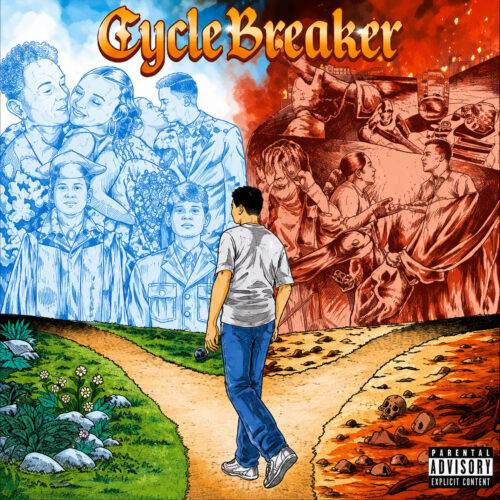
That idea is illustrated immediately by the album’s striking cover. Smith stands at a fork in the road while generations and competing realities appear around him. One direction is green and alive; the other is barren and destructive. The imagery gives visual form to the question sitting at the center of the album: What do you inherit, and what do you refuse to pass down?
Released June 26, “Cycle Breaker” is the El Paso, Texas emcee’s third album following A Work In Progress in 2023 and Balance To the Force in 2024. The new project contains 11 tracks, including “Walking That Walk,” “Lemonade,” “Sunflower,” “IT’S A VIBE,” “Priceless,” “Better Off,” “ALIVE,” “Eleonor’s Song,” “Damien Smith,” “H.I.P H.O.P,” and “King II.”
But the progression between those records is more important than the numbers.
SpitFireHipHop readers were introduced to Smith through “Stand Up Dude” before we covered Balance To the Force, an album centered heavily on reflection and personal redemption. Smith’s Apple Music biography offers additional context for that record and the artist behind it. He describes “Stand Up Dude” as being about the man he wants to become—a song that helps keep him grounded while he works on improving himself.
Cycle Breaker feels like the next stage of that conversation.
Smith has described the project as “legacy music,” and the phrase fits. The album confronts generational patterns involving incarceration, domestic violence, infidelity, education and absent fathers. Rather than approaching those subjects from a distance, Smith places himself inside the discussion. The point isn’t simply identifying destructive cycles. It is accepting the responsibility that comes with ending them.
Listen to Spit Fire Radio: www.spitfireradio.com
That makes “Walking That Walk” an appropriate opening statement. The song establishes one of the album’s most important ideas: words mean considerably less without action behind them. Smith isn’t interested in presenting transformation as something that happens through motivational slogans. Breaking a cycle means changing behavior.
“Lemonade” takes that philosophy into everyday life. Instead of manufacturing the appearance of success, Smith embraces what is actually his. References to ordinary possessions and a modest recording setup become important because they reject one of Hip-Hop’s easiest traps—the idea that an artist has to look wealthy before anyone will listen. Smith’s confidence comes from progress rather than presentation.
Then Cycle Breaker begins revealing just how much family sits at its center.
“Sunflower” uses its central image to explore fatherhood, patience and the responsibility of nurturing those around you. That perspective becomes even more personal on “Eleonor’s Song,” a dedication to Smith’s daughter built around love, protection and presence.
Those records matter because Cycle Breaker recognizes something Hip-Hop does not always discuss enough: fatherhood can be revolutionary when absence has become generational.
For Smith, breaking the cycle isn’t merely staying away from trouble. It is being there.
It is raising children differently.
It is creating stability where instability existed before.
It is becoming the example you may not have had yourself.
“Priceless” extends that thinking into Smith’s relationship with materialism. Hip-Hop has always wrestled with money from multiple directions—poverty, ambition, survival, wealth and status—and Smith doesn’t reject financial success. Instead, he refuses to let money establish his value. The distinction is important. If the purpose of breaking cycles is to create a better life, success cannot simply become another prison with a more expensive door.
“Better Off” deals with another uncomfortable part of personal growth: sometimes moving forward requires separation. Old relationships, negative energy and familiar environments can pull people toward versions of themselves they are attempting to leave behind. Smith treats distance not as betrayal, but sometimes as preservation.
By the time “ALIVE” arrives, gratitude becomes part of the album’s vocabulary. Peace itself begins sounding like an achievement.
Then comes the self-titled “Damien Smith,” arguably one of the clearest declarations of the album’s purpose. Smith addresses education, violence, family expectations and the determination to become better than the patterns preceding him. It is less a traditional self-titled rap record than a statement of identity: this is who Damien Smith has decided to become.
There is also something significant about placing “H.I.P H.O.P” near the end of the record. Smith’s love letter to the culture reminds listeners that conscious subject matter doesn’t require abandoning Hip-Hop’s foundations. Message and emceeing are not opposing ideas. Some of the culture’s greatest records have always managed to do both.
“King II” closes the album by returning responsibility to the forefront. Leadership here isn’t domination. It is discipline, humility and accountability.

That distinction may ultimately define Cycle Breaker.
The album cover depicts two roads, but Smith doesn’t pretend choosing the better one makes the journey easy. Breaking generational patterns means walking into unfamiliar territory. Sometimes dysfunction is inherited so consistently that dysfunction begins to feel normal. Changing it requires recognizing the pattern before having the courage to interrupt it.
And that is why Damien Smith’s evolution since A Work In Progress deserves attention.
Even the titles form an interesting progression.
A Work In Progress.
Balance To the Force.
Cycle Breaker.
The first acknowledges that growth is unfinished. The second searches for equilibrium. The third turns that growth outward and asks what happens when one person’s decisions begin affecting the generation coming behind them.
Smith may still describe himself as relatively unknown—his artist biography says one of his goals is eventually performing around the world—but Cycle Breaker sounds like an artist who has figured out something more important first: what he wants his music to represent.
Hip-Hop has always documented cycles. Poverty. Violence. Addiction. Survival. Fatherlessness. Ambition. Trauma. Redemption. Sometimes the culture records those realities because somebody needs to tell the truth about them.
But documenting a cycle and breaking one are different things.
With Cycle Breaker, Damien Smith isn’t interested in merely explaining where he came from. He is documenting the moment he decided certain things would stop with him.
And somewhere down the road, somebody who comes after him may never know how difficult that first turn was.
That might be the real meaning of legacy.