
Piff Penny Turns Childhood Memory Into Hip-Hop Storytelling on “Kid in Compton”
A place can leave you long before you ever leave it.
For Piff Penny, Compton is more than one of Hip-Hop’s most recognizable geographic names. It represents a piece of childhood, an environment that helped shape his perspective, and a chapter of his story that still carries enough weight to become music. On his new single “Kid in Compton,” produced by Get’em Rizzy, Penny reaches backward into that history without turning the record into nostalgia for nostalgia’s sake.
Instead, he turns memory into identity.
“Kid in Compton” arrives as the fourth single from Piff Penny and Get’em Rizzy’s collaborative EP, EPIFFANY. According to promotional information surrounding the release, Penny spent part of his early childhood in Compton, California, and credits the city with helping mold the person he became. The track was also reportedly singled out through listener feedback as one of the EP’s most creative and relatable records.
That background changes how the title should be understood. Piff Penny is not simply borrowing the mythology surrounding Compton. He is reaching into his own relationship with the city.
That distinction matters.
Hip-Hop has spent decades turning geography into autobiography. Queensbridge, Marcy, South Central, Compton, the Bronx, Atlanta, Houston and countless other neighborhoods became more than locations because emcees documented what those places did to the people growing up inside them. The strongest records in that tradition aren’t tourism. They’re testimony.
Listen to Spit Fire Radio: www.spitfireradio.com
Piff Penny approaches “Kid in Compton” from that personal lane. His storytelling feels less concerned with manufacturing a larger-than-life character than allowing listeners to understand another piece of the man behind the microphone. There is an ease to that approach. He doesn’t have to overstate the significance of the memories because the significance is already embedded in the fact that he is still carrying them.
Get’em Rizzy provides the musical environment for Penny to do exactly that.
The producer has become a recurring collaborator in Piff Penny’s catalog, with previous records including “Seasoned” and “Petty” featuring Aida, while their continuing work demonstrates a chemistry that goes beyond simply sending beats back and forth.
On EPIFFANY, that relationship appears increasingly important.
Get’em Rizzy’s production gives Piff Penny room to occupy the center of the record rather than competing with him for attention. That is especially valuable on a song built around personal recollection. Production for autobiographical Hip-Hop has to create atmosphere while leaving enough space for the emcee’s voice, details, and personality to remain the focal point.
“Kid in Compton” benefits from that balance.
There is also something fitting about the record appearing at this point in Piff Penny’s run. His recent output has shown an artist comfortable moving between traditional underground Hip-Hop aesthetics, character-driven records, and more personal writing. Earlier releases such as “Run Into Me,” “JR,” “Seasoned,” and his collaborations with Get’em Rizzy have steadily expanded the picture of what kind of emcee Penny wants to be.
“Kid in Compton” adds another dimension.
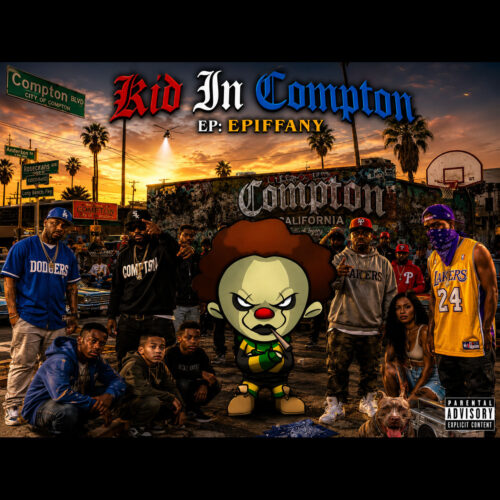
The cover art reinforces that idea immediately. Compton street signs, palm trees, neighborhood imagery, Los Angeles sports references and the oversized “Compton” backdrop establish location, while the central childlike character creates an interesting contrast. The image isn’t merely presenting Compton as scenery; it visually places childhood inside the environment.
And that may be the most compelling part of the record’s concept.
Adults often describe where they grew up through the understanding they developed years later. Children don’t experience neighborhoods as cultural symbols. They simply experience them as home. Streets, people, danger, humor, friendships, family, and everyday routines become normal long before someone understands what those surroundings might mean to the outside world.
“Kid in Compton” gives Piff Penny an opportunity to revisit that world from the distance of adulthood.
That makes the song another example of why personal storytelling remains one of Hip-Hop’s most durable tools. An emcee doesn’t always need an elaborate concept. Sometimes the most powerful subject is simply answering three questions: Where did I come from? What did I see? And what did it make me become?
Piff Penny appears to understand that.
With Get’em Rizzy behind the boards and EPIFFANY providing the larger framework, “Kid in Compton” becomes less about invoking the reputation of one of America’s most famous Hip-Hop cities and more about explaining Piff Penny’s connection to it.
Compton has already produced generations of stories.
On “Kid in Compton,” Piff Penny tells his.