The Dependency Trap: What Happens When an Independent Artist Builds a Career on Things They Don’t Control
Independence has become one of the most powerful ideas in modern Hip-Hop. Artists who once measured success by whether a major label would offer them a contract now routinely discuss master ownership, publishing rights, distribution agreements, and intellectual property with a level of sophistication that would have been unusual among emerging artists a generation ago. The shift has been significant. Technology has made it possible for a rapper to record a project independently, distribute it around the world, promote it directly to listeners, and sell merchandise without ever walking into a traditional record-company office.
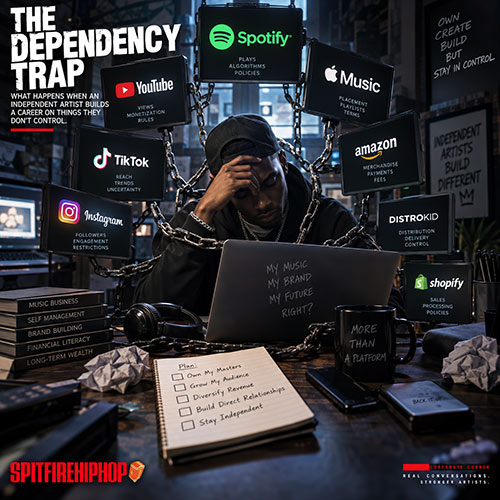
Yet there is a contradiction buried inside this new version of independence. An artist can own every master in the catalog and still build nearly every important part of the business on infrastructure controlled by somebody else. Discovery may depend on Spotify or TikTok. Communication with supporters may happen primarily through Instagram. Videos may live on YouTube. Music may reach streaming services through a distributor. Merchandise may be sold through an outside commerce platform, with payments processed by another company. Important files may sit in cloud-storage accounts maintained by yet another provider.
None of those relationships is inherently problematic. In fact, the accessibility of these services is one reason independent artists have more opportunities today than their predecessors could have imagined. The problem begins when an artist mistakes access for control. A business can appear independent while remaining remarkably vulnerable to decisions made by companies with which the artist has no meaningful negotiating power.
That is the dependency trap, and understanding it requires independent artists to expand the conversation about ownership.
Ownership and Control Are Not the Same Thing
Hip-Hop’s push toward ownership was necessary. For decades, artists learned painful lessons about contracts that separated creators from the recordings, publishing and intellectual property responsible for generating their wealth. The resulting emphasis on ownership has helped educate a generation of musicians who are far more likely to ask what they own before signing an agreement.
But owning an asset and controlling the infrastructure surrounding that asset are different matters.
Consider an independent artist who owns 100 percent of a new album. The artist controls the recordings and perhaps the publishing as well, but reaching listeners still requires a network of outside businesses. A distributor delivers the album to digital services. Streaming platforms determine how the music is presented within their ecosystems. Social networks provide much of the promotional reach. A third-party storefront processes merchandise orders, while payment companies facilitate transactions. The artist may own the underlying product while depending on other companies at virtually every stage between creation and consumption.
This distinction becomes important whenever one of those systems changes. A platform can alter its recommendation algorithm. A distributor can modify its policies. A social account can be restricted. A payment processor can review a transaction. A company can discontinue a feature that an artist spent years incorporating into a promotional strategy. Even when these actions are reasonable under the platform’s rules, they expose a fundamental reality of digital independence: the artist is often operating inside environments that can change without the artist’s approval.
True independence, then, cannot be measured exclusively by what appears on a copyright registration or recording agreement. It must also include a serious examination of how much of the artist’s career remains functional when an outside company changes the rules.
The Platforms Are Not the Problem
It would be easy to turn this argument into another warning about technology companies. That would also miss the point.
Digital platforms have dismantled barriers that once made independent distribution prohibitively difficult. A rapper in Texas can release a record and have it available to listeners across Europe, Africa and Asia almost immediately. A producer can upload a performance or studio session to YouTube and potentially reach an audience larger than many television programs once commanded. Social media allows emerging artists to communicate directly with listeners without purchasing advertising in magazines or depending entirely on radio programmers. E-commerce platforms make it possible to operate a merchandise business without opening a physical store.
These are extraordinary advantages, and independent artists should use them.
The strategic problem emerges when one platform becomes so central to an artist’s operation that losing access to it would effectively shut down the business. Companies call this concentration risk: too much of an organization’s success depends on one customer, supplier, market or system. Independent musicians rarely use that terminology, but the principle applies just as clearly to an artist whose entire promotional strategy depends on Instagram or whose income is overwhelmingly tied to a single source.
A useful distinction is to think of platforms as infrastructure that creates leverage rather than property the artist controls. That mindset changes how an artist approaches growth. Instead of asking only how many followers can be accumulated on a particular platform, the artist begins asking what durable relationship remains after that attention has been generated.
Listen to Spit Fire Radio: www.spitfireradio.com
A Follower Is Valuable, but It Is Not the Same as a Relationship You Control
Social-media numbers are among the most visible measures of an artist’s perceived relevance. Follower counts sit directly beneath usernames, making them easy for fans, promoters, journalists and potential business partners to evaluate. Growing those numbers can absolutely matter. A large and engaged social audience can provide significant promotional leverage.
Still, artists should understand exactly what those numbers represent.
Someone following an artist on Instagram has chosen to receive some form of connection with that artist, but Instagram remains the intermediary. The platform determines how often the artist’s posts appear, which formats receive greater distribution and how the audience interacts with the content. The artist does not possess a portable database containing every follower and cannot simply transfer those relationships intact to another network.
That becomes especially obvious when organic reach declines. An artist may have tens of thousands of followers while discovering that only a fraction regularly sees new posts. The audience still exists, but access to that audience is mediated by a system the artist does not control.
Direct relationships operate differently. When someone voluntarily joins an artist’s mailing list, purchases merchandise, becomes a member of a fan community or registers through an artist-owned website, the connection becomes more portable. The artist still relies on technology to maintain it, and privacy responsibilities accompany that access, but the relationship is less dependent on a single discovery platform.
This doesn’t mean artists should attempt to move everyone off social media. That would be impractical and unnecessary. Social networks are excellent places to discover and engage audiences. The more useful objective is to turn a portion of that temporary attention into a connection that can survive beyond the platform where the relationship began.
In other words, reach can be rented, but relationships should increasingly be retained.
When the Algorithm Quietly Becomes the Boss
Algorithms have become enormously influential in music discovery. They help listeners navigate an overwhelming volume of releases and can introduce independent artists to audiences they would never have reached through traditional promotion. For musicians operating without major-label marketing budgets, that opportunity is difficult to overstate.
The danger appears when artists begin designing their entire careers around what they believe an algorithm wants.
The shift can happen gradually. A particular type of video performs well, so more videos follow the same formula. Shorter songs appear to generate stronger engagement, so arrangements begin changing. Posting frequency increases because disappearing from a feed feels equivalent to disappearing from public consciousness. Before long, a substantial portion of the artist’s working day is devoted not to improving the music, strengthening the live performance or developing the business, but to producing material intended primarily to keep platforms satisfied.
At that point, the artist is no longer simply using the platform. The platform has begun influencing the architecture of the career.
There is nothing wrong with understanding algorithms or adapting intelligently to changing consumer behavior. Successful businesses have always learned how distribution systems work. The difference lies in whether the platform serves the artist’s larger strategy or gradually becomes the strategy itself.
Algorithms are powerful distribution partners. They are much less reliable as permanent business plans.
Distribution Has Its Own Dependencies
The same analysis applies to music distribution.
Digital distributors solved an enormous problem for independent musicians by creating practical access to streaming platforms that would otherwise be difficult for individual artists to manage. That infrastructure helped democratize global distribution and remains essential to the independent ecosystem.
But distribution also demonstrates how many layers can exist between ownership and control.
An artist records a song and owns the master. A distributor delivers it to a streaming service. The streaming service makes it available to listeners. Revenue is collected and eventually travels back through the system. Each participant operates under its own policies, technical standards and enforcement procedures.
Spotify’s policies surrounding artificial streaming provide a useful example of how complicated that chain can become. The company says confirmed artificial streaming can result in corrected public numbers, withheld royalties and removal from playlists, while distributors may impose their own warnings, penalties, suspensions or content removals depending on the circumstances. Spotify also warns artists that third parties promising guaranteed streams or playlist placement can expose releases to artificial activity.
The important lesson extends beyond artificial streaming. An artist can legitimately own a recording while still depending on several organizations to keep that recording commercially accessible. Ownership protects the underlying asset, but it does not eliminate the need to understand the systems responsible for monetizing it.
For independent artists, that makes operational knowledge increasingly important. Knowing who controls each stage of the business is no longer administrative trivia. It is part of protecting the career.
The 30-Day Test
One of the simplest ways to identify dependency is to imagine losing something important.
An artist should take the platform responsible for the largest share of their attention and mentally remove it for thirty days. If Instagram disappeared tomorrow, how would supporters hear about the next release? If TikTok stopped delivering meaningful reach, where would new listeners discover the music? If a distributor encountered a problem, what records and documentation would be available to resolve it? If a laptop failed tonight, would every master recording, contract, photograph, video, and session file still exist somewhere secure?
These questions are not predictions of disaster. They are a basic resilience test.
The exercise becomes even more useful when applied across five areas of an artist’s business: discovery, communication, distribution, revenue and assets. Artists should know which companies are essential in each area, what information those companies control and whether another path exists if the primary one becomes unavailable.
A career does not become stronger simply because an artist worries about everything that could go wrong. It becomes stronger when obvious single points of failure are identified before they become emergencies.
Redundancy Is Not Exciting, but It Is Professional
Musicians rarely talk about redundancy because the word sounds more appropriate for a technology department than a recording studio. Yet virtually every serious organization builds redundancy into critical operations.
Important data is backed up. Essential processes are documented. Businesses maintain multiple suppliers when relying on one would create unacceptable risk. Professional productions keep duplicate copies of irreplaceable files. The objective isn’t to expect failure; it is to ensure that ordinary failure doesn’t become catastrophic.
Independent artists should adopt the same mindset.
If social media is the primary method of communication, an email list provides another route. If streaming generates nearly all of the artist’s income, direct sales, performances, merchandise, licensing and other appropriate revenue streams can reduce concentration. Important creative assets should exist in multiple secure locations. Domain names, trademarks, contracts, account credentials and ownership records should be organized rather than scattered across devices and inboxes.
None of this produces the immediate excitement of releasing a single or watching a video accumulate views. Most fans will never know the work occurred.
That is precisely why it matters.
Professional infrastructure is usually invisible until the moment it is needed.
The Return of Direct-to-Fan Thinking
The broader music industry is also paying renewed attention to direct artist-fan relationships. In February 2026, Universal Music Group announced an agreement with EVEN centered on direct-to-fan experiences, including early access to music, exclusive content, community features and artist-led experiences. The platform has also promoted technology that can turn an artist’s own website into a destination for direct fan engagement.
The significance is larger than any individual company. For years, digital music strategy emphasized reach: more streams, more followers, more impressions and more views. Those metrics still matter, but the industry is increasingly recognizing another question that independent artists should have been asking all along: What does the artist retain after the attention occurs?
A listener discovering a song is valuable. A listener who returns is more valuable. A supporter who voluntarily joins an artist’s community represents something different again. A fan who buys an album, attends a show, purchases merchandise and remains connected for years has moved far beyond a streaming statistic.
The strongest independent businesses will likely become better at distinguishing those levels of engagement. They will continue pursuing reach while building systems capable of identifying and serving the people who want a deeper relationship.
The Website Was Never Really Dead
At various points in the social-media era, artist websites began to feel almost unnecessary. Why send someone to a separate website when fans already spend their time on Instagram, YouTube, TikTok and streaming services?
The answer is becoming clearer.
A website provides something social platforms cannot fully offer: a central destination organized around the artist rather than around the priorities of another company’s feed. It can connect music, merchandise, tour information, archives, press materials, mailing-list registration, videos and other parts of the artist’s identity in one place.
That doesn’t mean a website is completely independent. Hosting companies, domain registrars, commerce software and payment processors still provide infrastructure. Absolute technological independence is neither realistic nor desirable for most artists.
What a well-managed website offers is greater portability and greater control over presentation.
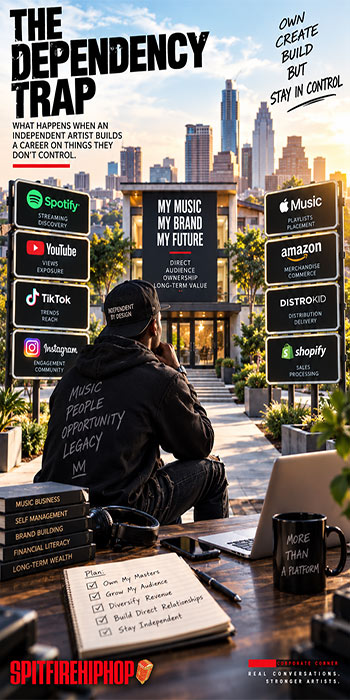
Think of the website as home and major platforms as roads leading toward it. Artists want busy roads. They want Spotify, YouTube, Instagram, TikTok and every other legitimate channel capable of introducing people to their work. But building roads is different from building the house.
The strongest strategy uses both.
Direct Data Comes With Direct Responsibility
There is an important qualification to the argument for direct audience relationships. Artists should not interpret “own your audience” as permission to collect as much personal information as possible.
Fan data creates responsibility.
An email address should be collected voluntarily and used respectfully. Customer information should be protected. Mailing lists should not become spam machines. People should be able to unsubscribe easily. Sensitive information should not be collected merely because technology makes collection possible.
The objective is not surveillance. It is permission.
That distinction matters because trust is one of the few assets that cannot be recovered simply by changing software providers. An artist who wants a closer relationship with supporters must demonstrate that the relationship will be treated with care.
The best direct-to-fan systems therefore do something deceptively simple: they give supporters a reason to remain connected. Valuable communication, early access, meaningful experiences, useful information and a sense of community are more sustainable than constant promotional demands.
Independence Should Mean Portability
Perhaps the independent music business needs a broader definition of independence.
Independence has never meant doing everything alone. Artists need producers, engineers, distributors, lawyers, managers, publicists, journalists, DJs, promoters, technology companies and countless other partners. Trying to eliminate every dependency would not produce freedom; it would produce isolation and inefficiency.
A more useful goal is portability.
An independent artist should be capable of changing partners without losing the career.
If a distributor no longer meets the artist’s needs, the catalog and underlying rights should remain intact. If a social platform declines in relevance, the entire fan community should not disappear with it. If an e-commerce provider becomes unsuitable, customer relationships and business records should be transferable where legally and technically possible. If a website host changes, the artist’s content should not vanish. If one promotional tactic stops working, another route to the audience should already exist.
This is what operational independence looks like. It doesn’t reject partnerships. It prevents partnerships from becoming points of captivity.
The Next Stage of Independent Hip-Hop
The evolution of independent Hip-Hop can be understood through a series of expanding freedoms.
The first battle was access. Artists needed ways to record, manufacture, distribute and promote music without waiting for traditional gatekeepers to approve them. Digital technology dramatically lowered those barriers.
The next battle centered on ownership. Artists became more conscious of masters, publishing, trademarks, licensing and intellectual property. That education changed how many musicians approached the business.
The next stage should be about infrastructure.
Independent artists need to understand not only what they own, but what their businesses depend upon. They need direct connections with supporters alongside social reach, diversified revenue alongside streaming income, organized records alongside creative assets, backups alongside cloud convenience and multiple pathways to an audience rather than a single platform responsible for everything.
That does not make the artist less dependent on other people. Music has always been collaborative, and business always requires relationships.
It makes the artist less fragile.
There is an enormous difference.
Final Thoughts
Today’s independent artist has access to an extraordinary collection of tools. A musician can create a record at home, distribute it globally, build an audience across several continents, sell products directly to supporters and operate a media company from a laptop. Previous generations fought for many of those capabilities, and their availability should not be taken for granted.
But convenience can disguise dependency.
An artist can own the masters while renting access to the audience. The artist can own the merchandise while relying on somebody else’s storefront. The artist can control the brand while depending on another company’s algorithm to make that brand visible. None of these arrangements is inherently dangerous. They become dangerous when the artist never recognizes how much of the career rests on systems outside their control.
The solution is not to abandon Spotify, YouTube, Instagram, TikTok, distributors or technology companies. The solution is to use them for what they are exceptionally good at while simultaneously building assets and relationships capable of traveling beyond them.
That means treating platforms as partners rather than property. It means maintaining direct connections with supporters. It means protecting creative assets, diversifying critical systems and understanding where the business is vulnerable before circumstances expose those vulnerabilities.
For years, independent artists have been encouraged to ask an essential question: Do you own your music?
They should keep asking it.
But the modern independent artist needs a second question sitting beside it:
If the companies surrounding my career changed their rules tomorrow, how much of what I’ve built would still belong to me—and how much of it would still work?
The answer may reveal more about independence than the ownership percentage printed on any contract.
Corporate Corner Perspective
Ownership remains one of the foundations of artist independence, but ownership alone cannot protect a business whose audience, revenue, distribution and communication all depend on a handful of outside systems. The next generation of independent artists will need to think beyond rights and begin thinking about resilience.
The objective isn’t complete self-sufficiency. No serious business operates that way. The objective is to build enough control, portability and redundancy that changing a partner does not mean losing the career.
Ownership protects the asset. Infrastructure protects what you’ve built around it. Independent artists need both.