



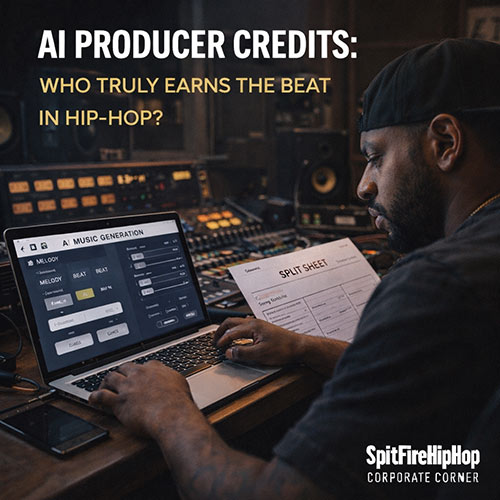
AI didn’t sneak into Hip-Hop — it kicked the door in. As artificial intelligence reshapes beatmaking, the industry is facing an uncomfortable question: when a beat goes viral, who actually deserves the credit, royalties, and legacy?
Why This Debate Is Exploding Right Now
AI tools are no longer experimental. Producers use them to generate melodies, drum patterns, chord progressions, and even full arrangements. As these beats land placements and rack up streams, credit disputes are surfacing across social media and studio conversations.
This isn’t a philosophical debate; it’s a financial one. Credits determine ownership, royalties, and long-term catalog equity. When AI enters the workflow, those lines blur fast.
What “Producer” Has Traditionally Meant in Hip-Hop
Historically, the producer credit represented creative authorship. The producer shaped the sound, rhythm, texture, and emotional direction of a record. Whether through sampling, sequencing, or live instrumentation, the producer’s identity was embedded in the beat.
That definition assumed one thing: a human creator.
AI breaks that assumption.
Where AI Fits Into the Creative Process
AI doesn’t create in isolation. It responds to prompts, training data, parameters, and human direction. The question isn’t whether AI is involved; it’s how it’s involved.
In most workflows today:
- humans select prompts
- humans curate outputs
- humans arrange and edit results
- humans decide what gets released
AI accelerates creation, but humans still determine intent.
Listen live on Spit Fire Radio → https://www.spitfireradio.com
Why Credit Matters More Than Ever
Credits aren’t symbolic. They determine who owns publishing, who receives backend royalties, and who builds long-term catalog value.
If credits are unclear:
- royalties may be misallocated
- future licensing becomes complicated
- disputes arise years later
- catalog equity gets diluted
This is why clarity now prevents lawsuits later.
Should AI Be Listed as a Producer?
From a legal standpoint, AI cannot own copyright. It has no personhood. It cannot collect royalties.
From a cultural standpoint, crediting AI as a “producer” confuses authorship and undermines creative accountability.
The emerging consensus among industry professionals:
- AI is a tool, not an author
- credit belongs to the human who directs, curates, and finalizes the work
This mirrors how DAWs, samplers, and plugins are treated, powerful tools, not collaborators.
The Real Question Artists and Producers Must Ask
The debate isn’t “Did AI help?”
The debate is “Who made the creative decisions?”
Authorship comes from:
- intention
- selection
- arrangement
- final approval
AI assists. Humans decide.
How Split Sheets Should Handle AI Usage
The smartest producers are already addressing AI in their documentation.
Best practices emerging include:
- crediting human producers only
- noting AI tools used in session notes (not credits)
- defining authorship clearly in split sheets
- maintaining transparency between collaborators
Documentation protects everyone involved.
Why This Matters for Catalog Equity
AI-assisted beats can earn for decades. If credits are wrong at release, fixing them later becomes expensive or impossible.
Catalog buyers, labels, and licensing agents examine:
- clean ownership chains
- clear authorship
- uncontested rights
Messy credits reduce asset value.
Why Hip-Hop Must Lead This Conversation
Hip-Hop has always navigated new technology first: samplers, drum machines, DAWs, streaming. AI is the next tool in that lineage.
The culture doesn’t lose authenticity by using tools. It loses authenticity by misrepresenting authorship.
The Corporate Corner Reality
Companies protect IP aggressively. Artists and producers must do the same. AI doesn’t remove responsibility — it increases it.
Whoever controls the tool must also control the credit.
The Real Takeaway
AI doesn’t earn credits.
People do.
In the future of Hip-Hop, the producer isn’t defined by who touched the machine — but by who shaped the outcome.
The beat belongs to the mind behind it.



Pingback: AI Producer Ethics: What True Authorship Means in Hip-Hop – SpitFireHipHop.com
Pingback: AI Authorship: Why Credit Still Matters in Hip-Hop – SpitFireHipHop.com