




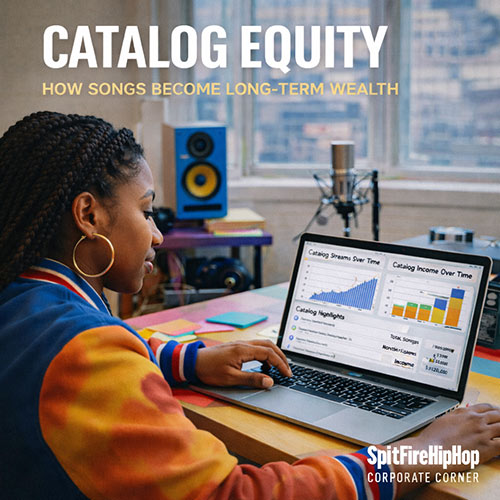
Artists are taught to chase hits. Investors chase catalogs. That difference explains why some creators struggle financially while others quietly build wealth. In today’s music economy, songs aren’t products — they’re assets. And assets compound.
What “Catalog Equity” Actually Means
Catalog equity is the long-term, appreciating value of an artist’s body of work. Unlike one-off releases, a catalog generates recurring revenue through streaming, licensing, playlists, and fan behavior over time.
Equity isn’t about how loud a song is today. It’s about how reliably it earns tomorrow.
This is why investors don’t buy hits — they buy catalogs.
Why Songs Behave Like Assets, Not Products
Products are sold once. Assets earn repeatedly.
Songs generate income every time they are:
- streamed
- saved
- licensed
- added to playlists
- discovered by new fans
Each interaction adds data, improves platform confidence, and increases long-term earning potential. Over time, songs stop relying on promotion and start relying on behavior.
That’s asset behavior.
Why Private Equity Is Buying Music Catalogs
Institutional buyers understand something most artists don’t: predictable cash flow beats explosive moments.
Catalogs attract investors because:
- streaming revenue is recurring
- listening behavior is measurable
- catalogs diversify portfolios
- music consumption is global
- risk decreases over time
Artists don’t need millions of streams to benefit from this logic — they need consistency.
How Equity Is Built Without Massive Hits
The myth is that catalog equity only exists at superstar levels. In reality, equity forms when income becomes predictable.
Independent artists build equity by:
- releasing consistently
- reinforcing a clear emotional lane
- increasing retention
- extending catalog depth
- stabilizing monthly listeners
Small catalogs with loyal listeners often outperform large catalogs with volatile traffic.
Why Catalog Density Multiplies Value
Every new song strengthens the existing catalog. When listeners move through multiple tracks in a session, platforms register confidence. That confidence translates into sustained visibility and earnings.
Catalog density:
- increases session length
- boosts repeat plays
- reduces dependence on promotion
- raises lifetime fan value
Dense catalogs compound quietly.
Why Ownership Determines Who Benefits
Equity only matters if you own the asset.
Artists who don’t own their catalogs may generate value — but someone else captures it. Ownership ensures that long-term appreciation flows back to the creator.
Without ownership, equity becomes extraction.
How Artists Accidentally Destroy Equity
Many artists sabotage long-term value without realizing it.
Common mistakes include:
- deleting older music
- rebranding too often
- abandoning emotional cohesion
- chasing trends at the expense of identity
- fragmenting catalogs across platforms
Equity rewards continuity.
Why Time Is the Most Powerful Multiplier
Catalog equity strengthens with age. Songs don’t depreciate like physical goods — they often earn more as new listeners discover them years later.
Time allows:
- behavior data to stabilize
- playlists to recycle tracks
- algorithms to resurface music
- fans to age with the catalog
Patience is part of the strategy.
Why Wealth Looks Boring
Catalog equity doesn’t feel exciting day-to-day. There are no spikes, no headlines, no viral moments. But over time, income smooths out, stress decreases, and leverage increases.
Wealth rarely announces itself. It accumulates.
The Corporate Corner Reality
Companies build portfolios. Artists should too. Each song is a unit of value that either strengthens or weakens the whole.
Catalog equity is how art becomes legacy.
The Real Takeaway
Hits fade.
Moments pass.
Catalogs endure.
Artists who treat songs as assets don’t just survive the industry — they outlast it.




Pingback: The Legacy Layer: What Happens to Your Music After You’re Gone – SpitFireHipHop.com
Pingback: The Institutional Shift: When Artists Stop Playing the Game and Start Shaping It – SpitFireHipHop.com
Pingback: AI Producer Credits: Who Truly Earns the Beat in Hip-Hop? – SpitFireHipHop.com