




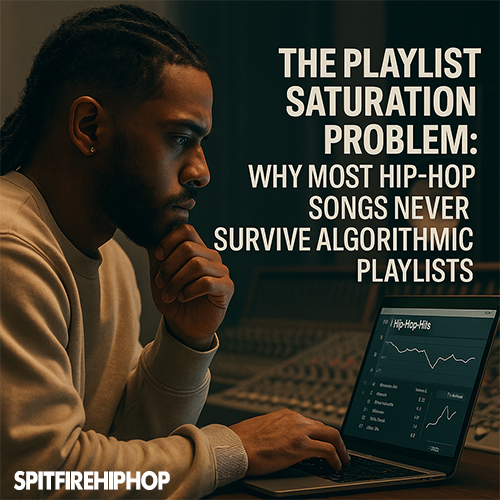
The Playlist Saturation Problem: Why Most Hip-Hop Songs Never Survive Algorithmic Playlists
For years, playlists were the goal. Get added, get streams, build momentum. In 2025, that logic is broken. Today, most Hip-Hop songs don’t fail before playlist placement; they fail after getting added. The reason is overstimulation, data pressure, and algorithmic survival.
Playlists Are No Longer Endorsements
There was a time when playlist placement functioned like a stamp of approval. If a song landed on a popular list, artists could expect sustained growth. That era is over. Today, algorithmic playlists act less like endorsements and more like testing environments.
Streaming platforms now receive tens of thousands of new tracks daily. Playlists don’t reward potential; they test performance. Songs are inserted, observed, and quickly replaced if engagement stalls. Placement is a probation period, not a guarantee.
Most songs fail this test silently.
Why Playlist Saturation Changed Everything
The biggest problem facing Hip-Hop artists today isn’t access, it’s saturation. Mood playlists, genre blends, and algorithmic feeds are overloaded. Users scroll faster, skip more quickly, and rarely commit unless a song maintains emotional value across multiple listens.
In this climate, playlists have become hostile environments. A new song enters, competing with thousands of others for attention, while listener patience continues to shrink. If engagement metrics don’t rise quickly, the system moves on without mercy.
The algorithm never tells artists why they were removed. It just stops pushing.
The Metrics That Decide Playlist Survival
Songs don’t leave playlists randomly. They’re removed because invisible thresholds weren’t met. DSPs focus on behavior after placement, not the fact of being playlisted.
What platforms monitor most closely includes:
- Skip behavior within the first 24–72 hours
- Save-to-listener ratio after exposure
- Listener retention past the first 30 seconds
- Repeat listens within a short window
- Continued usage inside user-created playlists
These are not hype metrics. They are commitment signals, and most songs don’t generate enough of them to survive saturation.
Why Artists Misread Playlist Failure
When songs fall off playlists, artists often blame marketing budgets, label politics, or genre bias. Those factors exist, but they aren’t the primary reason songs disappear.
The real reason is often structural.
Many tracks sound good in isolation, but fail when tested in playlist environments. The intro doesn’t hold attention. The energy dips. The emotion shifts too quickly. What felt exciting on the first listen doesn’t age well with repeated exposure.
Playlists don’t forgive inconsistency.
Mood Mismatch Is the Silent Killer
One of the most common playlist failures is emotional inconsistency.
A song may technically belong in a playlist, same tempo, same subgenre, but emotionally drift during playback. When listeners feel that drift, they disengage subconsciously.
Mood playlists exist for emotional continuity, not technical accuracy. If your song disrupts the emotional arc of the playlist, listeners skip, and algorithms notice.
Even subtle changes in vocal tone, beat intensity, or energy pacing can make a track feel intrusive in a curated mood environment.
How Playlists Expose Weak Song Design
Playlist environments amplify flaws that individual listens may hide. When grouped among similar songs, only tracks with structural discipline survive.
Common structural problems exposed by playlists include:
- Weak first 10–15 seconds
- Overlong intros that delay the emotional payoff
- Beat switches that reset energy at the wrong time
- Hooks that don’t sustain replay value
- Songs that peak too early and collapse afterward
These issues don’t ruin songs, but they do ruin playlist endurance.
Why Getting Playlisted Isn’t the Win Anymore
In 2025, artists shouldn’t ask, “Did my song get playlisted?”
They should ask, “Did it stay?”
Playlists are entry points, not destinations. If a song can’t maintain listener commitment, placement becomes a temporary spike instead of a growth engine.
The songs that last are the ones listeners keep — save, replay, and live with. Everything else becomes disposable.
What Artists Should Optimize For Instead
Playlist survival depends on listener attachment, not algorithmic luck. Smart artists now design records for durability, not merely exposure.
That means focusing on:
- save conversion after first exposure
- emotional consistency across the track
- replay-friendly production choices
- mood clarity from start to finish
- contribution to long-term catalog value
When those elements are strong, playlists work with you, not against you.
How Smart Artists Build Songs That Survive Playlists
Artists who consistently remain playlisted don’t chase trends; they engineer emotional stability.
They focus on:
- a clear emotional lane
- immediate immersion in the song’s mood
- subtle production that rewards repetition
- lyrical themes people return to
- endings that naturally encourage replays
These songs feel less dramatic, but they last longer.
The Bigger Picture: Playlists Are Pressure Tests
Algorithmic playlists aren’t broken. They’re doing exactly what they were designed to do: filter songs that can’t sustain attention in a hyper-saturated landscape.
The future of Hip-Hop success isn’t about getting in.
It’s about staying in.
Artists who understand this build catalogs, not moments.



Pingback: The Second-Life Song: How Hip-Hop Tracks Resurface Months After Release – SpitFireHipHop.com
Pingback: The Second-Life Song: How Hip-Hop Tracks Resurface Months After Release – SpitFireHipHop.com
Pingback: The 14-Day Cliff: Why Most Hip-Hop Songs Lose Momentum After Two Weeks – SpitFireHipHop.com