

Hip-Hop Is Starting to Push Back Against Viral Culture
For years, artists were taught to chase attention at all costs. Every platform rewarded the same behavior: be louder, post more, react faster, stay visible longer.
The viral era turned Hip-Hop into a nonstop race for relevance. One clip could launch a career overnight. One meme could generate millions of streams. One controversy could dominate the algorithm for days.
For a while, the strategy worked. But in 2026, something feels different.
A growing number of artists—and fans—are beginning to push back against the entire culture surrounding clout chasing. The conversation inside Hip-Hop is slowly shifting away from “how do I go viral?” and toward something much deeper:
“What actually lasts?”
That question is becoming one of the most important conversations in modern Hip-Hop.
The Internet Rewarded Attention — Not Identity
The viral era changed the priorities of the music industry.
At some point, many artists stopped building worlds around their music and started building moments for the feed instead. Songs became shorter. Rollouts became louder. Controversy became strategy.
The algorithm rewarded:
constant visibility,
constant engagement,
constant stimulation.
Artists quickly learned that staying quiet could feel dangerous. If you disappeared from the timeline for too long, you risked disappearing from the conversation completely. That pressure created an environment where artists felt forced to perform constantly—not just musically, but socially.
The result is a culture where many artists are visible all the time but understood very little.
Fans Are Beginning to Feel the Exhaustion
Hip-Hop audiences are overwhelmed right now.
Every day brings:
- another snippet
- another rollout
- another livestream
- another controversy
- another “viral moment”
The problem is that nonstop visibility eventually weakens emotional impact. When everything is presented as urgent, nothing actually feels important anymore.
Fans are beginning to recognize when content exists purely to trigger engagement instead of expressing something meaningful. They can feel the difference between:
- intentional artistry
and - algorithm bait
That awareness is changing how audiences respond to artists. The culture is slowly becoming more selective.
Virality Created Fast Success — But Short Attention Spans
One of the biggest lessons emerging from this era is that viral attention does not automatically translate into longevity.
Many artists learned how to capture attention quickly. Far fewer learned how to keep it.
A viral moment can:
- generate streams
- create headlines
- dominate social media
…but if there is no identity underneath the moment, the audience eventually moves on.
That cycle has become painfully common in Hip-Hop:
explode fast,
fade faster.
Fans are now beginning to value artists who feel more intentional, grounded, and emotionally connected to their music rather than artists simply chasing the next trend.
Intentional Artists Are Starting to Stand Out Again
Interestingly, some of the strongest reactions in Hip-Hop right now are coming from artists doing less—not more.
Artists who:
- disappear strategically
- avoid oversharing
- build focused rollouts
- release complete projects
- protect their image carefully
…are often generating stronger anticipation than artists posting all day long.
Why?
Because scarcity still creates emotional weight.
When an artist appears less frequently, every appearance feels more meaningful. Fans pay closer attention. Music feels like an event again instead of another piece of disposable content sliding through the feed.
In many ways, Hip-Hop is beginning to rediscover the power of restraint.
Listen to Spit Fire Radio: www.spitfireradio.com
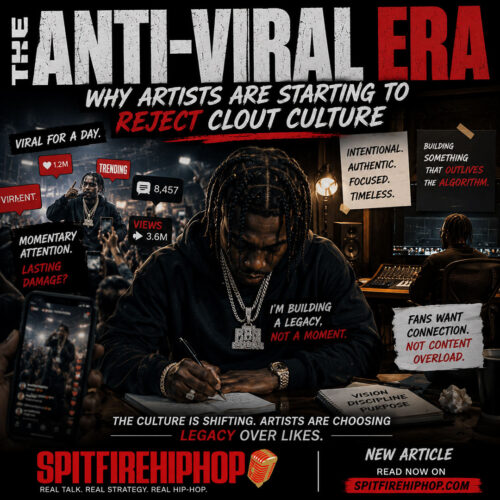
The Anti-Viral Era Is Really About Identity
This movement is not about rejecting the internet entirely.
Artists still need:
- marketing
- visibility
- engagement
- social platforms
The difference is that many artists are realizing identity matters more than short-term momentum.
The anti-viral era is about protecting:
- artistic direction
- emotional authenticity
- long-term branding
- cultural relevance
Instead of building careers around temporary trends, artists are beginning to focus on building worlds fans can emotionally invest in over time. That shift could completely reshape how future stars are created.
The Corporate Corner Perspective
The viral era taught artists how to get attention. The anti-viral era may teach them how to keep respect.
Because long-term influence is rarely built through nonstop reaction cycles alone. It is built through:
- consistency
- intentionality
- identity
- emotional connection
Fans are no longer impressed by visibility by itself.
The audience now wants:
substance attached to the visibility,
meaning attached to the rollout,
and authenticity attached to the brand.
That cultural correction is becoming impossible to ignore.
Hip-Hop May Be Slowing Down for a Reason
For years, the industry pushed artists to move faster and faster.
Faster releases.
Faster trends.
Faster reactions.
But audiences are beginning to crave the opposite:
depth,
intentionality,
and moments that actually feel memorable.
The next generation of important Hip-Hop artists may not be the artists who dominate the algorithm every single day. They may be the artists who know when not to feed it.
Final Thoughts
Virality changed Hip-Hop forever. But the culture is beginning to realize that attention without identity eventually becomes empty.
Fans still want artists who feel:
- human
- intentional
- emotionally grounded
- culturally meaningful
The anti-viral era is not about rejecting success. It’s about rejecting the idea that constant visibility alone equals value. And honestly? That may be one of the healthiest shifts Hip-Hop has seen in years.