
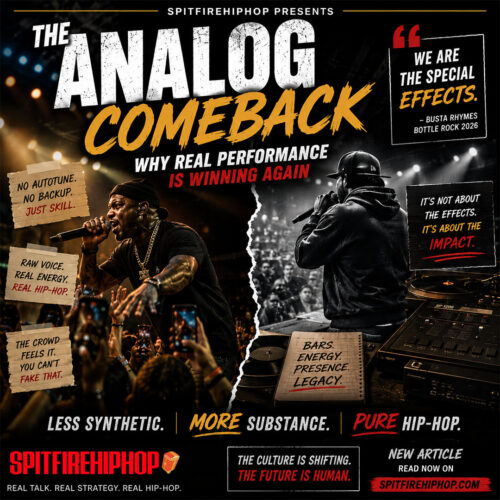
Hip-Hop Is Starting to Crave Realness Again
For years, music culture moved deeper into digital perfection. Performances became cleaner, louder, more synchronized, and more controlled. Artists relied heavily on backing tracks, visual effects, live autotune, and highly programmed stage production designed to create flawless moments for social media clips. At the same time, algorithms pushed artists toward constant optimization, rewarding whatever looked polished enough to stop the scroll.
But somewhere along the way, many performances stopped feeling human.
Fans noticed the difference long before the industry did. The more artificial entertainment became, the more audiences started gravitating toward moments that felt raw, unpredictable, and emotionally real. In 2026, Hip-Hop culture appears to be swinging back toward authenticity again. There is growing appreciation for artists who can genuinely command a stage, control a crowd, and deliver music without relying heavily on technology to carry the moment.
That shift is becoming one of the most important cultural movements happening in Hip-Hop right now.
The Digital Era Changed Live Performance Culture
Technology completely reshaped how artists perform. Over the last decade, live shows increasingly became extensions of digital branding instead of purely musical experiences. Massive visuals, synchronized production, vocal effects, and playback systems allowed performances to look bigger than ever before. In many cases, the spectacle became more important than the actual performance itself.
The problem is that audiences eventually began craving emotional tension again.
Real performance carries risk. Breath control matters. Crowd interaction matters. Imperfections matter. A genuinely live moment feels different because the audience understands that anything can happen. That unpredictability creates energy that cannot be fully programmed or automated.
As digital culture became more polished and algorithmic, raw performance started feeling more valuable.
Fans Are Becoming More Sensitive to Authentic Energy
Modern audiences consume artificial content all day long. Feeds are flooded with filtered videos, manufactured reactions, edited moments, and performances optimized specifically for engagement metrics. Because of that saturation, fans are becoming increasingly sensitive to moments that feel emotionally genuine.
When an artist walks onto a stage and delivers every lyric live, people notice.
When an emcee controls a crowd without depending entirely on production tricks, audiences react differently. There is a reason clips of strong live performances continue spreading online despite the internet’s obsession with short attention spans. Fans still recognize skill when they see it.
And perhaps more importantly, they recognize effort.
That emotional reaction is difficult to fake. It reminds audiences why Hip-Hop originally became powerful in the first place. Before streaming algorithms and social media existed, Hip-Hop built its reputation through cyphers, battles, freestyles, concerts, and live presence. Stage control was part of being respected as an artist.
That DNA never disappeared completely. It was simply overshadowed by the digital era.
Listen to Spit Fire Radio: www.spitfireradio.com
The Analog Comeback Is Bigger Than Music
What is happening inside Hip-Hop reflects a much larger cultural shift happening everywhere. People are becoming emotionally exhausted by hyper-digitized experiences. The internet rewards speed, quantity, and constant visibility, but human beings still crave emotional connection beneath all of it.
That is why audiences are increasingly drawn toward things that feel imperfect and alive.
The analog comeback is not simply nostalgia for older eras. It is a reaction against emotional disconnection. Fans are beginning to value:
- spontaneity
- emotional realism
- imperfections
- human presence
Ironically, the more advanced technology becomes, the more valuable authentic energy feels.
This is why artists known for real stage presence and raw delivery continue earning deep cultural respect even as trends constantly change around them. Skill feels timeless in an era dominated by temporary attention.
Performance Is Becoming a Separator Again
One of the most interesting things happening right now is that performance itself is becoming a differentiator again. In an oversaturated digital environment, fans are increasingly paying attention to artists who can genuinely perform rather than simply market themselves effectively online.
That changes the entire conversation around artist development.
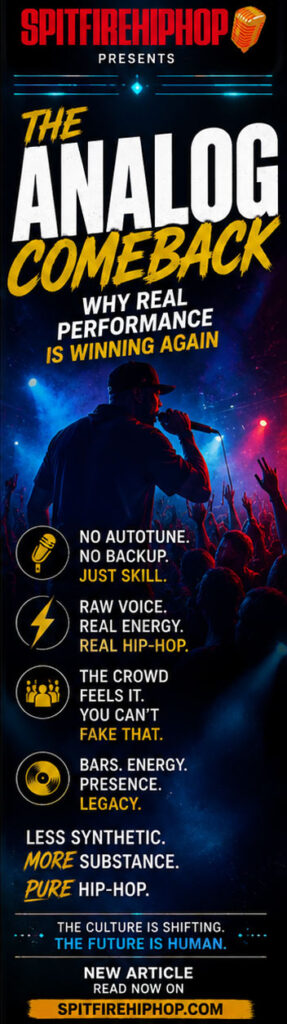
The next era of Hip-Hop may place heavier value on:
- live presence
- crowd control
- emotional delivery
- authenticity under pressure
Those qualities create deeper fan loyalty because they feel earned instead of manufactured.
Audiences may still enjoy polished content, but emotionally, many are beginning to lean back toward artists who feel grounded, skilled, and fully present in the moment.
The Corporate Corner Perspective
The analog comeback represents a deeper correction inside Hip-Hop culture. For years, artists were trained to focus almost entirely on visibility. The algorithm rewarded frequency and engagement above everything else. But visibility alone eventually becomes hollow when audiences no longer feel emotionally connected to what they are watching.
That realization is changing how fans respond to artists.
Long-term influence increasingly belongs to artists who create moments that feel human instead of merely optimized. Technology will absolutely remain part of music culture moving forward, but audiences are beginning to separate technological enhancement from emotional authenticity.
The artists who thrive in the next era may not necessarily be the artists with the most perfectly engineered content. They may be the artists who make fans feel something real in a culture overwhelmed by artificial experiences.
Final Thoughts
The analog comeback is not about rejecting technology entirely. Hip-Hop will continue evolving alongside digital culture, AI tools, and modern production systems. But emotionally, audiences are searching for balance again.
They want performances that feel alive.
They want artists who feel emotionally present.
They want moments that feel impossible to manufacture.
And at its core, Hip-Hop has always been strongest when human energy sits at the center of it. That truth may end up defining the next era of the culture more than any algorithm ever could.