

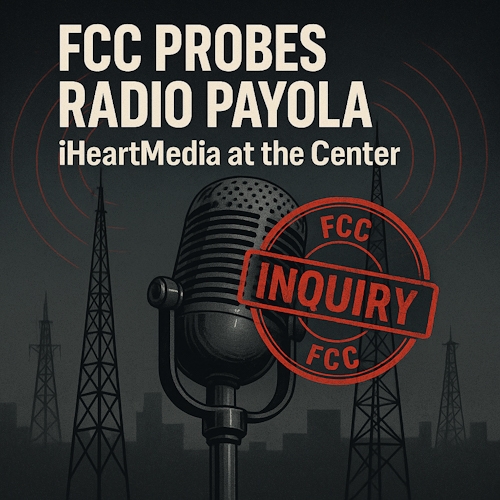
The Federal Communications Commission (FCC) has launched a probe into iHeartMedia, the largest radio broadcaster in the United States, over questions of whether its business practices amount to payola. While the situation has sparked online rumors of racketeering or RICO charges, the facts point clearly to a regulatory investigation, not a criminal one. This article breaks down what’s really happening, why it matters, and how it could reshape radio and music promotion in 2025.
What Is Payola?
“Payola” refers to the illegal practice of paying radio stations or DJs to play certain songs without disclosing those payments. The word itself dates back to the 1950s, when congressional hearings revealed widespread corruption in the radio industry. At the time, some DJs were secretly taking money, gifts, or favors to spin songs more often, artificially boosting their popularity.
Since then, the FCC has enforced rules designed to keep the airwaves fair. Any paid promotion of music must be disclosed on-air so listeners know what is editorial content and what is advertising. Despite these regulations, payola scandals have re-emerged repeatedly over the decades. In the early 2000s, major record labels paid hundreds of millions in fines after investigations uncovered improper payments to stations. Today, the FCC continues to monitor for signs of undisclosed or coercive arrangements.
The FCC’s Current Probe Into iHeartMedia
In February 2025, reports surfaced that the FCC sent formal inquiries to iHeartMedia about its iHeartCountry Festival and other live events. Regulators want to know whether artists are being pressured to perform for free or reduced compensation in exchange for more favorable airplay on iHeart’s radio stations. The FCC has asked the company to provide a list of performers, details of their compensation, and whether artists who decline to perform face consequences on the air.
iHeartMedia responded by denying any wrongdoing. The company stated it does not make “overt or covert agreements” linking live performances with radio promotion. According to iHeart, artists are free to choose whether or not to participate in its festivals, and participation is not tied to receiving more spins on its stations.
This is a regulatory probe, not a criminal case. The FCC’s role is to ensure compliance with federal broadcast standards, and at this stage no fines or penalties have been issued. The inquiry is still ongoing, and the outcome will depend on the information gathered.
The Broader Industry Context
The investigation highlights how questions of pay-for-play continue to shape the music business. Traditional radio, though less dominant than in past decades, still plays a huge role in shaping hits. A song added to heavy rotation on a national station network can dramatically boost streams, chart position, and touring opportunities.
For independent Hip-Hop and underground artists, the concern is clear: if festival participation or behind-the-scenes negotiations determine airplay, it becomes even harder to break through without corporate backing. The practice, if proven, would favor major labels and mainstream stars who have the leverage to participate in large events, while leaving smaller acts behind.
Meanwhile, similar debates are happening in streaming. Some services have faced criticism for playlist “pay-for-placement” arrangements, where labels or distributors pay to secure prominent spots on curated playlists. In both radio and streaming, the underlying issue is fairness—ensuring that listeners discover music based on merit and artistry, not undisclosed deals.
Artist and Audience Impact
For artists, especially those building careers in Hip-Hop, transparency in promotion is critical. If audiences begin to believe airplay or playlist slots are primarily bought and sold, it undermines the trust between fans and the industry. Independent artists who already struggle with limited resources may feel they cannot compete at all.
Audiences, too, have a stake. Listeners expect radio stations to deliver music chosen for its quality or popularity, not for undisclosed financial arrangements. Payola distorts the cultural landscape by amplifying certain voices while muting others. It also erodes the credibility of outlets that depend on public trust.
The FCC’s probe offers an opportunity to reset expectations. If the inquiry results in stronger transparency requirements, both artists and listeners may benefit from a fairer playing field.
The Legal Framework Behind Payola Rules
The payola laws are not simply a relic of the past—they are codified in the Communications Act of 1934 and strengthened in later amendments. Broadcasters must clearly identify any sponsored content on air. When it comes to music, if a label, promoter, or third party provides payment, the station must disclose that fact so audiences know the airplay is essentially advertising.
Violations can lead to hefty fines. In past cases, broadcasters have paid millions in penalties for failing to disclose paid spins. DJs, too, can face consequences, including loss of licenses or even criminal charges if fraud is involved. This legal framework underscores why the FCC is so attentive to even the appearance of undisclosed influence.
Public Reactions to the Probe
The announcement of the FCC inquiry into iHeartMedia triggered a wave of commentary across social media and music forums. Some industry insiders see the probe as overdue, arguing that the blurred lines between promotional events and airplay have gone unchecked for too long. Others worry that heightened scrutiny could limit opportunities for cross-promotion that benefit both artists and audiences.
Fans, meanwhile, express frustration that mainstream radio still wields such power, even in the streaming age. Many independent Hip-Hop fans believe this proves the importance of supporting smaller, community-driven outlets that champion authenticity over corporate interests.
Lessons for Independent Artists
For artists navigating today’s industry, the FCC probe provides valuable lessons. First, transparency matters—audiences reward artists who communicate openly and avoid associations with questionable promotional tactics. Second, diversification is essential. Relying solely on mainstream radio or major-label connections is increasingly risky. Independent platforms, grassroots marketing, and direct fan engagement often provide more sustainable growth.
Finally, artists should understand their rights. They are under no obligation to participate in events or promotions that make them uncomfortable. Knowing the rules surrounding payola empowers artists to make informed choices and to call out unfair practices when they encounter them.
What Happens Next?
So far, no penalties or charges have been issued. The FCC will review the documents iHeartMedia provides, evaluate whether its practices comply with disclosure laws, and determine next steps. Possible outcomes include fines, new compliance requirements, or, if no evidence of wrongdoing is found, closure of the case.
It’s important to emphasize that this is not a Department of Justice criminal investigation, and no RICO or racketeering charges are being prepared. Claims to the contrary circulating on social media are not supported by court filings or DOJ announcements. The situation remains strictly within the FCC’s regulatory authority.
For industry watchers, the probe will be a key test of how the FCC enforces payola rules in 2025. The results could ripple beyond iHeartMedia to other broadcasters and even streaming platforms, setting new standards for transparency.
Why This Matters for Hip-Hop and Independent Platforms
For Hip-Hop culture, which has long battled for recognition against corporate gatekeeping, the probe underscores why independent platforms are vital. Independent radio, online stations, and blogs play a critical role in elevating artists who might otherwise be overlooked. By offering exposure free from corporate influence, these outlets help preserve authenticity and diversity in the culture.
The FCC’s investigation also highlights the need for artists to diversify their promotional strategies. While radio remains powerful, artists increasingly rely on social media, direct-to-fan marketing, and independent networks to build their audiences. The more transparent and fair the system becomes, the better it is for artists at every level.
The FCC’s probe into iHeartMedia is a reminder that payola remains an ongoing concern in American radio. While rumors of racketeering and RICO charges are unfounded, the regulatory investigation is real and significant. Its outcome could shape how music is promoted on the airwaves for years to come.
For independent artists and fans, this moment underscores the importance of transparency, fairness, and diverse voices in the industry. As the probe continues, the focus should remain on facts: ensuring that music promotion is based on talent and creativity—not secret deals behind the scenes.