


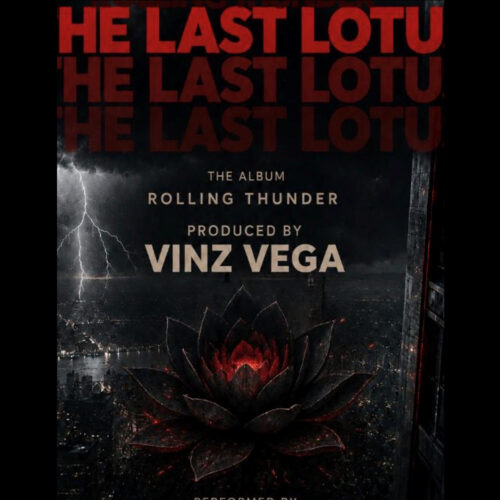
Vinz Vega and Indigo Phoenyx Find Beauty in the Darkness on “The Last Lotus”
Some Hip-Hop records announce themselves with volume. Others establish their presence through atmosphere. On “The Last Lotus,” Parisian producer Vinz Vega chooses the latter, constructing a shadowy backdrop for Indigo Phoenyx that feels less like a conventional single and more like an excursion into the colder corners of underground Hip-Hop.
“The Last Lotus” appears on Vega’s new album, Rolling Thunder, a project built around the producer connecting his sound with lyricists from the underground. With Indigo Phoenyx stepping to the microphone here, the pairing makes immediate sense. Her work has already circulated through the international underground Hip-Hop ecosystem, and “The Last Lotus” places her uncompromising delivery against production that leaves plenty of room for words, cadence and personality to carry weight.
Vega’s production is the foundation. Moving at a measured pace of roughly 83 BPM, the track never feels hurried. Instead, the beat creates tension through space, texture and restraint. There is darkness in the soundscape, but it isn’t darkness for decoration. The production feels intentionally designed to make every vocal entrance more pronounced.
That approach matters when working with an emcee like Indigo Phoenyx.
Listen to Spit Fire Radio: www.spitfireradio.com
Rather than overwhelming her with unnecessary layers, Vega gives her a pocket that allows the rhymes to remain front and center. Indigo responds with a performance built around control and conviction. Her presence cuts through the record, bringing an edge to the production without disturbing its atmosphere. There is a difference between rapping over a beat and sounding as though you belong inside its world; “The Last Lotus” succeeds because producer and emcee occupy the same space.
The title becomes especially fitting when considered alongside the music. A lotus is traditionally associated with something beautiful emerging from difficult surroundings, and whether or not Vega and Indigo intended every layer of that symbolism, the imagery complements what the record sounds like: something alive and commanding rising from a murky environment.
That aesthetic also connects naturally to the Rolling Thunder artwork. Lightning splits a nighttime cityscape while a dark lotus dominates the foreground, illuminated from within by red light. It presents Vega’s album as something cinematic before the listener ever presses play. “The Last Lotus” extends that imagery sonically.
More importantly, the collaboration illustrates how international underground Hip-Hop has continued to erase geographical boundaries without sacrificing regional individuality. Vega may be operating from Paris, but the musical language underneath “The Last Lotus” belongs to a much broader network of artists and listeners who value lyricism, producer identity, and records that do not need to chase mainstream structures.
That producer identity may ultimately be one of Rolling Thunder’s most interesting qualities.
Producer albums work best when the person behind the boards does more than simply collect guest appearances. The producer has to establish the environment and then understand which emcee can inhabit each part of it. “The Last Lotus” suggests Vega understands that responsibility. He doesn’t merely provide Indigo Phoenyx with drums and a loop; he creates a setting for her performance.
And Indigo makes use of it.
At roughly two-and-a-half minutes, the track doesn’t overstay its welcome. It arrives, establishes its mood, and leaves an impression. There is no need to inflate the arrangement simply to make the song feel bigger. Its strength comes from concentration.
That restraint makes “The Last Lotus” an effective introduction to what Vinz Vega is building with Rolling Thunder. It is underground Hip-Hop presented without apology: dark production, deliberate pacing, an emcee with presence and a producer who understands that sometimes the most powerful thing happening in a beat is the space left open for the rapper.
With Indigo Phoenyx commanding that space, “The Last Lotus” doesn’t need to chase the storm.
It grows directly out of it.