




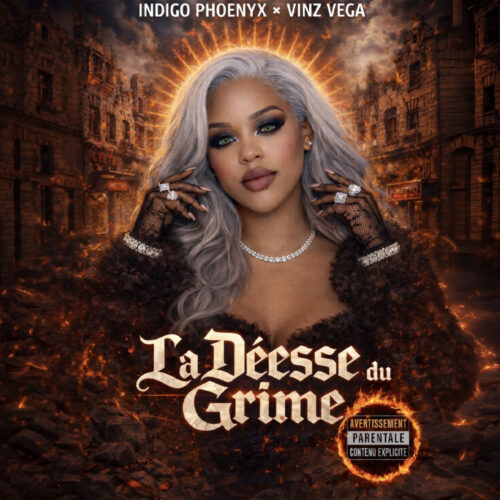
From the opening moments of La Déesse du Crime, it’s clear this isn’t a scattered collection of tracks—it’s a tightly constructed world. Indigo Phoenyx and Vinz Vega build a sonic bridge between New York’s raw, unapologetic edge and Paris’ mystique and elegance, and more importantly, they make it believable.
Too often, artists attempt “global” sounds that feel forced. That’s not the case here. The Paris influence doesn’t dilute the grit, it elevates it. The production carries a sense of luxury and danger at the same time, like walking through a high-end district with tension in the air.
This is Hip-Hop with atmosphere. With intention. With identity. Indigo Phoenyx doesn’t rap like she’s trying to prove something—she raps like she already knows. That distinction defines this entire EP. Her delivery is measured, confident, and sharp. There’s no overreaching, no unnecessary aggression—just precision and authority. She embodies the concept of “La Déesse du Crime” without needing to overstate it. The presence is felt in her tone, her pacing, and her control.
What stands out most is her ability to balance:
- Street-rooted realism
- Elevated, almost regal composure
That duality is what makes her performance stick. She’s not chasing energy—she’s controlling it.
Vinz Vega’s production is the backbone of this project, and it deserves to be treated as such. Instead of overwhelming the listener, the beats create space—space for Indigo to move, to speak, to dominate.
The soundscape is:
- Dark and textured
- Cinematic in structure
- Minimal where it needs to be
Every drum pattern, every melodic layer feels placed with intention. There’s a restraint here that many producers overlook. Vega understands that power doesn’t always come from density—it comes from control and timing.
Listen to Spit Fire Radio: www.spitfireradio.com
This isn’t just production.
This is world-building through sound.
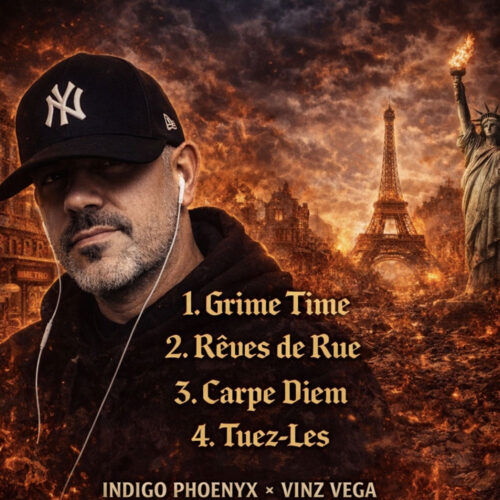
The EP wastes no time establishing its presence. “Grime Time” opens the project with immediate authority, setting a tone that feels deliberate and controlled rather than rushed. From there, “Rêves de Rue” emerges as one of the project’s most distinct moments, leaning into its Parisian aesthetic with a dreamlike quality that never loses its connection to the street narrative at its core. “Carpe Diem” shifts the energy into a more reflective space, where ambition is balanced with realism, allowing Indigo Phoenyx to deliver with intention and clarity instead of falling into cliché.
By the time “Tuez-Les” closes the run, the EP reaches its most aggressive and commanding point—dark, focused, and unapologetic, fully embodying the essence of La Déesse du Crime. Across all four tracks, what stands out most is the consistency. There is no filler, no drop-off—just a tight, deliberate sequence that executes exactly what it sets out to do.
With contributions from Emhyr Rhymes, Vektrx, and King Androit, the features are used strategically. They don’t disrupt the energy—they extend it. Each guest feels like part of the same universe Indigo and Vega created. Nobody sounds out of place, and more importantly, nobody pulls focus away from the core identity of the project.
That’s how features should be used.
What truly elevates La Déesse du Crime is its ability to feel like more than music. This project plays like a soundtrack—something visual, something immersive.
You can hear:
- The tension
- The movement
- The luxury layered over survival
It’s not just about bars and beats—it’s about presentation and cohesion. That’s where this project separates itself from the overcrowded field of underground releases.




Pingback: Vinz Vega and Indigo Phoenyx Bring Underground Grit to “The Last Lotus” – SpitFireHipHop.com