
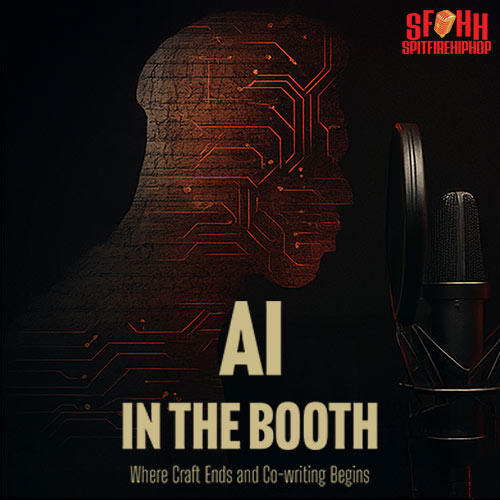
Hip-Hop has always been about innovation. From Kool Herc looping breaks on two turntables to the rise of sampling machines, to the digital revolution of Pro Tools and Auto-Tune, technology has consistently expanded the soundscape of rap. Now, a new player has entered the booth, Artificial Intelligence. Unlike past tools, AI doesn’t just help you create beats or polish sound; it can actually generate lyrics. That raises an uncomfortable question: is AI another extension of Hip-Hop’s inventive spirit, or does it threaten to erase the very craft and lived experience that defines the culture?
Over the past few years, AI has gone from futuristic concept to an everyday studio tool. Programs can now analyze rhyme schemes, spit out punchlines, and even imitate the voices of major artists. Viral examples, such as AI-generated “Drake” and “Kendrick Lamar” songs, blurred the line between satire and piracy. Industry veterans like Freddie Gibbs have openly criticized AI rappers, warning that machines cannot capture the soul of storytelling or the truth of lived struggle.
Still, the appeal is obvious: AI can deliver endless rhyme options in seconds, give new writers a jumping-off point, or even provide labels with an inexpensive way to churn out content. In an era where streaming platforms reward volume, some see AI as the perfect “ghostwriter.” But Hip-Hop has always demanded more than output; it has demanded authenticity.
Rap is rooted in craft: wordplay, cadence, and the ability to turn personal experiences into universal anthems. At the same time, collaboration has always existed in the culture. Producers suggest hooks, friends throw out punchlines in the studio, and ghostwriters have shaped some of rap’s biggest records. The difference is that those voices come from real people with perspectives, not lines of code.
AI can be compared to a rhyme dictionary or sample pack, tools that provide inspiration but don’t replace creativity. Yet when AI spits entire verses, it blurs the line between assistance and replacement. If an artist leans too heavily on AI, are they still honing their pen, or outsourcing their identity? The answer might depend on how transparent they are with fans, and whether listeners value honesty over product.
There’s also the business side to consider. Copyright law wasn’t designed for AI-generated content. Who owns a verse created by a machine, the developer of the AI, the artist who prompted it, or nobody at all? Major labels are already testing how far they can push AI without facing lawsuits. For independent artists, the risk is different: being drowned out in a flood of AI-generated tracks that mimic their style.
Catalog deals and publishing rights have been central to Hip-Hop for decades. Now, AI introduces a new wrinkle. If music becomes infinitely reproducible by machines, the value of originality could decline. That might make live shows, brand partnerships, and fan trust even more important revenue streams for real artists.
Hip-Hop is built on authenticity. Fans want to feel that the bars they hear come from real life, pain, hustle, joy, or triumph. AI threatens to flatten that emotional depth, creating music that sounds right but feels hollow. Imagine an AI generating a verse about systemic oppression or street survival. Without lived experience, does that cross into exploitation?
At the same time, younger listeners who grew up on gaming, TikTok filters, and digital remixes may view AI differently. To them, it could be another playful tool, like sampling was to an older generation. The culture will likely split, with some fans demanding authenticity while others embrace AI as part of Hip-Hop’s evolution.
For artists navigating this new reality, the key is to treat AI as a collaborator, not a replacement. Here are a few practical guidelines:
- Use AI for brainstorming, not finished verses. Let it spark ideas, then rewrite with your own voice.
- Stay transparent. If AI helped, acknowledge it. Fans value honesty more than secrecy.
- Double down on what AI can’t do. Authentic storytelling, stage presence, and fan connection remain irreplaceable.
- Protect your work. Monitor platforms for unauthorized AI clones of your voice or style.
- Experiment, but don’t outsource identity. AI might give you a hundred rhyme options, but only you can decide which ones represent your truth.
The future of AI in Hip-Hop won’t be about whether the tech exists; it’s here already. The question is how artists will wield it.
AI isn’t leaving the booth. Just like Auto-Tune, digital samplers, and drum machines, it will find its place in Hip-Hop. But the culture has always been about how you use the tools, not just having them. For artists, the choice is clear: let AI inspire you, but don’t let it replace you. The most powerful weapon in Hip-Hop will always be a voice rooted in lived experience, something no algorithm can replicate.