



Hip‑Hop wasn’t always a global sound. Back in the day, it was deeply locally rooted, firmly in cities and regions with distinctive voices, rhythms, and cultural backdrops. You could hear the geography in the flow, the beats, even the slang.
Hip-Hop wasn’t always a global sound. Back in the day, it was deeply local, rooted firmly in cities and regions with distinctive voices, rhythms, and cultural backdrops. You could hear the geography in the flow, the beats, even the slang. It wasn’t just music; it was a sonic map, and each region carried its own DNA that you could recognize instantly.
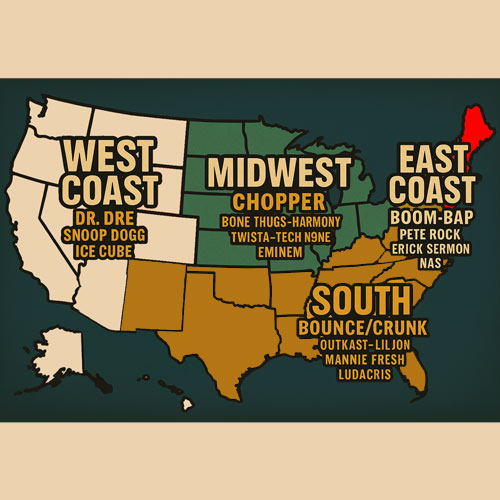
The East Coast is where it all began. Born in the Bronx in the early 1970s, Hip-Hop grew out of block parties, DJ culture, and breakbeats, with pioneers like DJ Kool Herc and Afrika Bambaataa laying the foundation. It evolved into complex, lyric-driven styles characterized by “boom-bap” beats and intricate metaphors. This sound was gritty, raw, and intellectually sharp, urban storytelling layered over drum-heavy production. Legends like Nas, The Notorious B.I.G., Rakim, Public Enemy, and Wu-Tang Clan embodied this aesthetic, their rhymes painting pictures of New York streets with surgical precision.
Across the country, the West Coast developed its own identity. It emerged from California’s DJ-heavy party scene, infused with electronic influences and dance styles like popping and locking. In the early ’90s, Dr. Dre pioneered the G-funk sound, smooth synthesizers, slow grooves, deep bass, and melodic hooks, creating a laid-back California vibe that contrasted sharply with East Coast aggression. While East Coast rappers were known for their sharp lyricism and dense flows, West Coast artists like Snoop Dogg, Ice Cube, and Tupac brought a more relaxed delivery, painting vivid images of palm trees, lowriders, and sunny, but dangerous, L.A. streets.
Down South, Hip-Hop took on a whole different life. The “Dirty South” era from the late ’90s into the early 2000s brought heavy bass, catchy slang, and production innovation from groups like OutKast, producers like Mannie Fresh and Lil Jon, and artists such as Ludacris and Lil Wayne. New Orleans bounce music emerged as a hyper-local sound, dance-centric, percussive, and driven by call-and-response chants. It had Mardi Gras in its DNA, blending parade rhythms with street party energy. Labels like Take Fo’, Cash Money, and No Limit were instrumental in taking bounce from block parties to national charts. Meanwhile, crunk music, born in Memphis and popularized in Atlanta, delivered high-energy club anthems fueled by booming drums, shouted hooks, and an aggressive party atmosphere.
In the Midwest, the defining characteristic was speed. The region became famous for its “chopper” style, rapid-fire flows delivered with precision and breath control. Bone Thugs-n-Harmony out of Cleveland, Twista from Chicago, Tech N9ne in Kansas City, and Eminem from Detroit all mastered this art. But the Midwest was far from one-dimensional. Kanye West brought a soulful, sample-heavy style; Common gave us introspection and social commentary; and artists like Nelly infused Southern bounce influences into the St. Louis sound. The diversity was so broad that you could still tell a Chicago MC from a Detroit MC, even if they were both from the same general region.
Some of the most unique sub-regions had their own defining movements. In the Bay Area, hyphy exploded in the late 1990s and early 2000s. It was raw, frenetic, and deeply tied to local culture, born for “sideshows,” where cars performed stunts in intersections, and infused with slang like “go dumb.” Mac Dre and E-40 were its most visible ambassadors, turning Oakland and Vallejo into Hip-Hop hotbeds. Memphis carved out its own identity with horrorcore, dark, eerie, lo-fi rap with haunting beats, distorted vocals, and street-level authenticity. Artists like Three 6 Mafia pioneered this sound, which has gone on to influence modern trap and even pop production.
What made these regional sounds so distinct? First, the cultural roots of each location directly shaped its music. Mardi Gras rhythms influenced New Orleans bounce just as the gritty street life of New York molded East Coast lyricism. Second, the DIY nature of early Hip-Hop meant that communities built their own infrastructure, mixtapes, local labels, and pirate radio stations, before major labels took notice. Third, there was identity and pride. Representing your city or coast was not optional; it was central to the music. Fourth, before the Internet era, local radio and media kept the sound pure. You had to physically be in a place to absorb its style, slang, and beats.
As Hip-Hop went global, these once-distinct sounds began to blur. Streaming platforms, social media, and cross-regional collaborations created a unified soundscape where an Atlanta producer could work with a London rapper, and a New York MC could adopt a Houston-inspired flow. While this evolution has brought incredible innovation and diversity, some argue it has also diluted the unique flavors that once defined the culture. That said, the DNA of these regional sounds still lives on, whether in G-funk basslines resurfacing in modern West Coast rap, bounce rhythms sneaking into pop hits, or Midwest chopper flows appearing in drill tracks.
The era when you could hear where a rapper was from just by the rhythm, flow, or beat was golden. It was a time when Hip-Hop doubled as a cultural atlas, each region marking its territory with sonic fingerprints that couldn’t be faked. While today’s scene is more global than ever, the spirit of regional Hip-Hop remains an anchor for authenticity, a reminder that this culture was built from the ground up, city by city, block by block.



Pingback: AI in the Booth: Where Craft Ends and Co-Writing Begins – SpitFireHipHop.com