

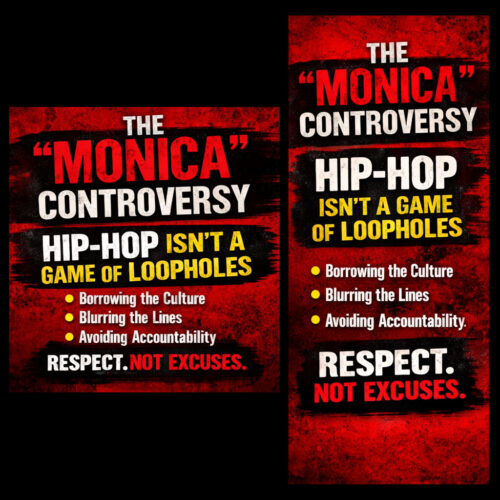
The “Monica” Problem: Hip-Hop Isn’t a Game of Loopholes
There’s a line in Hip-Hop that has always been clear, even when everything else about the culture evolves. That line is respect. Not performative respect. Not selective respect. Real respect, rooted in understanding where the culture comes from and what it carries.
And right now, that line is being tested again.
The emergence of the term “Monica” as a possible stand-in for the n-word isn’t just another internet rumor or passing joke. It represents something deeper and more troubling. Whether it was intended that way or not, the fact that people are even entertaining it as a workaround says everything about where parts of the culture are drifting.
Because let’s be honest: Hip-Hop has seen this before. Not the exact word. Not the exact moment. But the same pattern.
A new generation finds a way to get close to the culture without fully respecting its boundaries. A new workaround appears. A new excuse gets tested. And every time, the culture is expected to just… accept it.
This time, it’s not being accepted.
This Isn’t Creativity—It’s Evasion
There’s a difference between innovation and imitation. Between expression and exploitation.
Using a term that sounds like “my n****” while pretending it’s something else doesn’t fall into any category of creativity. It falls into evasion. It’s an attempt to sit in the energy of a word without taking accountability for what that word means and who it belongs to.
And that’s where the problem lives.
Hip-Hop has always been about language. About bending it, flipping it, redefining it. But those transformations come from within the culture, not from outside perspectives trying to game the system.
Because when you strip it all the way down, this isn’t about syllables. It’s about access.
Who gets to say what?
Who gets to benefit?
Who gets to participate without consequence?
“Monica,” in this context, feels less like a word and more like a test. A test to see how far the line can be pushed before someone pushes back.
And the pushback is happening.
The Culture Sees Through It
Hip-Hop isn’t just music. It’s memory. It’s a lived experience. It’s identity is layered over decades of struggle, innovation, and expression. You can’t separate the language from that history, no matter how creative the workaround might seem.
That’s why this moment matters.
Because even if “Monica” was never officially intended as a substitute, the fact that it’s being interpreted that way—and repeated that way—is enough to trigger a response. In Hip-Hop, perception carries weight. Energy carries weight. And intent doesn’t erase impact.
The culture doesn’t operate on technicalities.
It operates on feel.
And right now, this doesn’t feel right.
Listen to Spit Fire radio: www.spitfireradio.com
The Bigger Pattern Nobody Wants to Address
If this were just about one word, it wouldn’t be a conversation. It would fade out like every other random internet trend.
But it’s not just about one word.
It’s about a recurring cycle that Hip-Hop has been dealing with for years:
- Proximity to Black culture without accountability
- Adoption of slang without understanding its weight
- Participation in the art form without respect for its boundaries
That’s the real issue.
Because every time something like this surfaces, it exposes the same underlying question:
Do you love Hip-Hop enough to respect it—or just enough to use it?
There’s a difference. And the culture knows it.
No More Loopholes
Hip-Hop doesn’t need coded language to survive. It doesn’t need substitutes, workarounds, or phonetic tricks designed to blur lines that were never meant to be crossed.
It needs clarity.
It needs respect.
It needs people who understand that some parts of the culture are not up for reinterpretation—no matter how clever the delivery might seem.
If “Monica” is just a name, then let it be just a name. Stand on it fully, without ambiguity. But if it’s being used as a wink, a nod, or a disguised version of something else, then it deserves to be called out without hesitation.
Because at this point, the culture isn’t confused. It’s watching. And it’s responding.
Final Word: Hip-Hop Is Global—But Respect Is Still Required
Hip-Hop has grown beyond borders. It’s global, influential, and constantly evolving. But growth doesn’t erase foundation. Expansion doesn’t remove responsibility.
You don’t get to rewrite the rules just because you found a clever way around them.
And you definitely don’t get to test the culture and expect silence.
Not this time.