

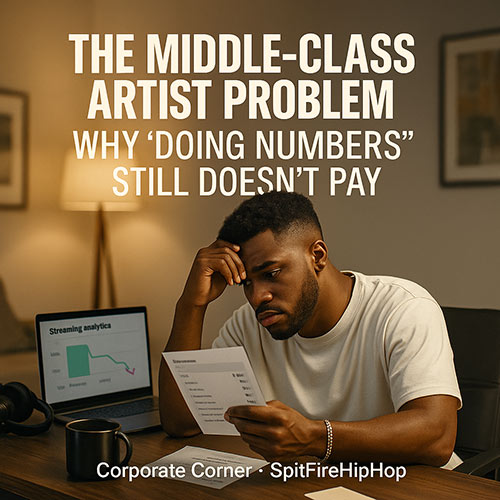
There’s a growing class of Hip-Hop artists who look successful online. They stream. They tour lightly. They post consistently. Yet financially, nothing moves. This is the middle-class artist problem — and it’s becoming the most common stage of modern music careers.
What “Middle-Class” Means in Music
In business, the middle class exists because people earn something, but not enough to accumulate leverage. Music is no different.
Middle-class artists aren’t failures. They’ve done many things right. They’ve built an audience. They’ve unlocked distribution. They’ve proven viability. But they’ve mistaken activity for profitability. The system rewards visibility far earlier than it rewards sustainability.
Why Numbers Create a False Sense of Security
Streams, followers, and engagement metrics are psychological traps. They signal motion, but not direction.
An artist can rack up millions of streams and still operate at a loss. Streaming payouts are spread thin, touring costs rise, and marketing becomes a recurring expense. Numbers inflate perception while income plateaus.
The result is a dangerous illusion: everything looks like growth, but nothing compounds.
How the Industry Creates Musical Inequality
The streaming economy mirrors wealth inequality. A small fraction of artists earn outsized returns, while a massive middle sustains the ecosystem without escaping it.
Platforms reward:
- consistency over ownership
- attention over attachment
- volume over leverage
This keeps artists working… but rarely owning.
Why Streams Flatten Income
Streaming income scales slowly because it’s built on fractions. Each play carries microscopic value. Scaling requires either massive volume or a long shelf life, often both.
Artists hit a ceiling because:
- streams don’t convert automatically into paying behavior
- casual listeners don’t become supporters
- visibility doesn’t equal demand
Streams keep artists busy, not wealthy.
The Difference Between an Audience and a Market
This is where most careers stall.
An audience listens.
A market buys.
Middle-class artists have listeners, but not systems that guide fans toward spending. No conversion architecture. No intentional monetization. Just hope that numbers magically lead somewhere.
They rarely do.
Why Hustle Culture Makes It Worse
Artists are told to “post more,” “drop more,” and “stay visible.” That advice keeps them relevant… but trapped.
Constant output without structure leads to:
- burnout
- shallow engagement
- scattered messaging
- no accumulated value
In corporate terms, this is operating cost inflation with no revenue strategy.
What Breaks Artists Out of the Middle
Escape doesn’t come from bigger numbers. It comes from a different way of thinking.
Artists who break out stop chasing attention and start building systems. They treat songs as assets, fans as stakeholders, and time as capital.
They focus on:
- retention over reach
- value per fan over fan count
- catalog performance over momentary spikes
- infrastructure over hype
This shift is subtle, but decisive.
Why Corporate Thinking Is the Exit
Corporations don’t rely on spikes. They rely on predictability.
When artists adopt corporate thinking, they:
- design releases around revenue pathways
- build catalog engines instead of isolated drops
- develop multiple income streams
- track performance over quarters, not days
This is how artists stabilize rather than scramble.
What Success Actually Looks Like Now
True success looks quieter than social media suggests.
It often shows up as:
- fewer viral moments
- steadier monthly income
- smaller but loyal fanbases
- music that continues earning without constant promotion
These artists don’t look flashy. They look free.
The Hard Truth
The middle-class artist problem isn’t caused by lack of talent.
It’s caused by lack of structure.
Artists don’t fail because they didn’t hustle enough. They stall because they weren’t taught how to convert momentum into leverage.
In 2025, survival belongs to artists who stop chasing proof of life and start building systems that pay them back.