

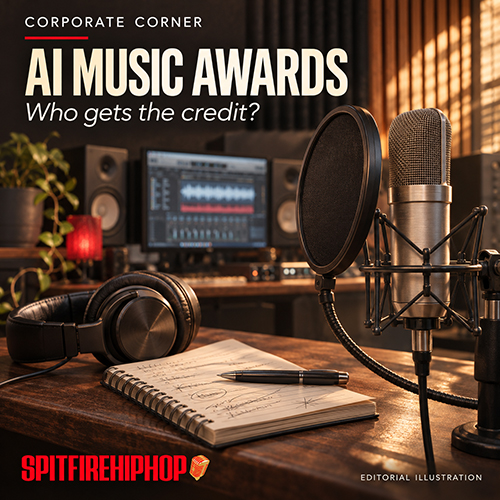
Hip-Hop audiences have always paid attention to the credits. Who wrote the verse? Who made the beat? Whose voice is coming through the speakers? The inaugural AI Music Awards give those questions another layer.
Organized by the Sonic Intelligence Academy, known as SIQA, the November 13, 2026 ceremony at The Mayan in Los Angeles recognized music made with artificial intelligence. Its official winners list names Slime Dot as Best AI Hip-Hop Artist, with “Big Slime” taking Best AI Hip-Hop Song. Xania Monet earned AI Artist of the Year, AI Album of the Year for Unfolded, and AI Song of the Year for “How Was I Supposed To Know?”
Behind Monet is songwriter Telisha “Nikki” Jones. According to Reuters’ reporting, published by GV Wire, Jones said she wrote the lyrics and used AI to set them to music. Other participants described the technology as a way to turn ideas into recordings when they lacked the skills to complete every part themselves. Reuters also reported musicians’ concerns about competition for attention and work.
That tension deserves more attention than a simple argument over whether AI music sounds good.
For an independent artist, tools that help bring a song to life can offer creative access. But the conversation also needs room for the vocalist developing a distinctive delivery, the producer shaping a signature sound, and the engineer whose decisions make a recording connect.
Listen to Spit Fire Radio: www.spitfireradio.com
What does “AI music” actually mean?
SIQA’s framework separates AI-assisted recordings, self-voice cloning under its “Human + AI Hybrid” classification, and fully AI-generated work directed through prompting and selection. These are the organization’s own definitions. Its registry says creators declare how AI was involved, and SIQA reviews those declarations.
Those distinctions matter. A songwriter supplying original lyrics and a person selecting an entirely generated song contribute in different ways. Listeners deserve credits that make those differences understandable.

The awards also have a defined voting community. SIQA says verified registry artists select nominees and winners, with members prohibited from voting for their own work. The results therefore reflect recognition within that community; they cannot establish agreement across the wider music industry.
Clear credits should lead to harder questions
Clear credits answer only part of the question. Artists and listeners also deserve transparency about permission to reproduce a voice and the music used to train the tools. Recognizing the person directing an AI recording should leave room to examine the contributions—and compensation—of the people whose work helped make that technology possible.
These are questions for scrutiny, rather than allegations about an individual winner. An award and a disclosed creative process do not, by themselves, answer questions about consent or compensation.
The discussion connects with SpitFireHipHop’s earlier examination of AI producers and the ethics of beat ownership. The practical challenge is making the human contribution visible enough for listeners to understand what they are supporting.
For Hip-Hop, the most useful response is careful scrutiny. Ask who wrote, who performed, what the technology generated, and how everyone involved is credited. An awards ceremony can celebrate a developing creative scene. Earning listeners’ trust requires making the process behind the music clear.