

AI didn’t break Hip-Hop’s ethics — it exposed them. As artificial intelligence becomes embedded in beatmaking, the culture is being forced to answer a foundational question it avoided for years: who actually authors the music, and who deserves the credit that follows?
Why Ethics Entered the AI Conversation
Hip-Hop has always embraced technology. From samplers to drum machines, innovation was never the issue. The ethical tension emerged when AI began generating material that resembles authorship without being human.
This created confusion around responsibility, ownership, and recognition — especially once AI-assisted beats began earning real money.
Ethics became unavoidable the moment credits turned into capital.
What Authorship Has Always Meant in Hip-Hop
Authorship in Hip-Hop isn’t about touching equipment — it’s about creative decision-making. The producer historically earned credit because they chose the sounds, shaped the rhythm, structured the arrangement, and finalized the direction.
The culture recognized intent as authorship.
AI challenges this only if we forget that machines don’t intend — they respond.
Why AI Complicates the Credit Conversation
AI systems generate outputs based on prompts, datasets, and constraints. Without a human guiding those inputs, nothing happens.
Yet confusion arises because AI can now:
- generate melodies instantly
- mimic established styles
- assemble full arrangements
- adapt outputs dynamically
This speed creates the illusion of authorship. But illusion is not ownership.
The Ethical Line Artists Must Draw
Ethics aren’t about banning tools — they’re about clarity.
The ethical responsibility lies in identifying:
- who directed the process
- who selected the output
- who arranged the final version
- who approved the release
Listen live on Spit Fire Radio → https://www.myksfr.com
Authorship belongs to the person accountable for the outcome.
Why Crediting AI as a Producer Is Misleading
AI cannot:
- claim copyright
- collect royalties
- accept accountability
- build legacy
Crediting AI as a producer doesn’t honor creativity — it erases responsibility. It shifts credit away from human decision-making and confuses future ownership.
Ethical clarity protects artists, producers, and catalogs.
How Ethical Credits Protect Catalog Value
Credits aren’t cosmetic — they’re contractual. Years later, licensing deals, catalog sales, and royalty audits rely on accurate attribution.
When AI involvement isn’t documented properly:
- catalog buyers hesitate
- legal disputes surface
- revenue gets delayed
- asset value drops
Ethics today prevent lawsuits tomorrow.
How Producers Are Addressing AI Transparently
Forward-thinking producers aren’t hiding AI use — they’re contextualizing it.
Ethical best practices emerging include:
- crediting the human producer exclusively
- documenting AI tools privately in session notes
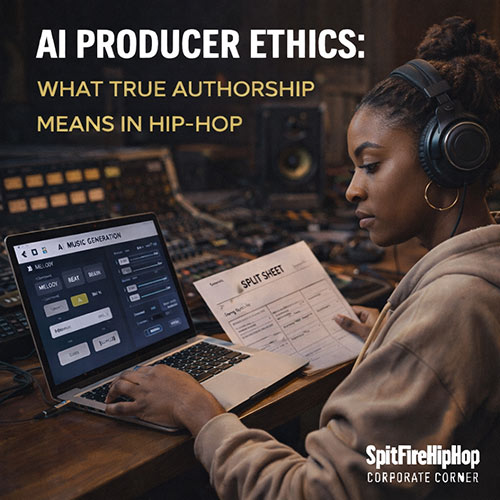
- clarifying authorship in split sheets
- maintaining consistency across releases
Transparency doesn’t weaken credibility — it strengthens it.
Why Hip-Hop’s Ethics Matter Beyond Music
Hip-Hop doesn’t just influence sound — it influences culture. How the genre handles AI will set precedents for other creative fields.
Ethical leadership here signals that innovation and integrity can coexist.
The Corporate Corner Reality
Companies protect IP through structure and documentation. Artists and producers must adopt the same discipline.
AI doesn’t remove ethical responsibility — it magnifies it.
The Real Takeaway
AI can assist creation.
Humans remain authors.
Ethics in Hip-Hop aren’t about rejecting technology — they’re about protecting accountability, ownership, and legacy in a world moving faster than clarity.