



October 24, 2026
The New Middleman: Is Independent Music Building Its Own Major Labels?
EMPIRE founder Ghazi Shami’s global expansion of Supply Chain reflects a significant change in the independent music business. As technology gives smaller companies access to infrastructure once associated with major labels, a more complicated question emerges: Who controls the systems that make independence possible?
Corporate Corner → Growth & Operations
The independent music industry has spent decades trying to escape the limitations of the traditional record business. Artists wanted ownership of their recordings, better financial terms, greater creative freedom, and the ability to build careers without surrendering control to companies that could determine whether their music reached an audience. Digital distribution helped make that ambition achievable, opening commercial opportunities that once required the resources and relationships of established record labels.
But something unexpected has happened as independence has grown into a serious commercial force. The businesses created to challenge the old industry are beginning to resemble parts of the infrastructure they once sought to replace.
They operate international distribution networks, administer royalties, manage substantial catalogs, provide marketing services, negotiate commercial relationships, and develop technology that smaller companies depend on to function. Some offer many of the capabilities associated with major labels while maintaining business models built around independent ownership.
That development is not necessarily a contradiction. A company can become large without becoming exploitative, just as an artist can remain independent while relying on outside partners. The more important question concerns the structure of those relationships and the amount of practical control retained by the people creating and owning the music.
This distinction is becoming increasingly relevant following the global expansion of Supply Chain, a business-to-business music infrastructure company founded by Ghazi Shami, the entrepreneur behind EMPIRE.
Announced during the week of October 21, 2026, Supply Chain’s expanded operation represents an effort to provide independent music businesses with the technology, distribution capabilities, and administrative systems necessary to compete internationally. Its proposition is that smaller companies should be able to access sophisticated infrastructure without surrendering control of their catalogs, data, customer relationships, or commercial decisions.
It is an ambitious proposition, and one that deserves attention beyond the announcement itself.
The development points toward a potentially significant reorganization of the independent music business, in which artists and labels may no longer need traditional major-label agreements to operate at a professional scale. Instead, they can assemble services from specialized companies that provide the technical and commercial machinery behind the music.
That model could create meaningful opportunities. It could also introduce another generation of powerful intermediaries whose influence is less visible than the record executives of earlier decades.
The question facing independent music is no longer simply whether artists can succeed without major labels. Increasingly, it is whether the infrastructure supporting their success will preserve their independence as those service providers become larger and more influential.
Ghazi’s Next Move Is Bigger Than Distribution
To understand the significance of Supply Chain, it helps to consider the company that established Ghazi’s reputation.
Founded in San Francisco in 2010, EMPIRE developed into an influential independent music company through distribution, label services, publishing, and direct involvement in artist development. Its history includes work connected to Kendrick Lamar, Anderson .Paak, XXXTentacion, Cardi B, and numerous other performers whose careers helped demonstrate that major cultural and commercial impact did not always require a conventional major-label arrangement.
EMPIRE’s development reflected a broader shift in the business. Distribution was becoming more accessible, but the ability to release music did not automatically provide the expertise, relationships, or resources necessary to develop a sustainable enterprise. Companies capable of combining those functions could create value for artists who wanted professional support without accepting every condition associated with traditional recording agreements.
Supply Chain extends that logic into a different market.
Rather than primarily presenting itself as another destination where individual musicians upload singles and albums, Supply Chain is designed to serve businesses that already work with artists and rights holders. Those customers can include independent labels, distributors, technology companies, and other organizations that require professional music infrastructure.
The company offers software and application programming interfaces, commonly known as APIs, that allow other businesses to incorporate distribution and administrative capabilities into their own operations.
Listen to Spit Fire Radio: www.spitfireradio.com
That distinction is central to the story.
A conventional digital distributor typically maintains a direct relationship with the musician or label delivering recordings. A white-label infrastructure provider may operate behind another company’s brand, supplying the technology that enables that company to offer distribution and related services to its own customers.
The artist may never interact directly with the underlying technology provider. Nevertheless, the provider can play an important role in how recordings are delivered, information is processed, royalties are accounted for, and commercial activity is managed.
Supply Chain was first introduced in 2023, so its October 2026 announcement should not be characterized as the creation of an entirely new business. The development is its global expansion, supported by new executive appointments and an announced relationship with Ampsuite, the music technology company owned by Beatport. Supply Chain has established its international headquarters in Amsterdam and appointed Craig May as senior vice president of marketing and Kristy May as senior vice president of business affairs.
The Ampsuite relationship is particularly noteworthy because it connects Supply Chain with an established technology business serving independent labels. It provides a concrete example of the business-to-business model Supply Chain is pursuing, although the public announcement does not establish the precise commercial terms or demonstrate how every customer will use the underlying services.
Supply Chain also has existing relationships that illustrate the flexibility of its approach. In November 2025, EngineEars, the music technology company founded by Grammy-winning engineer Derek “MixedByAli” Ali, launched EngineEars Direct with distribution technology supplied by Supply Chain. In April 2026, music technology startup Nebula announced a partnership involving a model through which fans could participate in royalty payouts associated with upcoming recordings.
These examples point toward a larger ambition: allowing independent companies to build different commercial offerings on a shared technological foundation.
If that approach develops successfully, the result could be an industry in which smaller music businesses gain access to capabilities that previously required substantial internal investment.
But access to sophisticated infrastructure raises another question. When many independent companies rely on the same underlying systems, where does independence actually reside?
The Major Labels’ Advantage Was Never Just Their Money
Discussions about the power of major record labels often focus on advances, recording budgets, and promotional spending. Those resources remain important, but they represent only part of the competitive advantage that large music companies have developed over decades.
Major labels possess extensive administrative and commercial infrastructure. Their operations include rights management, royalty accounting, international licensing, financial reporting, marketing coordination, legal services, and relationships with streaming platforms and other commercial partners. These functions make it possible to manage substantial catalogs across multiple markets while supporting artists at different stages of their careers.
The average independent artist cannot replicate that organization, and most independent labels cannot justify building every component internally.
A small Hip-Hop label may have a talented roster, recognizable brand, loyal audience, and a clear understanding of its musical identity. Its founder may know how to identify promising artists and develop records that resonate with listeners. Yet the company can still struggle with the less visible demands of operating professionally.
Recording metadata must be accurate. Ownership information must be documented. Royalty statements must be reconciled. Collaborators must receive the payments they are owed. Distribution agreements must be monitored, and international releases may introduce additional administrative complications.
As the business grows, those responsibilities become more difficult to manage through spreadsheets, disconnected software subscriptions, and informal arrangements.
This is the opportunity companies such as Supply Chain are attempting to address.
Rather than requiring every independent label to develop proprietary systems, infrastructure providers can offer specialized technology that serves multiple businesses. The arrangement potentially lowers the cost of operating professionally and allows label owners to concentrate more attention on artists, music, and audience development.
In economic terms, this is an example of specialization. One business develops technology and administrative capabilities, while another applies those capabilities to its own creative and commercial relationships.
The benefits can be substantial when the arrangement works properly. An independent label does not need to employ a large engineering team to build royalty software. A distributor does not necessarily need to establish every commercial connection independently. A music entrepreneur can develop a branded service without constructing the entire technical foundation from the beginning.
That possibility helps explain why infrastructure has become such an important competitive territory.
The business opportunity is no longer limited to signing artists or distributing recordings. It also includes supplying the systems used by companies that perform those functions.
And a business that provides essential infrastructure can become influential even when its name is unfamiliar to the artists whose music passes through its systems.
A New Kind of Middleman
The word middleman carries considerable historical baggage in the music industry.
For generations, artists have complained about intermediaries who controlled access to recording opportunities, radio promotion, distribution, retail placement, and commercial relationships. Those companies often provided legitimate services, but their negotiating power could allow them to impose unfavorable terms on musicians with few alternatives.
Digital technology changed that arrangement by making it easier for artists to reach listeners without obtaining permission from a traditional label.
However, removing one intermediary does not necessarily eliminate the need for intermediation. It often changes which companies perform the work and how they are compensated.
Today, an independent recording can pass through several commercial relationships before generating income for its creator. A label may administer the release, a distributor may deliver it to streaming services, a rights-management company may process information, and a payment provider may help distribute revenue.
Each business can contribute something useful. The problem arises when the artist or label does not understand which company controls a particular function, what the service costs, or how easily the relationship can be changed.
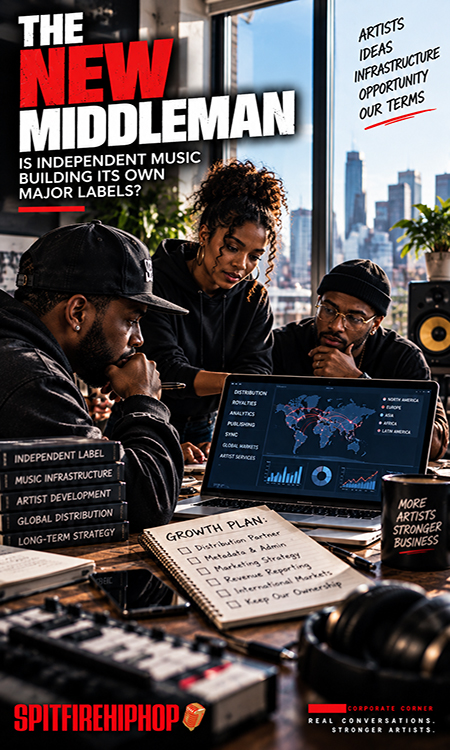
White-label technology adds another layer because the company providing the visible service may not own or operate every system behind it.
This is not inherently problematic. Similar arrangements exist throughout modern commerce, from online payment processing to cloud computing. Businesses routinely depend on specialized technology companies to perform functions that would be expensive or inefficient to build themselves.
The important distinction is between a service relationship that increases a company’s capabilities and one that gradually limits its options.
An independent label might retain ownership of every master recording while relying on an outside provider to manage its catalog information, distribution connections, royalty reporting, and administrative history. If those records can be exported accurately, agreements are transparent, and switching providers is commercially practical, the relationship may strengthen the label’s position.
If the company cannot retrieve essential data, faces unreasonable termination costs, or discovers that its operations are difficult to transfer elsewhere, the same arrangement can become restrictive.
The concern is not that outside services exist. It is that operational dependence can become a source of negotiating power.
This is where the new generation of independent music infrastructure providers will have to demonstrate that their business models offer something meaningfully different from the systems they are challenging.
Independence Is Becoming a Business Structure
For many years, independence in Hip-Hop was understood primarily as a question of whether an artist had signed with a major record label.
That definition became less useful as the industry developed more flexible commercial arrangements. Artists began entering distribution agreements, licensing partnerships, joint ventures, marketing agreements, and other relationships that did not necessarily require transferring ownership of their recordings.
A musician could work with a substantial company and still retain important rights. Another artist could remain technically unsigned while entering agreements that imposed significant financial or operational restrictions.
The label attached to a business relationship tells us less than the actual terms.
The same principle applies to the emerging infrastructure market.
A company describing itself as independent does not automatically guarantee that every customer retains meaningful control. Likewise, a service provider’s size does not establish that it behaves like a traditional major label.
The relevant questions concern ownership, contractual obligations, financial transparency, decision-making authority, and the ability to leave a relationship without unreasonable disruption.
Listen to Spit Fire Radio: www.spitfireradio.com
Supply Chain’s stated position is that independent businesses should be able to use enterprise-level infrastructure without giving up control over their catalogs, data, client relationships, or commercial choices. That is an important distinction in its public positioning, although the practical protections available to individual customers will ultimately depend on their agreements and the capabilities delivered.
For independent Hip-Hop entrepreneurs, this is a development worth studying.
Consider a producer who has spent years building relationships with artists and now wants to establish a small record label. The producer may have the creative expertise to assemble a compelling roster but lack the resources to hire experienced royalty administrators, software developers, and international licensing specialists.
Access to professional infrastructure could make the business more viable.
The producer could potentially focus on developing artists and establishing the label’s identity while relying on specialized providers for technical and administrative functions.
That is a different proposition from signing every artist to a traditional recording agreement simply because the label needs access to established industry systems.
It could allow more independent businesses to compete on their judgment, creativity, relationships, and service quality rather than their ability to finance expensive internal operations.
Still, access to the same technology does not make every company equally competitive.
A label must understand how to identify and develop talent, create demand, manage finances, and maintain credibility with artists. Infrastructure can improve execution, but it cannot substitute for sound business decisions.
The danger would be assuming that purchasing sophisticated services automatically creates a sophisticated music company.
The Consolidation Question
There is another reason the emergence of independent infrastructure providers matters.
The music industry continues to experience consolidation across distribution, rights management, and technology. One prominent example is Universal Music Group’s Virgin Music Group completing its acquisition of Downtown Music Holdings in February 2026, bringing businesses associated with Downtown’s operations into a major-label-owned organization.
Downtown’s portfolio included FUGA, a business-to-business music distribution technology company founded in Amsterdam.
This development illustrates why the ownership of infrastructure has become strategically important.
An independent label may not object to working with a company that has major-label ownership. Such partnerships can provide reliable services, substantial reach, and valuable expertise. But other businesses may prefer infrastructure supplied by companies outside the major-label system, particularly when the provider also has access to sensitive commercial information.
That concern should not be exaggerated into an assumption that major-label-owned technology providers necessarily misuse customer data or interfere with independent competitors. Such claims would require evidence.
The more reasonable point is that ownership and incentives deserve scrutiny when choosing a long-term business partner.
A distributor may possess information about an independent label’s sales, release schedules, commercial performance, and catalog activity. Contracts and operational safeguards determine how that information may be used, shared, or protected.
For some independent companies, knowing that their infrastructure provider is not owned by a direct competitor may be an important consideration. Others may place greater weight on service reliability, cost, geographic reach, or established commercial relationships.
There is no universal answer.
Supply Chain’s global expansion offers another option in a market where independent companies are evaluating how much of their operations they want to place within major-label-owned networks.
Competition among infrastructure providers could benefit independent music businesses by encouraging better technology, more transparent agreements, and improved service. Whether those benefits materialize will depend on how companies compete and how much choice customers retain.
A market containing several recognizable providers is not necessarily competitive if customers face significant barriers to switching between them.
For that reason, the next stage of independent music infrastructure should be evaluated not only by the number of companies offering services but also by the practical freedom available to the businesses using them.
What Independent Labels Should Examine Before Signing
For a small independent label, the excitement surrounding new technology can make it tempting to concentrate on the advertised capabilities rather than the underlying commercial arrangement.
A platform may promise international distribution, advanced reporting, simplified accounting, and greater efficiency. Those features are valuable only if they work reliably and fit the company’s actual needs.
Before entering an infrastructure agreement, an independent music business should understand several essential matters:
- Catalog and data control: Who owns the underlying information, and can complete records be exported in usable formats?
- Revenue and reporting: How are fees calculated, royalties reconciled, adjustments documented, and statements delivered?
- Contract flexibility: What happens when the agreement expires or the company decides to change providers?
- Operational accountability: Who handles delivery errors, disputed rights, incorrect metadata, missing payments, and technical failures?
- Commercial independence: Are there exclusivity provisions, restrictions on other partners, or obligations that affect future business decisions?
These are not accusations against Supply Chain or any other provider. They are fundamental due diligence questions that apply whenever a company entrusts important business functions to an outside organization.
A music entrepreneur should also consider whether the technology is appropriate for the company’s current scale.
A label releasing a handful of projects annually may not require the same infrastructure as a distributor managing thousands of recordings across several territories. Paying for unnecessary complexity can be just as damaging as operating without adequate systems.
The right partnership should solve identifiable business problems.
If royalty accounting consumes excessive administrative time, improved reporting may be valuable. If international delivery creates recurring problems, broader distribution capabilities may justify an investment. If the company already has reliable systems, changing providers simply because a new platform has attracted industry attention may offer little advantage.
Independent companies should approach infrastructure purchases with the same financial discipline they would apply to recording budgets, marketing expenditures, or staffing decisions.
Professional growth is not measured by the number of services a business purchases. It is measured by whether those services improve its ability to operate sustainably.
The Opportunity for Independent Hip-Hop
Hip-Hop has a long history of entrepreneurs recognizing opportunities that established music companies underestimated.
Independent labels, regional distributors, production companies, and artist-led businesses have repeatedly demonstrated that cultural understanding can become a competitive advantage when combined with disciplined commercial execution.
Many of those businesses began with limited resources and strong local relationships. Their founders understood their communities, knew which artists were connecting with listeners, and developed promotional methods suited to audiences that larger companies had not yet prioritized.
The challenge was often scaling those operations without surrendering the qualities that made them successful.
Modern infrastructure could help address that problem.
A regional Hip-Hop label might be able to maintain its identity while distributing music internationally. A producer-led company could potentially develop a roster without investing heavily in proprietary technology. An independent management business might offer additional services through carefully selected partners.
These possibilities deserve attention because they suggest a music industry with more room for specialized businesses.
But the opportunities should not be confused with guaranteed outcomes.
A company can acquire sophisticated technology and still fail because it does not understand its audience, spends beyond its means, or enters agreements it cannot sustain. Distribution capacity does not create listener demand, and administrative efficiency does not guarantee that an artist will develop a successful career.
The strongest independent companies will likely be those that combine professional infrastructure with genuine cultural expertise.
That combination has always mattered in Hip-Hop. The technology may be changing, but the importance of judgment, relationships, and trust has not disappeared.
Listen to Spit Fire Radio: www.spitfireradio.com
Is Independent Music Building Its Own Major Labels?
The answer depends on what we mean by a major label.
If the term refers strictly to the established multinational record companies and their corporate structures, then the expansion of independent infrastructure providers does not automatically create new major labels.
Supply Chain, for example, is positioning itself as a technology and services company rather than simply reproducing the conventional artist-signing model. Its business-to-business approach is structurally different from a record label whose primary commercial activity centers on acquiring or licensing recordings and developing artists.
But if we are talking about the functions that historically gave major labels their influence, the comparison becomes more interesting.
Independent companies are increasingly developing access to international distribution, rights administration, sophisticated technology, and commercial networks. They are assembling capabilities that once distinguished the largest organizations in the business.
Some will use those resources to provide artists with better alternatives. Others may eventually become powerful intermediaries in their own right.
There is no reason to assume that growth inevitably leads to exploitation. Equally, there is no reason to assume that a company remains aligned with independent creators simply because it began outside the major-label system.
The real test will come as these businesses expand, acquire customers, negotiate increasingly complex agreements, and make decisions that affect the livelihoods of the artists and companies depending on them.
Will they make their services easier to understand? Will customers retain meaningful control over their information and commercial relationships? Will independent labels have the ability to change providers without jeopardizing years of operational history? And will competition create better choices for smaller businesses rather than simply concentrating influence among a different group of companies?
Those questions matter more than the terminology used in promotional announcements.
Ghazi’s expansion of Supply Chain represents an important development because it addresses a legitimate need in independent music. Smaller businesses require dependable infrastructure if they intend to compete in a global market, and the ability to obtain those services without building everything internally can create real economic opportunity.
The broader significance, however, extends beyond one company.
Independent music is entering a period in which the business of supporting independent businesses may become as consequential as the business of signing artists.
That shift could produce a more diverse and competitive industry. It could also create new concentrations of power if the companies supplying essential services become difficult to replace.
For artists and entrepreneurs, the objective should not be to eliminate every intermediary. That would be neither practical nor desirable. The objective should be to build commercial relationships in which the value provided is clear, the terms are fair, and the people who create and own the music retain meaningful choices.
The independent music industry’s next chapter will not be determined solely by who owns the recordings. It will also be shaped by who operates the systems through which those recordings become businesses.
The next generation of music gatekeepers may not decide who gets a record deal. They may decide who has access to the infrastructure needed to compete without one.