


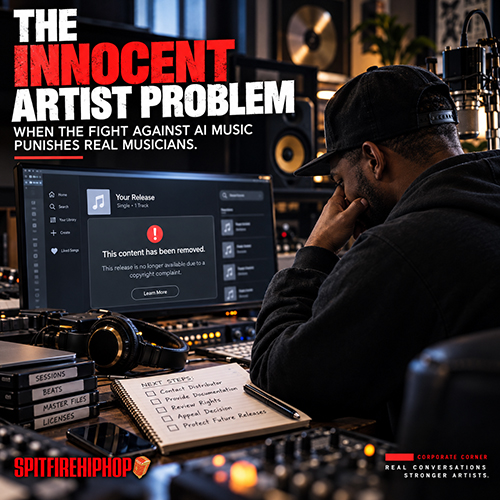
The Innocent Artist Problem: When the Fight Against AI Music Punishes Real Musicians
As the music industry intensifies its efforts to identify artificial intelligence-generated recordings and protect copyrighted works, independent artists face a troubling possibility: having legitimate music removed from distribution without a clear explanation or a meaningful opportunity to challenge the decision.
There is a particular kind of helplessness that comes with losing control of something you created. For an independent musician, a song represents more than a digital file delivered to a streaming service. It can be months of writing, recording, producing, revising, mixing, and mastering, followed by the considerable work required to introduce that recording to an audience. When the music finally reaches listeners, its availability becomes part of a larger professional commitment involving promotion, relationships, income, and reputation.
Now imagine discovering that the recording has disappeared from streaming platforms because someone has questioned whether it was made by a human being.
The artist may possess the original session files, remember every lyric written, and know exactly who played the instruments. None of that necessarily prevents a distributor or platform from restricting the recording while a dispute is investigated. More troubling is the possibility that the artist will have little understanding of the evidence behind the decision or how to establish that the recording is legitimate.
That scenario is no longer merely hypothetical. Reports surrounding a dispute involving Universal Music Group, music distributor DistroKid, and allegedly AI-generated recordings have raised questions about whether legitimate independent musicians are being caught in the music industry’s expanding enforcement efforts.
The underlying objective—protecting artists and rights holders from unauthorized copying, impersonation, and other abuses—is important. But an enforcement system cannot be judged solely by how aggressively it identifies suspicious material. It must also be judged by what happens when its decisions affect people who have done nothing wrong.
The central issue is not whether the music industry should fight fraudulent AI-generated recordings. It is whether that fight can be conducted without making legitimate musicians collateral damage.
Listen to Spit Fire Radio: www.spitfireradio.com
A Lawsuit That Reached Beyond the Courtroom
The controversy began with a legal challenge from Universal Music Group, one of the world’s largest music companies. In September 2026, UMG sued DistroKid, alleging that the distributor had facilitated the circulation of AI-generated recordings that infringed copyrights and diverted attention and revenue from legitimate artists and rights holders.
The lawsuit, filed in federal court in Delaware, accused DistroKid of copyright infringement and deceptive business practices. Those accusations remain allegations rather than established judicial findings, and the distinction matters. The outcome of the litigation cannot be presumed simply because a major rights holder has presented a serious complaint.
UMG’s concerns nevertheless reflect a real problem. Advances in generative AI have made it easier to produce convincing imitations of recognizable voices and styles, while automated distribution systems can move large quantities of recordings into digital music catalogs. Some of those recordings may be authorized experiments, while others can involve impersonation, infringement, misleading attribution, or efforts to manipulate streaming payments. Treating all AI-assisted music as equivalent would obscure these differences and make sensible enforcement more difficult.
DistroKid itself does not categorically prohibit music created with AI tools. Its published guidance permits such releases when the uploader has the necessary rights and the recording complies with rules against impersonation, infringement, and mass-generated spam. That policy is important because it demonstrates that the relevant questions concern authorization and conduct, not simply whether technology played some role in creating the recording.
The controversy became more complicated when reports emerged that DistroKid had removed recordings in response to UMG’s claims. In reporting published October 10, The Verge documented complaints from musicians who said their legitimate recordings had disappeared without advance notification. DistroKid confirmed that removals had occurred, although the company disputed UMG’s characterization of its business and described the number of affected recordings as small.
Among the musicians identified in the reporting was McGwire, who said six tracks had been removed, including material he maintained was properly licensed. Rapper Insane Ian also described the removal of an original recording, while King Chase reported the disappearance of an album. These accounts raise significant questions, but they should not be mistaken for independent verification that every removal was erroneous. Establishing the precise grounds for each decision would require access to the underlying complaints, licensing information, and distributor communications.
What is already apparent is the disparity between the parties involved. Universal Music Group can pursue its interests through extensive legal and administrative resources. DistroKid can make decisions across a substantial distribution network. The independent musician whose release is removed may have little more than an account dashboard, a support request, and personal records documenting how the music was created.
That imbalance becomes especially consequential when a distributor’s response to litigation changes the availability of recordings belonging to artists who are not parties to the lawsuit.
The Difference Between Suspicion and Proof
Copyright enforcement has always involved difficult judgments about ownership, authorization, and similarity. A recognizable sample may be properly licensed, a musical passage may resemble an earlier composition without infringing it, and a performer may possess written permission to use material that appears suspicious to someone unfamiliar with the arrangement.
Generative AI adds another layer of complexity because the technology can imitate characteristics traditionally associated with human performances. Yet an unfamiliar vocal texture, unusually polished production, or resemblance to a known artist is not sufficient by itself to establish that a recording was unlawfully generated. Even a determination that AI was involved would not automatically prove infringement.
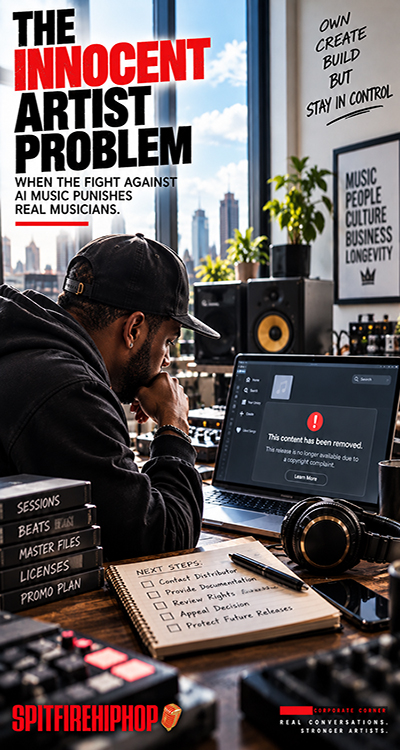
Consider an independent rapper who purchases an exclusive instrumental license, records original vocals, and releases a song through a distributor. The producer may have used digital instruments, sample libraries, pitch correction, or other sophisticated processing techniques. If the recording is challenged, the artist should be able to demonstrate the source of the instrumental, the terms of the license, and the creation of the vocal performance.
Those records may help resolve the dispute, but they do not guarantee that an artist will receive a timely opportunity to present them. An effective enforcement system therefore needs more than the ability to flag or remove material. It needs a process for evaluating competing evidence.
This is where the distinction between a temporary precaution and a final determination becomes important. A distributor may reasonably restrict access to a recording while investigating a credible infringement claim, particularly where continuing distribution could cause additional harm. But a temporary measure can become disproportionately damaging if the artist receives no meaningful explanation, no practical opportunity to respond, and no indication of when a decision will be reviewed.
The music industry must also recognize that evidence of a recording’s origin can take several forms. Original multitrack sessions, dated project files, studio invoices, licensing agreements, correspondence with collaborators, and earlier versions of a song can help establish its production history. None is necessarily conclusive on its own, and the appropriate evidence will vary with the allegation.
A fair system would identify the specific issue being investigated and give the artist a reasonable opportunity to supply relevant documentation. It would also distinguish a complaint about unauthorized sampling from an allegation of voice impersonation, fraudulent streaming activity, or deceptive AI-generated content. Those are different problems, and artists should not be expected to defend themselves against an undefined accusation.
Without that distinction, enforcement risks becoming a process in which the accusation is visible to the company making the decision but effectively invisible to the person suffering its consequences.
The Real Cost of a Missing Recording
A music takedown may appear to be a straightforward administrative action. A file is removed, a listing becomes unavailable, and the distributor’s system records a change in status. From the artist’s perspective, however, that same action can disrupt several interconnected activities.
An independent release is often supported by a campaign that begins weeks before the music becomes available. Artists schedule interviews, commission artwork, arrange video premieres, contact playlist curators, purchase advertising, and coordinate announcements with collaborators. Some invest personal savings or borrowed money into those activities, expecting listeners to find the recording on a particular date.
If the music disappears during that campaign, the immediate problem is not simply the loss of streams. Promotional links may stop functioning, advertising can direct listeners toward unavailable content, and journalists or DJs who intended to support the release may encounter an error instead of the recording. The artist then has to explain a disruption that may have occurred without warning.
The financial impact is difficult to quantify without access to the artist’s campaign records. A removal does not automatically establish lost royalties or permanent damage to audience growth. Nevertheless, it creates a foreseeable risk of wasted promotional spending, missed commercial opportunities, and additional administrative work.
For a developing Hip-Hop artist, the reputational consequences can be just as concerning. The independent music business relies heavily on trust between artists, producers, DJs, playlist curators, media outlets, and fans. When a recording suddenly disappears, observers may wonder whether the artist failed to clear a sample, violated a distribution policy, or engaged in some other questionable activity.
Those assumptions may be unfounded, but the absence of a clear explanation leaves room for speculation. A musician who has complied with licensing requirements can find themselves answering questions about misconduct they may never have committed.
This is particularly relevant to independent Hip-Hop, where sampling, collaboration, remixes, and unconventional production techniques are longstanding elements of the culture. The genre’s creative practices require careful distinctions between authorized reuse, original transformation, disputed rights, and actual infringement. A poorly explained enforcement action can collapse those distinctions into a general suspicion surrounding the artist.
A takedown also places an additional burden on musicians who already manage most aspects of their careers. Instead of writing, recording, rehearsing, or developing their next release, they may spend days trying to reach support personnel, reconstruct documentation, and determine what went wrong.
The practical cost of that diversion should not be underestimated. Independent artists rarely have dedicated legal, distribution, and rights-management departments. Their time is a limited business resource, and every hour spent navigating an opaque dispute is an hour unavailable for the work that sustains their careers.
Why the Industry Cannot Ignore AI Fraud
It would be a mistake to interpret these concerns as an argument against aggressive enforcement of legitimate copyright claims. The risks associated with unauthorized AI-generated recordings and streaming manipulation are substantial, and independent musicians have reasons to support efforts that protect the integrity of the music marketplace.
Sony Music, for example, has reported an escalating effort to remove unauthorized AI-generated imitations of prominent performers. According to an October 2026 Financial Times report, the company had requested the removal of more than 260,000 fake tracks by the end of September. The scale of those requests illustrates why major rights holders believe existing systems face significant pressure.
Streaming manipulation presents a related but distinct challenge. In a recently concluded federal criminal case, Michael Smith received an 18-month prison sentence for a scheme involving automated streams and large numbers of recordings, including AI-generated material. The case involved more than $8 million in fraudulent royalty proceeds, according to reporting on the sentencing.
Schemes of that kind can damage confidence in streaming metrics and divert money from legitimate participants in the market. Artists who build audiences through genuine listener engagement should not have to compete against automated systems designed to manufacture commercial activity.
At the same time, the existence of serious fraud does not justify treating every questionable recording as fraudulent. A policy designed to protect human creators must be capable of recognizing when a human creator has been incorrectly accused.
There is a meaningful difference between using AI to impersonate an established performer without authorization, using bots to manipulate royalty payments, and employing an AI-assisted production tool while creating an otherwise lawful recording. Enforcement that fails to recognize those distinctions can undermine the very creative community it claims to defend.
The industry’s challenge is therefore more demanding than simply removing suspicious material as quickly as possible. It must develop systems that are effective against bad actors while remaining sufficiently precise, transparent, and accountable to protect legitimate participants.
That requires investment not only in detection technology but also in human review, evidence handling, customer support, and reliable dispute-resolution procedures. These functions may be less visible than new AI detection tools, but they are essential to the credibility of the entire enforcement process.
Who Bears the Burden of a Mistake?
When a distributor receives a complaint alleging infringement, several competing interests come into play. The complainant wants potentially unlawful activity stopped. The distributor wants to comply with applicable law, protect its commercial relationships, and reduce legal exposure. Streaming platforms want to maintain trustworthy catalogs and avoid distributing infringing content.
The independent artist also has legitimate interests, but those interests can receive less attention when decisions are made under pressure.
This raises a fundamental question: Who should bear the burden of an incorrect enforcement decision?
An artist whose recording is removed may be expected to produce documentation, contact support, wait for review, and manage the consequences of the interruption. Meanwhile, the distributor may face little immediate obligation to explain the precise allegation publicly or provide an individualized account of its investigation.
That does not mean every distributor acts improperly or that every complaint should be disclosed in full. Certain investigations may involve confidential information, commercially sensitive records, or allegations that cannot be shared without compromising legitimate interests.
But confidentiality should not become a blanket justification for denying artists the information necessary to respond.
DistroKid publishes a process for submitting counterclaims when material is removed because of a copyright complaint. That process is significant, although the existence of a formal counter-notice mechanism does not establish that it applies to every type of removal or that it resolves every practical problem artists encounter. A DMCA counter-notice is a legal procedure with potential consequences and should not be treated as a routine customer-service form.
The broader issue is whether musicians have access to understandable procedures that correspond to the actual reason for removal. A copyright complaint, a suspected streaming-fraud violation, and a dispute over unauthorized AI voice imitation may require different evidence and different methods of review.
An artist should not have to guess which category applies.
There is also a distinction between having the legal right to challenge an action and possessing the practical ability to do so. A musician may technically have access to a counterclaim process while lacking the legal knowledge, financial resources, or supporting information needed to use it effectively.
For artists operating on narrow budgets, that gap can make formal rights considerably less useful than they appear on paper.
What Accountability Should Look Like
The solution is not to require distributors to guarantee that every release remains available regardless of credible legal complaints. Such a requirement would be unrealistic and could leave rights holders exposed to continuing infringement.
A more reasonable standard would focus on proportionality, documentation, and meaningful review.
When circumstances permit, artists should receive advance notice of a proposed removal. When immediate action is necessary, they should receive a prompt explanation afterward. The notice should identify the category of concern, explain what information can be provided, and direct the artist toward the appropriate response procedure.
Distributors should also distinguish between allegations and confirmed violations in their communications. A recording that has been removed pending investigation should not automatically be described in language suggesting that misconduct has already been established.
Where a dispute involves documentation that an artist can reasonably supply, there should be a practical way to submit that evidence and obtain an individualized review. Automated acknowledgments alone cannot resolve disagreements about licensing, authorship, or authorization.
Just as important, companies should establish reasonable expectations for response times and provide meaningful status updates when investigations extend beyond those periods. Not every dispute can be resolved quickly, but uncertainty should not be treated as an unavoidable feature of the process.
When a removal is determined to have been erroneous, restoration should be handled with attention to the consequences of the interruption. That includes examining whether previously available recordings can be reinstated without unnecessarily disrupting their identifiers, catalog information, and associated release history. The exact technical options will depend on the platforms and circumstances involved.
The industry could also benefit from greater transparency about enforcement outcomes. Aggregated reporting on removal categories, appeals, reversals, and review times would help artists and rights holders assess whether policies are working as intended, without requiring the disclosure of private case details.
These measures would not eliminate disputes or guarantee that every decision is correct. They would, however, make the system more accountable to the people whose livelihoods it affects.
What Independent Artists Can Do Before a Dispute
Artists should not be expected to solve structural problems created by distributors, platforms, or major rights holders. Still, there are practical steps that can improve their position if a release is questioned.
The first is maintaining reliable records of the creative process. Multitrack sessions, original recordings, dated project files, producer agreements, beat licenses, sample clearances, and collaborator correspondence should be stored securely and organized by release. These materials may become essential if an artist needs to demonstrate ownership or authorization.
Independent musicians should also read the distribution agreements and content policies governing their releases. Particular attention should be paid to removal rights, prohibited activities, royalty withholding, account termination, and dispute procedures. Terms can change, and artists should retain copies of relevant agreements when possible.
For collaborations, written documentation is especially important. Informal understandings may be common in independent Hip-Hop, but a clear agreement identifying contributors, permissions, ownership, and revenue arrangements can prevent uncertainty later.
Artists who receive a removal notice should preserve the communication, identify the affected recordings and their identifiers, and request the specific reason for the action. If the dispute concerns copyright, the appropriate response may differ from a streaming-fraud investigation or an alleged violation of a platform’s AI policy.
Where significant rights or revenue are at stake, consultation with a qualified music attorney may be appropriate before submitting a formal legal counter-notice.
These precautions cannot prevent every wrongful removal. Their value lies in making it easier to establish the facts when a dispute arises, rather than attempting to reconstruct the entire production history under pressure.
They also reinforce a principle that independent artists should already understand: professional documentation is not merely administrative paperwork. It is part of protecting creative work.
The Larger Question Facing Independent Music
The music industry is entering a period in which the authenticity and ownership of recordings will face increasingly complex scrutiny. AI-generated performances, synthetic voices, automated uploads, and streaming manipulation have introduced problems that existing enforcement systems were not necessarily designed to handle at their present scale.
Major labels have legitimate reasons to defend their catalogs. Distributors have legitimate reasons to investigate complaints and enforce their agreements. Streaming platforms have legitimate reasons to protect listeners and maintain trustworthy services.
Independent artists deserve equally serious consideration.
Their interests cannot be reduced to a secondary concern that matters only after companies have addressed their legal exposure. Musicians supply the creative work that gives the distribution system its value, and a system that cannot adequately distinguish legitimate creators from fraudulent activity risks damaging its own foundation.
The DistroKid controversy does not establish that every reported removal was improper, nor does it determine the merits of UMG’s lawsuit. What it does reveal is the importance of asking how enforcement decisions are made, what evidence supports them, and whether affected musicians have a realistic opportunity to challenge mistakes.
Those questions will become more important as AI technology develops and the pressure to police digital music catalogs increases.
The industry should resist the temptation to measure success exclusively by the number of recordings removed, complaints processed, or suspicious uploads blocked. Those figures may demonstrate enforcement activity, but they do not establish whether the process is fair or accurate.
A trustworthy system must also account for the legitimate recordings it preserves, the errors it corrects, and the musicians it protects from unjustified disruption.
For independent Hip-Hop artists, the stakes are immediate. A song can be the product of years of artistic development, a substantial financial investment, and the beginning of a relationship with listeners who may support the artist for decades. Its removal should never be treated as a trivial administrative matter.
The music business cannot defend human creativity by making human creators powerless in the process.
Protecting artists means more than removing fraudulent music. It also means protecting legitimate musicians from the consequences of getting that decision wrong.