

The Biggest Shift in Hip-Hop Isn’t Happening on the Charts
For decades, the music industry taught artists to think in terms of audience size. The goal was always bigger numbers.
More listeners.
More followers.
More streams.
More visibility.
Success was measured by how many people you could reach.
That philosophy shaped an entire generation of artist development. Labels chased mass appeal. Marketing campaigns focused on expanding reach. Social media transformed follower counts into status symbols. The assumption was simple: the bigger the audience, the stronger the career.
But something interesting is happening in 2026. A growing number of artists are beginning to realize that audience size and audience value are not the same thing.
The Difference Between an Audience and a Community
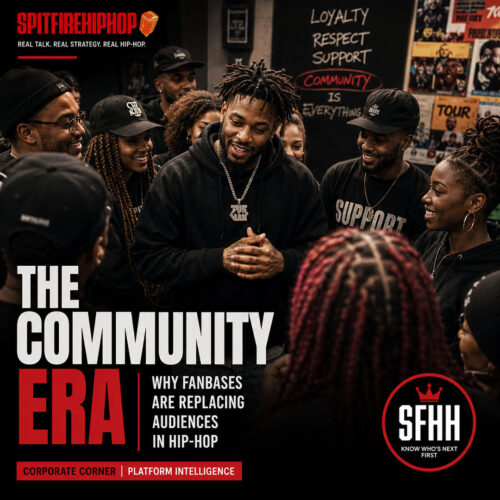
An audience consumes. A community participates. That distinction is becoming increasingly important.
An audience might stream a song once because it appeared on a playlist. They may watch a video because it landed in their feed. They may enjoy the content and then move on to the next artist within minutes.
A community behaves differently.
Communities talk to each other. They share content voluntarily. They attend events. They purchase merchandise. They defend artists during criticism. Most importantly, they remain connected even when the algorithm stops providing constant visibility.
For years, many artists focused almost exclusively on building audiences. Now they are starting to focus on building communities.
The Algorithm Accidentally Created This Shift
Ironically, the platforms that promised unlimited reach may have helped create the community era.
Algorithms trained artists to chase scale. Every platform encouraged creators to pursue larger audiences, more impressions, and higher engagement numbers. For a while, those metrics appeared to represent success.
But many artists eventually discovered a frustrating truth. Millions of views do not automatically translate into sustainable careers.
An artist can generate enormous attention and still struggle to sell tickets, merchandise, or exclusive experiences. Visibility creates opportunities, but it does not guarantee loyalty. That realization forced many artists to rethink their priorities.
Instead of asking:
How many people saw this?
They started asking:
How many people actually care?
Why Superfans Matter More Than Ever
One dedicated supporter often creates more value than dozens of casual listeners. That idea sounds simple, but it completely changes how artists approach growth.
The most successful independent artists increasingly understand that sustainable careers are built through depth rather than width. They focus on creating meaningful relationships with supporters instead of constantly chasing larger audiences.
A fan who feels connected to an artist is more likely to:
- attend shows
- purchase merchandise
- support special releases
- introduce friends to the music
Those actions create stability. And stability has become increasingly valuable in a culture driven by constant change.
Listen to Spit Fire Radio: www.spitfireradio.com
Hip-Hop Is Becoming More Interactive
The community era is also changing how fans engage with artists. In previous generations, fans mostly consumed content. The relationship was one-directional. Artists created, and audiences received.
Today, fans expect participation.
They want access.
They want interaction.
They want to feel included in the journey.
This is why communities built around:
- Discord servers
- livestreams
- private groups
- direct messaging platforms
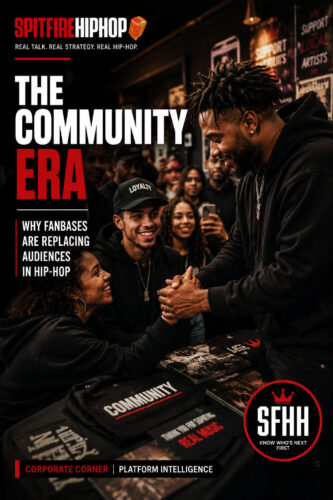
continue growing in importance. Fans no longer want to simply support artists. They want to belong.
The Independent Artist Advantage
This shift strongly favors independent artists. Large corporations are excellent at scaling audiences. They have marketing budgets, advertising resources, and distribution networks designed to maximize reach. Communities work differently.
Communities are built through trust, consistency, and direct relationships. Those qualities often develop more naturally when artists maintain close connections with supporters.
Independent artists can respond directly. They can create personal experiences. They can build cultures around their music instead of simply promoting products. That ability may become one of the most important competitive advantages in modern Hip-Hop.
The Corporate Corner Perspective
The community era represents a fundamental change in how influence is measured. For years, the industry prioritized attention. Now loyalty is becoming equally important. Artists are discovering that sustainable careers often come from building ecosystems rather than chasing moments. A strong community provides resilience when algorithms change, trends shift, or attention moves elsewhere.
Communities create something audiences rarely provide:
Durability.
The artists who thrive in the next decade may not be the artists with the largest reach. They may be the artists whose supporters feel the strongest sense of belonging.
The Future Belongs to Connected Artists
Hip-Hop has always been rooted in community. The culture itself was built through neighborhoods, local scenes, shared experiences, and collective participation. In many ways, what we are seeing now is not entirely new.
It is a return.
Technology has simply given artists new tools to build the same type of connection that helped create Hip-Hop in the first place. The difference is that communities can now exist globally.
A supporter in Austin can connect with a supporter in London. Fans can build relationships around artists without ever meeting in person. Shared identity has become more powerful than geography.
That changes everything.
Final Thoughts
The attention economy taught artists how to get noticed. The trust economy taught them how to earn loyalty. The community era may teach them how to build something that lasts. Because in the end, audiences listen. Communities stay. And in an industry where attention disappears quickly, staying power may be the most valuable asset of all.