

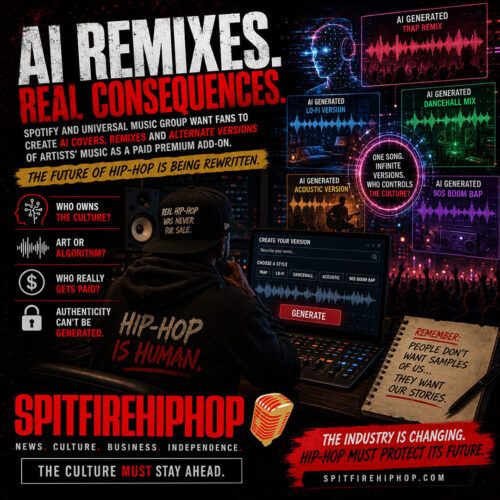
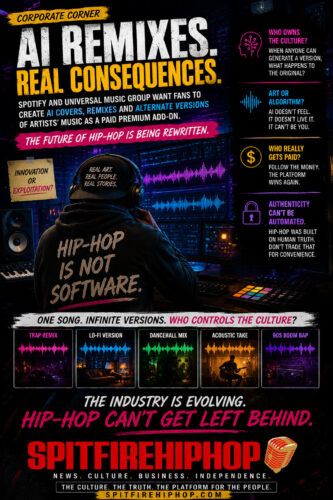
Spotify and Universal Music Group just announced something that could permanently reshape how people experience music. The two companies revealed a new licensing agreement that will allow Spotify users to create AI-generated covers and remixes using songs from participating artists. The feature is expected to launch as a paid add-on for Spotify Premium subscribers.
At first glance, the concept sounds futuristic, interactive, and even creative. Fans will reportedly be able to generate alternate versions of songs, create remixes, and experiment with different musical styles while the original artists and songwriters receive royalties from the AI-generated content. Spotify executives are framing the initiative around “consent, credit, and compensation,” while Universal Music Group is calling the system “artist-centric” and “responsible AI.”
But beneath the polished corporate language sits a much larger question:
What happens to Hip-Hop when songs stop being finished works of art and become endlessly editable digital products?
That question matters because Hip-Hop has never been just music. Hip-Hop is identity. It is regional culture, lived experience, delivery, emotion, pain, confidence, storytelling, and originality. The voice itself matters. The imperfections matter. The humanity matters.
This new AI remix model threatens to fundamentally change the relationship between artists and listeners.
For decades, fans consumed music as an artist’s final vision. Whether people loved or hated an album, there was an understanding that the record represented a specific moment in time. A beat selection. A vocal take. A creative decision. A finished statement.
Now imagine a future where listeners can turn:
- a Griselda record into a dance remix,
- a Kendrick Lamar-style track into an EDM anthem,
- or a soulful underground record into an AI-generated trap version with a few prompts and clicks.
That is no longer fan interpretation. That is algorithmic reconstruction.
And the deeper the industry moves into this territory, the more the line between artist and software begins to blur.
Spotify and Universal Music Group are not doing this accidentally. This is a strategic business move designed to unlock new forms of monetization and fan engagement.
From a corporate perspective, the model is extremely attractive:
- more subscription upgrades,
- more platform engagement,
- more user-generated content,
- more data collection,
- and more revenue extracted from existing catalogs without requiring entirely new recordings.
The economics are obvious.
Instead of relying solely on artists to continuously produce new material, streaming platforms can now transform old songs into endlessly renewable assets.
That changes the entire business model of streaming.
The concern for Hip-Hop is that the culture has historically resisted artificiality. Hip-Hop audiences value authenticity differently than many other genres. Fans debate realness, originality, ghostwriting, production quality, regional identity, and lyrical credibility constantly. Those conversations exist because Hip-Hop culture has always attached value to human perspective.
AI-generated reinterpretations complicate that foundation.
Supporters of the new system will argue that remix culture has always existed in Hip-Hop. DJs extended breaks. Producers sampled records. Mixtape culture flipped classics into something entirely new. Chopped-and-screwed music transformed records into different experiences. Remixing itself is not new.
But there is a difference between human reinterpretation and machine-generated personalization at industrial scale.
Traditional remix culture required:
- human taste,
- technical skill,
- crate digging,
- production knowledge,
- DJ experience,
- musical instinct,
- and creative risk.
AI-generated remix systems remove much of that process and replace it with automation.
That distinction matters.
Because eventually the listener stops asking:
“What did the artist create?”
And starts asking:
“What version do I want the AI to generate for me?”
That is an entirely different relationship with music.
Independent artists should be paying especially close attention.
Major labels already dominate playlists, recommendation systems, advertising partnerships, and algorithmic discovery. If AI remix tools become integrated directly into streaming ecosystems, superstar catalogs could become even more dominant because fans will continuously generate alternate versions of already-popular records.
The rich catalogs could become richer.
Meanwhile, independent artists may struggle even harder for visibility in a marketplace flooded with AI-assisted variations of mainstream music.
Producers also face a potentially dangerous future.
Hip-Hop producers are not simply beat-makers. They create atmosphere, tension, bounce, rhythm, emotion, and sonic identity. But if AI tools can rapidly alter tempos, instrumentation, moods, or arrangements, the industry may slowly begin treating production itself as something infinitely adjustable instead of a crafted art form.
That could commoditize creativity in ways many people are not fully considering yet.
The timing of this announcement also matters.
Over the last year, the music industry has aggressively moved toward AI partnerships. Universal Music Group previously announced collaborations involving AI music development tools and “responsible AI” initiatives with major technology partners.
At the same time, platforms are already struggling with floods of AI-generated content. Reports have shown major streaming services battling spam uploads, fake artists, and unauthorized AI remixes that generate millions of plays online.
That means the industry is simultaneously:
- trying to monetize AI,
- trying to control AI,
- and trying to protect itself from AI.
Those goals do not always align.
Spotify says participating artists will have the ability to opt in or opt out of the remix ecosystem.
But history shows that once the music industry identifies a scalable revenue stream, pressure eventually follows. Artists may soon face label expectations to participate in AI systems because the financial incentives become too large to ignore.
That possibility is where many cultural concerns begin.
Because Hip-Hop has already spent years fighting battles around:
- unfair streaming payouts,
- catalog exploitation,
- algorithmic suppression,
- ownership rights,
- and corporate influence over discovery.
Now the culture may be entering another phase where technology companies redefine how music itself is consumed.
To be clear, there are potential positives.
If handled ethically, AI remix systems could:
- create new revenue streams for artists,
- allow fans to interact with music creatively,
- strengthen independent artist communities,
- and expand remix culture into new spaces.
Some artists may genuinely embrace it.
Others will likely reject it completely.
But regardless of which side people take, one reality is becoming impossible to ignore:
The streaming era is evolving from passive listening into interactive music manipulation.
And Hip-Hop may be the genre most affected by that transformation because no major genre places a higher premium on human authenticity than rap music.
The music industry keeps presenting AI as a tool that will bring artists and fans closer together.
The real question is whether this technology deepens artistic connection — or slowly turns artists into customizable software products.
That answer could define the next decade of Hip-Hop.