
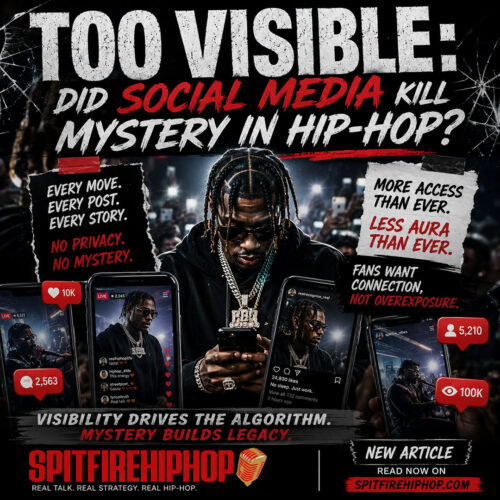
Hip-Hop artists are more accessible than ever before. Livestreams, stories, daily posts, and nonstop content have erased the distance between artists and fans. But as visibility increases, many fans are beginning to wonder if social media has destroyed the mystery that once made Hip-Hop feel larger than life.
Hip-Hop Used to Feel Larger Than Life
There was a time when Hip-Hop artists felt untouchable.
Fans didn’t know what artists were doing every hour of the day. You learned about them through music videos, album covers, radio interviews, magazines, and rare public appearances. If an artist disappeared for six months, the anticipation only grew stronger. Mystery was part of the culture.
That distance created aura.
Artists felt bigger because fans didn’t have unlimited access to them. The imagination filled in the gaps. A rapper could walk into an interview once a month and dominate the conversation because people hadn’t already seen 40 clips of them that week.
Today, that dynamic has completely changed.
The Feed Never Stops
Modern artists live inside the algorithm now.
Fans see:
- livestreams
- backstage clips
- arguments
- shopping trips
- studio sessions
- random thoughts posted at 3 a.m.
Social media erased the wall between artists and audiences. Platforms reward constant activity, which means visibility itself became part of the job description.
The problem is that nonstop visibility changes perception.
When artists are available all the time, they stop feeling rare. The audience no longer waits for moments because moments are happening every hour.
Hip-Hop shifted from:
event culture
to:
access culture
And many fans are beginning to feel the difference.
Content Culture Changed Artist Behavior
The pressure to stay visible has completely changed how artists operate.
In previous eras, artists focused primarily on:
- music
- performances
- interviews
- major appearances
Now, artists are expected to become full-time content creators.
The algorithm rewards:
- daily posting
- engagement frequency
- instant reactions
- constant updates
That system creates an environment where disappearing—even briefly—can hurt momentum.
As a result, artists often feel forced to share more than they actually want to.
Not because it helps the art…
but because it feeds the machine.
When Oversharing Kills Aura
Mystique has always been one of the most powerful elements in entertainment.
The less audiences know, the more curiosity grows.
But in today’s environment, overexposure can flatten perception. When fans constantly see artists online, the emotional distance that once created fascination disappears.
The artist no longer feels mythic.
They feel familiar.
And familiarity changes how fans consume the music itself.
Songs become content updates instead of moments.
Listen to Spit Fire Radio: www.spitfireradio.com
Fans Still Want Authenticity — But Not Constant Access
Interestingly, this doesn’t mean fans want artists to become robots or disappear entirely.
Modern audiences still connect deeply with:
- honesty
- personality
- vulnerability
- transparency
But there is a growing difference between:
connection
and
overexposure
Fans want artists to feel real—but they still want them to feel important.
That balance is becoming harder to maintain in a culture built around nonstop posting.
Why Some Artists Still Feel Iconic
Some artists still manage to maintain mystery in the social media era.
Why?
Because they control access intentionally.
They:
- disappear strategically
- avoid oversharing
- make appearances feel meaningful
- create anticipation naturally
In a world where everybody is constantly visible, restraint itself becomes powerful branding.
Scarcity still creates value.
The Corporate Corner Perspective
This is bigger than social media habits.
It’s about branding psychology.
Mystique creates:
- anticipation
- replay value
- emotional investment
- cultural longevity
Overexposure can create short-term engagement, but it can also weaken long-term fascination.
The artists who thrive in the next era may not be the loudest or most visible.
They may be the ones who understand when to pull back.
Hip-Hop’s New Identity Crisis
Hip-Hop now faces a strange contradiction.
Artists are expected to:
- feel authentic
- stay visible
- feed the algorithm
- remain culturally relevant
…all at the same time.
But sometimes those goals conflict with each other.
Because the more accessible artists become, the harder it becomes for them to feel larger than life.
And Hip-Hop has always depended on larger-than-life energy.
Final Thoughts
Social media gave fans more access than ever before.
But access changes value.
When everything is visible all the time, nothing feels rare anymore.
The future of Hip-Hop may belong to artists who understand something the algorithm doesn’t:
Sometimes mystery is part of the art.