


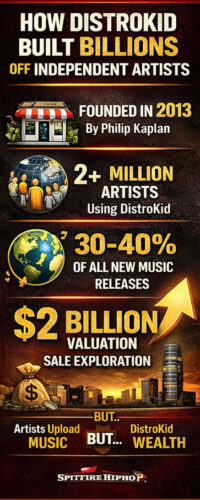
The music business is full of stories about artists chasing value, but every now and then, a story surfaces that reminds everyone where the real money has been going all along. DistroKid’s reported exploration of a sale at around $2 billion is one of those stories. As reported in January 2026, the company has been working with Goldman Sachs and Raine while exploring a potential sale, with the figure being discussed around the industry at roughly $2 billion. That matters because DistroKid was already valued at $1.3 billion in 2021, which means the market has continued to see enormous value in the infrastructure serving independent musicians.

For independent Hip-Hop artists, this headline should not be treated like distant business news. It should be read as a warning, a lesson, and an opportunity. DistroKid did not become a billion-dollar company by making music. It became a billion-dollar company by building a system that sits between artists and the platforms where their music is heard. The uploads, subscriptions, release volume, and long-tail catalogs supplied by independent artists helped turn distribution into a highly valuable business. That does not mean artists were tricked. DistroKid offered a service the market wanted. But it does mean artists should pay attention to who is building equity from the independent grind—and who is not.
To be precise, DistroKid is a private company, so its exact current cap table is not fully public. What is public is that Philip Kaplan founded DistroKid, Spotify disclosed in 2018 that it made a passive minority investment in the company, Silversmith Capital Partners led DistroKid’s first outside investment in 2018, and said in 2021 that it would retain a meaningful ownership position, and Insight Partners announced a substantial investment in 2021 that valued the company at $1.3 billion. So when we talk about who owns DistroKid, the safest factual answer is that the company was founded by Kaplan and has backing from investors including Spotify, Silversmith, and Insight Partners, while the exact ownership percentages are not publicly disclosed in the reporting I could verify.
The origin story matters too. DistroKid officially launched in 2013 under Philip Kaplan with a model built around a simple pitch: artists could upload unlimited music for a flat yearly fee and keep 100% of their royalties. That offer landed at the right time. Independent artists wanted faster access to Spotify, Apple Music, and other digital stores without old-school gatekeeping or paying per-release costs every time they dropped a track. The company’s appeal was speed, simplicity, and affordability. In other words, DistroKid understood that the independent market was massive before much of the wider industry fully respected it.
That is why this moment should hit artists differently. DistroKid’s wealth was not built from one superstar catalog or one label deal. It was built from scale. It was built from thousands upon thousands of artists paying recurring fees, uploading songs, releasing albums, experimenting, failing, winning, and staying active. DistroKid’s own marketing says millions of musicians rely on the service, while the 2021 investment announcement said more than 2 million artists used its tools and services. The company offering distribution may not own artists’ music, but it absolutely built enterprise value from artists’ activity, consistency, and need for access.
That distinction is the heart of the article. DistroKid’s support materials state that it does not take ownership or intellectual property rights from artists and that artists keep 100% ownership of the music they upload. That is an important point, and it should be acknowledged clearly. But ownership on paper is only one part of the conversation. The deeper issue is leverage. A platform can leave your copyright with you and still become enormously wealthy by monetizing the traffic, scale, behavior, and dependency of the artist community it serves. That is the bigger lesson here for independent Hip-Hop. Keeping your masters matters, but so does having a plan for how those masters create long-term value outside the platform that helped deliver them.
This is where independent artists need to think harder about an exit strategy for their IP. Too many artists hear “keep 100% of your royalties” and stop their business thinking there. But ownership without strategy is underused power. If your catalog lives on platforms you do not control, and your audience primarily engages through systems you do not own, then your music may be legally yours while much of the surrounding leverage belongs to somebody else. The platform can be sold. The investor can cash out. The company can change direction. The artist who supplied the raw fuel for all that growth is often still trying to figure out how to turn songs into durable assets. The DistroKid story should push artists to stop thinking only about distribution and start thinking about monetization, licensing, direct audience relationships, and future transfer value.
Listen to Spit Fire Radio: www.spitfireradio.com
A real exit strategy for an independent artist does not mean planning to disappear. It means planning for your catalog to work like property. It means understanding what happens if you want to move distributors, license records for film and TV, bundle rights for a partnership, sell a portion of your catalog later, or pass the business side of your music to a manager, family member, or company. It also means reducing overdependence on any single platform. When a distribution company can command a multi-billion-dollar sale conversation, that is proof the infrastructure side of music has serious market value. Artists should take that as a sign to organize their own business with the same seriousness.
There is also a cultural layer here that Hip-Hop especially should not ignore. Independent artists helped prove that the middleman era was changing. They embraced digital distribution, normalized direct release models, and trained audiences to accept a world where artists could move without waiting for label permission. That spirit helped companies like DistroKid rise. But if artists stop at access and never build systems around ownership, then the freedom they fought for can still end up enriching everyone around them more than it enriches them. That is not anti-DistroKid commentary. It is a pro-artist strategy.
Independent artists should not read this story as “don’t use DistroKid.” That would be too simplistic. The smarter takeaway is this: use platforms, but do not build your future as if the platform is your future. The platform is a tool. Your IP is the business. Your audience is the moat. Your catalog is the asset. Your data, email list, website, publishing setup, and licensing readiness are what start to turn songs into something investors would actually respect as enterprise value. DistroKid’s possible $2 billion outcome is not just a company story. It is a mirror. It shows artists what infrastructure built on independent volume can become. The next question is whether artists are building anything with that same long-term discipline for themselves.
What artists should take from this
- Keep your masters, but also build a real business around them.
- Do not rely on one distributor as your only connection to the market.
- Treat your catalog like an asset that may need to be licensed, transferred, defended, or monetized later.
- Build direct-to-fan channels so your audience is not trapped inside someone else’s system.
- Have a plan for what happens to your music business if a platform changes, sells, or loses relevance.
DistroKid’s reported $2 billion sale talks should be one of the loudest business lessons independent artists hear all year. A company founded in 2013 around a flat-fee distribution model is now being discussed like a major asset because it positioned itself at the center of the independent music economy. That did not happen without artists. Independent musicians helped create the usage, volume, and recurring revenue that made the business so valuable.
The real challenge now is whether artists will learn the right lesson from it. The goal is not just to upload faster. The goal is not just to keep ownership on paper. The goal is to build enough structure around your music that your IP can create leverage no matter what happens to the platform layer. That is the difference between participating in the system and actually building wealth from your art. And if this DistroKid moment tells us anything, it is that the infrastructure around independent music is extremely valuable. Artists need to start acting like their side of the business can be, too.