



Introduction: Why Hip-Hop Never “Dies”
Every generation produces a version of the same argument: Hip-Hop isn’t what it used to be.
What’s often missing from that argument is history.
Hip-Hop has never been static. It has always been a response to pressure, economic pressure, technological pressure, social pressure, and cultural pressure. Each time the rules changed, Hip-Hop changed with them. That adaptability is not a flaw. It is the culture’s defining feature.
To understand where Hip-Hop is going, you have to understand how it has reinvented itself repeatedly over the last five decades.
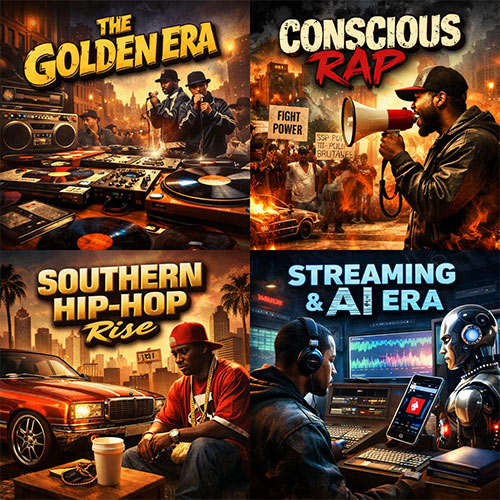
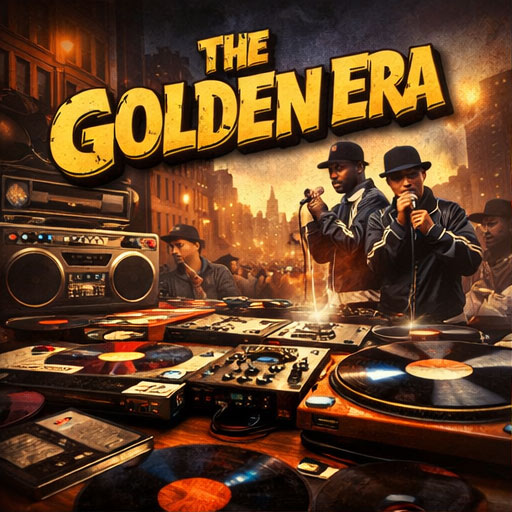
The Golden Era (Mid-1980s to Early-1990s): Skill as Proof of Legitimacy
The Golden Era wasn’t simply a stylistic peak; it was Hip-Hop’s first formal value system.
During this period, credibility was earned through:
- Lyric complexity and originality
- Battle readiness and competitive excellence
- Distinct regional voices
- Producer-MC chemistry built on innovation
Sampling technology allowed artists to reconstruct Black musical history into something new, while limitations in equipment forced creativity. There was no algorithmic safety net. If your records didn’t move people, they didn’t move at all.
Importantly, this era established something crucial: Hip-Hop rewarded mastery. The audience expected progression, growth, and originality. That expectation would later clash with commercial and technological shifts.
Conscious Rap & Cultural Documentation: Hip-Hop as Historical Record
As Hip-Hop gained national visibility, it also gained responsibility.
Conscious and politically charged rap did not emerge as a trend, it emerged as a necessity. Artists chronicled:
- Policing and surveillance
- Urban divestment
- Mass incarceration
- Systemic inequality
This wasn’t abstract commentary. It was first-hand reporting. Hip-Hop became one of the most detailed cultural archives of late-20th-century urban America.
This era proved Hip-Hop could carry intellectual weight without sacrificing cultural relevance. It also reinforced the idea that Hip-Hop wasn’t just entertainment—it was evidence.
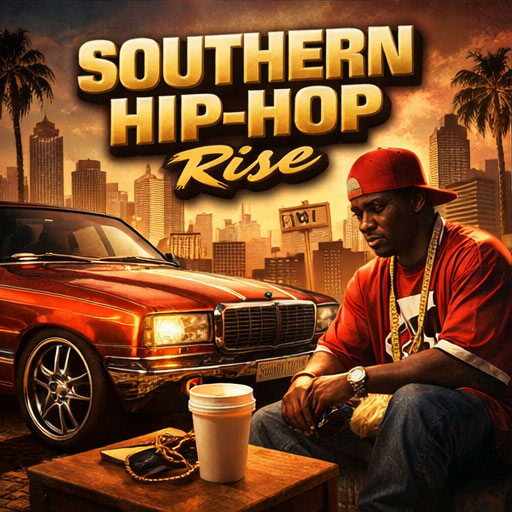
The Southern Shift (Mid-1990s to 2000s): Geography Loses Its Grip
For years, Hip-Hop power was concentrated in a few cities. The Southern explosion dismantled that structure.
Southern artists didn’t just introduce new sounds—they introduced new business logic:
- Independent distribution before it was fashionable
- Artist-owned labels
- Local scenes scaled nationally
- Regional authenticity without coastal approval
This was a major turning point. Hip-Hop stopped orbiting around a single center and became multipolar. The culture expanded, not diluted.
What mattered wasn’t where you were from; it was whether you could build momentum.
The Internet & Mixtape Era (Mid-2000s to Early-2010s): Gatekeepers Collapse
The internet didn’t change Hip-Hop overnight; it slowly eroded control.
Mixtapes, blogs, file-sharing, and early social platforms shifted discovery away from labels and toward listeners. Artists could now:
- Release music directly to fans
- Build audiences before deals
- Test sounds in real time
- Control narrative without media intermediaries
This era created a new truth: access no longer required permission.
But it also introduced oversaturation. For the first time, being talented was no longer enough—you had to be discoverable.
The Streaming Era (2010s–Present): Music Becomes Data
Streaming platforms transformed Hip-Hop into a numbers-driven economy.
Songs are now evaluated by:
- Skip rates
- Completion rates
- Playlist placement
- Algorithmic momentum
While access expanded globally, compensation shrank dramatically. Artists gained visibility but lost leverage. One million streams sounded impressive—until artists realized what it actually paid.
This era exposed a critical imbalance:
- Platforms scaled infinitely
- Artists competed infinitely
- Revenue concentrated narrowly
Hip-Hop didn’t fail in this system, it adapted. Artists diversified income, leaned into branding, touring, merch, and community-driven models. The culture shifted from record sales to ecosystem building.
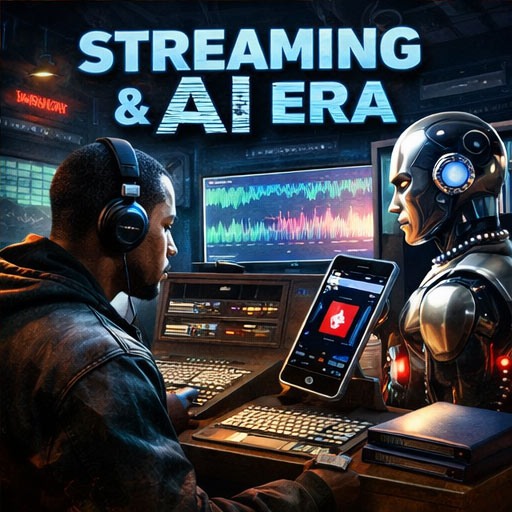
The AI Era (2020s– ): Tools, Ownership, and the Next Power Struggle
AI is not Hip-Hop’s first technological disruption, and it won’t be the last.
Drum machines were once criticized. Samplers were once called theft. Digital workstations were once seen as shortcuts. Each tool eventually became normalized.
AI raises a different question, not about creativity, but control.
Who owns:
- Training data?
- Vocal likenesses?
- Creative direction?
- Monetization pathways?
Used ethically, AI can lower barriers and expand creative capacity. Used extractively, it risks repeating the same power imbalances Hip-Hop has faced for decades.
History suggests one outcome: the culture will adapt—but only after redefining its standards.
Reinvention Is Hip-Hop’s Core Skill
Hip-Hop did not move from the Golden Era to the Streaming Era by losing itself.
It survived by changing form without changing purpose.
Each era:
- Responded to new pressure
- Redefined success
- Shifted power—sometimes forward, sometimes backward
The artists who last are not the ones who resist change, but the ones who understand it faster than everyone else.
Hip-Hop’s next chapter will not belong to nostalgia or automation.
It will belong to creators who understand that reinvention is not betrayal.
It is tradition.




Pingback: Gene Simmons Is Wrong: 50 Years of Hip-Hop Proves It Belongs in the Rock & Roll Hall of Fame – SpitFireHipHop.com