




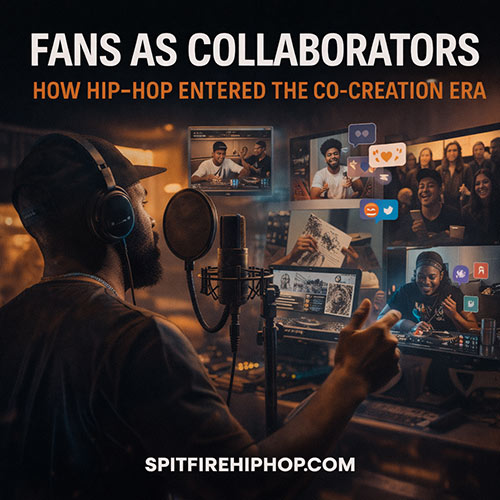
Hip-Hop has always been interactive, but something has shifted. Fans aren’t just listening anymore — they’re shaping visuals, influencing releases, and extending records in real time. Welcome to the co-creation era, where community is no longer optional.
From Audience to Architecture
For most of Hip-Hop history, fans reacted after the art was finished. Today, they’re influencing the process while it’s still unfolding. Comment sections, remix challenges, Discord servers, and livestreams are shaping creative decisions before a song even hits DSPs.
This isn’t marketing gimmickry. It’s a structural change. Artists are discovering that momentum built with fans lasts longer than hype built at fans.
Why Co-Creation Works Better Than Traditional Rollouts
When fans contribute, even indirectly, their emotional investment multiplies. A listener who helps choose cover art, suggests a hook variation, or inspires a remix becomes an advocate, not just a consumer.
That advocacy shows up as:
- Higher repeat streams
- Organic social sharing
- Deeper loyalty during quiet release cycles
Hip-Hop didn’t invent this behavior, but it’s perfect for it. The culture has always thrived on response, reinterpretation, and call-and-response energy.
The Tools That Changed Everything
Technology didn’t replace creativity; it expanded the room.
Artists are using:
- Short-form video feedback loops
- Fan-run remix culture
- Private communities (group chats, email lists, Discords)
- Live reactions and listening sessions
Instead of guessing what will connect, artists now watch it connect in real time.
Platforms like Spit Fire Radio (www.myksfr.com) amplify this dynamic by giving artists and listeners shared space — not just passive airplay.
Independent Artists Benefit the Most
For independent artists, co-creation isn’t a trend — it’s leverage.
Without label budgets, fan participation becomes:
- A distribution engine
- A feedback system
- A trust signal
Artists who invite fans into the journey don’t have to chase algorithms as aggressively. Their audience does the work with them.
This is how indie records outperform expectations without mainstream infrastructure.
The Line That Shouldn’t Be Crossed
Co-creation doesn’t mean surrendering authorship.
The healthiest artists maintain boundaries:
- Fans influence direction, not ownership
- Participation doesn’t replace vision
- Feedback informs — it doesn’t dictate
The goal isn’t democracy. It’s dialogue.
Artists who confuse the two risk losing identity, which is why this article follows Who Owns the Sound? — Collaboration works best when identity is already protected.
What This Signals for Hip-Hop’s Future
Hip-Hop is shifting from broadcast culture to community culture.
Expect:
- Longer life cycles for records
- Smaller but more committed fanbases
- More artist-led ecosystems instead of platform-dependent fame
The next generation of successful artists won’t just drop music. They’ll build spaces.
SpitFireHipHop Intelligence Note
Hip-Hop has never been one-directional. The difference now is intentionality. Artists who treat fans as collaborators — not commodities — are building legacies that outlast trends.
At SpitFireHipHop, we don’t just watch the culture evolve. We break down how and why it’s changing.


Pingback: Algorithm-Proof Artist: Why Reach Doesn’t Equal Control – SpitFireHipHop.com