

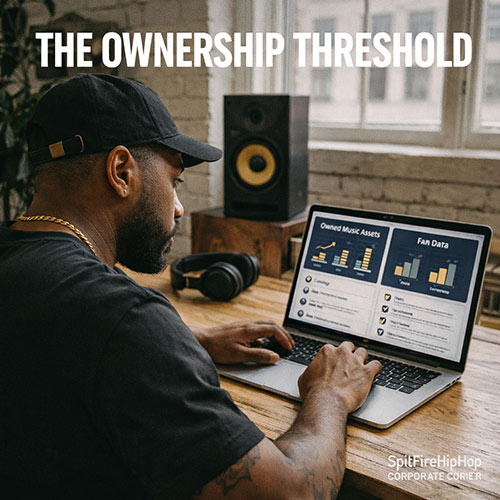
Every artist talks about ownership. Few understand when it actually begins. Ownership isn’t a contract clause or a buzzword—it’s a threshold. Once crossed, artists stop asking for permission, stop rushing decisions, and start controlling their future.
What the Ownership Threshold Really Is
The ownership threshold is the point where an artist’s career no longer depends on outside approval to function. It’s when momentum, income, and access are self-sustaining. Artists above this line can decline offers without fear. Artists below it feel constant pressure to say yes.
Ownership is not binary. It’s not “signed” or “unsigned.” It’s a functional state, defined by whether your career continues even when nobody co-signs you.
Why Most Artists Never Reach It
Artists often believe ownership arrives after success. In reality, ownership must be built before leverage matures. Those who wait usually trade it away to maintain momentum.
The most common blockers:
- relying on platforms for reach
- relying on labels for capital
- relying on distributors for visibility
- relying on virality for growth
Reliance delays ownership.
What Actually Constitutes Ownership in 2025
Ownership today is broader than masters and publishing. True ownership exists when an artist controls the systems that move their career forward.
That includes:
- masters and publishing
- release schedules
- catalog direction
- fan communication channels
- monetization pathways
- brand narrative
Control across systems is what turns assets into power.
Why Masters Alone Don’t Equal Freedom
Owning masters without infrastructure still leaves artists vulnerable. If distribution, discovery, and revenue are controlled elsewhere, ownership is symbolic, not functional.
True freedom comes when masters are paired with:
- direct fan access
- diversified income
- catalog density
- consistent retention
Without these, ownership has no leverage.
The Invisible Line Artists Cross
The threshold isn’t announced. It’s felt.
Artists cross it when:
- revenue continues between releases
- fans follow the artist, not just the song
- older music still earns
- offers become optional
- urgency disappears
This is when careers calm down, and power shows up.
Why Ownership Changes Negotiations Instantly
Industry conversations shift dramatically once an artist doesn’t need the deal.
Ownership flips leverage because:
- timelines slow down
- terms improve
- equity becomes negotiable
- advances stop being the focus
- long-term value enters the room
When walking away is real, negotiation becomes strategic.
Why Labels Respect Ownership More Than Buzz
Buzz is temporary. Ownership is permanent.
Labels understand that artists who control assets can’t be exploited easily. That’s why deals increasingly target catalog slices, participation structures, or distribution partnerships instead of traditional ownership grabs.
Ownership forces collaboration instead of extraction.
How Artists Build Toward the Threshold
Artists who reach ownership rarely do so accidentally.
They:
- build catalog flywheels
- design revenue stacks
- prioritize fan data
- plan in quarters
- resist premature deals
- think in systems
Ownership is built layer by layer.
Why Rushing Deals Delays Ownership
Fast deals solve short-term problems and create long-term dependency. Artists who rush contracts often trade future control for present relief.
Once ownership is gone, regaining it is expensive—if it’s possible at all.
The Corporate Corner Reality
Companies don’t give away core assets to scale faster. Artists shouldn’t either. Ownership isn’t anti-growth—it’s anti-exploitation.
Artists who reach the ownership threshold don’t reject partnerships. They redefine them.
The Real Truth
Ownership isn’t about saying “no” forever.
It’s about having the option to say no at all.
The moment an artist no longer needs permission to move forward, everything changes.
That moment is the ownership threshold.



Pingback: The Partnership Era: Why the Smartest Artists Don’t “Sign” Anymore – SpitFireHipHop.com