


Puma & Hip-Hop: The Untold Story of How B-Boys Built a Global Streetwear Icon
When people talk about Hip-Hop fashion, the conversation usually goes straight to Adidas Shelltoes, Nike Air Force 1s, or the rise of the Jordan era. But before sneaker culture exploded… before brands poured millions into endorsements… before the blogs, the drip videos, and the fit checks — Puma was one of the first brands to have its identity shaped by the streets.
The legacy didn’t start in a boardroom.
It started in basements, rec centers, cardboard circles in the Bronx, and the early park jams that formed the foundation of Hip-Hop.
This is the full story — how Puma became a cultural cornerstone, not because the company tried to infiltrate Hip-Hop, but because Hip-Hop embraced it first.
Before Hip-Hop: Puma’s Feud-Fueled Origin Story
Puma’s roots are dramatic enough for Netflix. The brand was born from a family breakup that changed the global sneaker game forever.
The Dassler Brothers
Rudolf Dassler and Adolf “Adi” Dassler originally ran a joint athletic shoe company in Germany in the 1920s. Their shoes were serious performance gear — Jesse Owens wore Dassler spikes during his legendary 1936 Olympics run.
But behind the scenes, the brothers clashed constantly.
War, stress, and mistrust pushed them apart.
The Split That Created Two Giants
In 1948:
- Rudolf formed PUMA
- Adi formed ADIDAS
Two rival companies.
Two different visions.
One small German town — Herzogenaurach — split right down the middle.
Adi chased innovation and athletic dominance.
Rudolf chased street appeal and bold design.
Only one of them inadvertently built a sneaker legacy rooted in Hip-Hop.
Why Puma Became the Breakers’ Favorite Before Hip-Hop Even Had a Name
Before there were labels calling Hip-Hop “Hip-Hop,” there were B-Boys and B-Girls searching for sneakers that could withstand:
- footwork
- power moves
- spins
- freezes
- street terrain
- park jam cyphers
- and constant practice
The earliest breakers didn’t have big budgets. They needed shoes that were:
✔️ affordable
✔️ durable
✔️ stylish
✔️ workable for movement
Puma fit all four perfectly.
The Puma Suede: The First B-Boy Sneaker
Originally released in 1968, the Puma Suede was never meant for the streets. It was created as a warm-up and casual athletic shoe.
Hip-Hop turned it into an icon.
Why the Suede Was Perfect for Breakers
- Flexibility: It let dancers stay low and glide naturally.
- Smooth sole: Great for spins, better than rubber treads.
- Durability: Suede could take a beating on concrete and linoleum.
- Style: Clean shape, simple colorblocking, timeless silhouette.
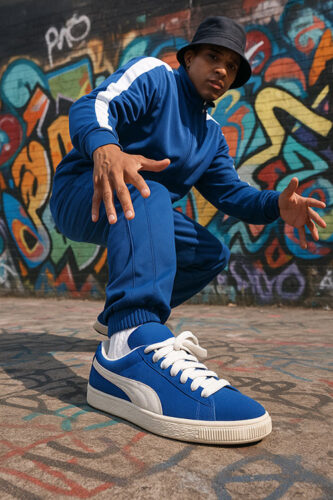
- Fat laces compatibility: B-Boys made this their signature look.
The community didn’t just wear Suedes — they customized them.
White fat laces.
Bleached tips.
Hand-cleaned suede.
Matching tracksuits.
The look became a code.
If you wore Puma Suedes…
you were about that life.
The Puma Clyde: The First Real Hip-Hop Endorsement (Even if It Wasn’t Meant to Be)
In 1973, Puma signed Knicks legend Walt “Clyde” Frazier, creating the first signature basketball shoe ever released.
The Clyde wasn’t just a shoe — it was a vibe.
Why the Clyde Spoke to Hip-Hop
Clyde was:
- flamboyant
- stylish
- charismatic
- unpredictable
- and clean with his outfits
Everything early MCs, DJs, and B-Boys valued.
The Clyde became the unofficial dress shoe of New York’s earliest dancers and DJs. The silhouette was slimmer and even cleaner than the Suede — perfect for footwork.
Ask any OG B-Boy and they’ll tell you:
The look from 1979–1984 was unmistakable:
- Puma T7 tracksuit
- Suedes or Clydes
- White fat laces
- Kangol hat
- Thick rope chain
- Name belt buckle
This was pre-sponsorship, pre-brand collaborations, pre-corporate Hip-Hop.
It was raw.
Organically built.
Culturally owned by the streets.
The Crews Who Carried Puma Into History
Several legendary groups cemented Puma in Hip-Hop’s DNA:
- Rock Steady Crew
- New York City Breakers
- Bronx Boys
- Dynamic Rockers
- Zulu Kings
These crews didn’t wear Puma because they were paid — Puma didn’t even know how deep the connection was.
They wore it because
Puma made sense for the movement.
Footage from early battle tapes shows Puma Suedes and Clydes everywhere — from the Roxy to Lincoln Center to Beat Street to the Fresh Fest era.
How Puma Got Overshadowed in the 80s (But Never Lost Its Roots)
Once Hip-Hop exploded commercially:
- Adidas caught fire with RUN-DMC.
- Nike dominated basketball culture.
- Reebok took over aerobics and women’s fitness.
Puma wasn’t spending big marketing dollars.
But the streets never abandoned them.
In breaking circles worldwide — Japan, South Korea, France, Germany — Puma was still the authentic choice for pure movement.
Puma’s Quiet Return Through Breakdance Culture
By the late 90s and early 2000s, breaking went global.
Crews from Japan, Korea, Germany, Ukraine, Russia, and Brazil revived Puma’s presence:
- Suedes and Clydes returned in new colorways
- Puma-sponsored breaking events emerged
- Street dancers kept the style alive
And in 2020–2025, as breaking became an Olympic-recognized sport, Puma surged again in the dance world.
The brand had come full circle —
from the Bronx floor to the global stage.
Puma in Today’s Hip-Hop: Legacy, Nostalgia, and Street Authenticity
Modern Hip-Hop artists still reference Puma, especially those inspired by:
- old-school aesthetics
- breakdance culture
- street cyphers
- graffiti crews
- vintage New York style
Artists like J. Cole (formerly with Puma), Nipsey Hussle, and numerous independent MCs have rocked Puma in videos and promo shots.
Puma is not the “flashiest” sneaker in Hip-Hop.
It’s the realest.
A brand defined by the people, not by campaigns.
Puma’s Influence Is Bigger Than Sneakers — It Helped Shape Hip-Hop Identity
When you break down Hip-Hop culture into its four elements:
🟡 DJing
🟡 MCing
🟡 Graffiti
🟡 Breaking
…only one of those elements required a specialized uniform.
And that blueprint — the breaker’s uniform — was Puma.
Puma helped shape:
- color coordination
- the tracksuit era
- sneaker customization
- crew identity
- early streetwear codes
Puma isn’t just a brand in Hip-Hop.
It’s part of the DNA.