
I knew it was coming, because he had been sick for some time. But I still sighed, heavily, when I woke in the wee hours of Tuesday morning to learn the Reverend Jesse Louis Jackson, Sr. had died at age 84. Gone in this February month of Black History, no less, and amidst the kind of sustained ugly unrest we have not seen in America since Rev. Jackson was a very young man.
Jesse Jackson’s mere existence changed my life forever. I was a youth, a kid, truly, when he first ran for president of the United States in 1984. I had little knowledge of American history, let alone African American history, and certainly did not know a Black woman named Shirley Chisholm had had the courage and audacity to be the first Black person to run as a major party candidate for president, 12 years before, in 1972.
So Reverend Jackson’s first presidential campaign was as electrifying as anything I had witnessed in my short life. As a poor Black kid born and raised in an American ghetto Jackson’s story mirrored mine: one of poverty, despair and an absent father and a hard-working mother; one of faith that promised unlimited possibilities if there was a deep belief in self. Yes, Jesse Jackson became my first Black superhero, before the Black Panther films, before the miraculous rise of hip-hop and sports icons like Michael Jordan and before political leaders like our first Black president, Barack Obama. Indeed, there would not have been a Barack if there had not been a Jesse. Nor would there have been a Bernie Sanders, an AOC or a Mayor Mamdani.
Rev. Jackson was a magnetic speaker, handsome and tall, a fashion trendsetter, a servant-leader who implored us to keep hope alive, who told us, prophetically, the hands which once picked cotton would one day pick the president. “I am somebody,” he told we the people. And I, we, believed him. I believed, so much so that when I worked security for Rev. Jackson at an anti-apartheid rally on my campus at Rutgers University, I cried, unashamedly, wearing an armband with his name ink-penned on it. I stood as close to him as I could without being able to touch him, because the man transformed my journey that much. I even studied political science in college because of his presidential campaign.
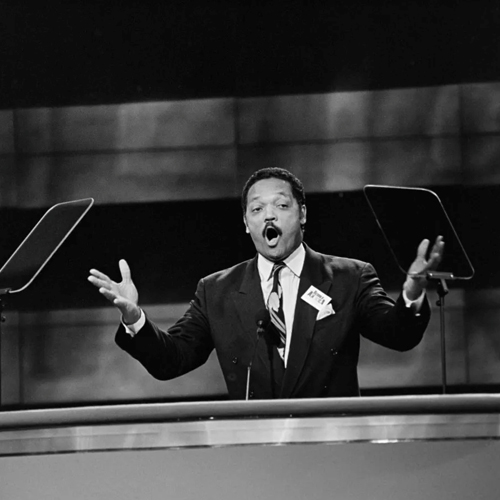
And Rev. Jackson had become, because of that first bid for the presidency, because of his historic Democratic National Convention speech the summer of 1984 and because of his sheer will to be a voice for the voiceless, one of the de facto fathers I craved desperately in my early years of loneliness, youth activism, depression and a sudden awareness of what was possible for my own life.
But I would also come to have moments of supreme disappointment with Rev. Jackson, because of his own very human shortcomings. Be it his antisemitic remark referring to New York City as “Hymie Town,” or the countless allegations of marital infidelity, or endless questions about his behavior in the immediate aftermath of Dr. King’s assassination or his being caught on a live mic dissing with crude language then-presidential candidate Barack Obama, many complications dimmed my respect and appreciation for Rev. Jackson for an extended period.
But how I saw Rev. Jackson began to shift again when I was covering the 2012 Democratic National Convention as a journalist. I was milling about on the convention floor when I noticed my youthful superhero alone, no entourage, just standing, no one paying him any mind. It was a stunning image: this now elder, who had given his entire life to civil and human rights in America, on the planet, had nowhere to sit. So the activist spirit in me was activated. I spoke with folks I knew at the DNC, and got Rev. Jackson a seat. Black history has been so discarded, banned, erased, in some circles, yet I could not imagine anyone discussing the long struggle for democracy in the United States and acting as if Rev. Jesse Jackson—whose two presidential campaigns revolutionized modern American electoral politics—did not matter. He did.
The last time I spoke with him was a few years back, via telephone, while working on my forthcoming book on Tupac Shakur. Because Rev. Jackson was a contemporary of Tupac’s mother, Afeni; because his Rainbow Coalition organization (later Rainbow/Push) got its name and inspiration from Fred Hampton, a member of the Black Panther Party like ‘Pac’s mom; and because Jackson had had an long relationship with young America across hip-hop generations, I asked for his thoughts, about his connections to Tupac.
It was clear on the call his mind was still sharp, his essence eternally ready to uplift others. But it was also clear the afro-ed and dynamic Rev. Jesse Jackson I had been so inspired by as a kid was no more. His tone shaky, his breath tired, the convo short.
In that instance I forgave Rev. Jackson’s human contradictions, vowed I would do my best to learn from his immense victories, and his profound mistakes, to never stop helping others, and believing I could help heal America and our world, just as he had believed, right to his very end.
Kevin Powell is a GRAMMY-nominated poet, humanitarian, filmmaker, public speaker, frequent contributor to Newsweek, and author of 17 books, including his newest poetry collection, A Poem for Evangeline, And Other Songs (Get Fresh Books Publishing). Kevin lives in New York City. You can find him on social media platforms by typing poet kevin powell.
Source: Newsweek