By Kevin Powell
I have watched Super Bowls since the late 1970s and mid-game spectacles since Michael Jackson in the early 1990s.
But this halftime show, featuring global music superstar Bad Bunny, was different. That is because, presently, I am observing people I know, and complete strangers too, tremble for their very lives due to ICE’s movements in countless American communities, targeting immigrants, certain kinds of immigrants.
As my wife and I traveled to do Dr. King events in places like Florida and Ohio, it was not lost on us how many immigrants worked at local hotels, local restaurants, local airports, or were fixing roads, houses and office buildings, or serving audiences food at one MLK gathering or another, even as some anti-immigrant folks were at those very Dr. King celebrations of love and unity.
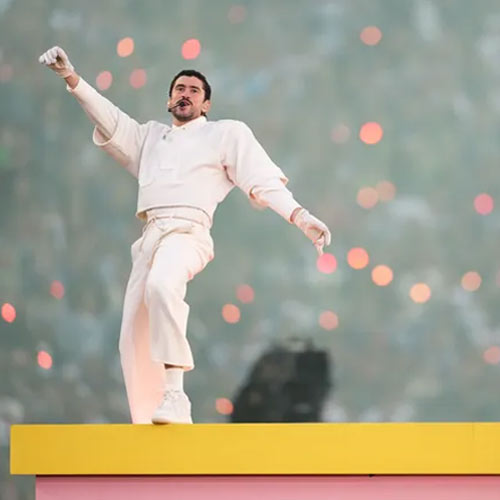
Nor was it lost on me, as I watched Bad Bunny’s historic, magnificent and entirely inclusive Super Bowl performance, that my hometown of Jersey City, New Jersey, across the Hudson River from New York, is where I grew up with Puerto Ricans like Bad Bunny. That I began to learn Spanish, as a very little child, because of friends with names like Maria and Mildred and Richie and Chico; that it was the strands of salsa music and the smell of arroz con pollo wafting from their apartments to mine that formed a love so profound for everything Puerto Rican inside of me, an African American, that I would eventually have a chapter in my autobiography titled “Puerto Ricans;” I would also make multiple trips to P.R., including in aftermath of the last major hurricane; and I owe a huge part of my poetry education to the famed Nuyorican Poets Cafe in New York City, and a legacy of Boricua writers with names like Miguel Algarín and Sandra María Esteves.
So what Bad Bunny deftly painted with his vocals and his imagination for the biggest Super Bowl audience in the annals of the halftime show (135 million) was so readily familiar to me. Because it was and is America, the true and whole America. Like my native land of Jersey City where my schoolmates and friends were not merely African American and Puerto Rican, but also Irish, Italian, Jewish, Polish, Indians from India, Filipino, Arab Muslims and West Indians who spoke English from Jamaica, and those who spoke Creole from Haiti. And, yes, quite a few also spoke Spanish from places not a part of the United States like Puerto Rico, because, yes, Puerto Ricans are very much American citizens due to colonization, something often referenced in Bad Bunny’s music, if one simply uses Google Translate.
This is why a Bad Bunny performing at a supremely All-American phenomenon like the Super Bowl has been so polarizing, a cultural civil war in the worse ways. Because everyone from President Donald Trump to Fox News pundits have blasted the National Football League and its partners for having the audacity to put a “non-American” on its stage, while not acknowledging that many actual non-Americans, like Paul McCartney, Shania Twain, The Rolling Stones, Shakira and Coldplay have each held this prestigious slot, with no debate whatsoever. The difference here, arguably, is that Bad Bunny is not white or an overtly white-presenting Latinx person, and that he mostly sings and raps in Spanish. In a society where a hard and fast wedge has been driven between who and what is an American, Bad Bunny has become, essentially, the poster boy for the ugly arguments around immigration, citizenship and representation.
Rather than return hate and ignorance with hate and ignorance, Bad Bunny has been called to be a teacher, a savant, in the grand tradition of artists like Nina Simone, Stevie Wonder, Bob Marley, U2’s Bono, Bruce Springsteen, Sinead O’Connor, and Miss Lauryn Hill: artists who evolved into voices not simply to sell records or become famous, but found, along their bumpy journeys, their souls and a soulful desire to uplift and heal humanity.
As my wife and I sat there and absorbed the Super Bowl show we could not help but feel pride, a bottomless and liberating pride. That this working-class young man from Vega Baja, Puerto Rico, an island-state often dissed, ignored, erased, would dare take the most-watched American and world television program of the past several decades, and make it into an open love letter to immigrants who spoke Spanish, while doing it strictly in Spanish. He did this while also symbolically acknowledging the tragic history of exploitation and gentrification with references to sugar cane fields, the lack of electricity and the devastating effects of poverty in his beloved country. All as the joy and magic of music, dance and food were being honored as if a massive Broadway production layering ancestral tracks from Old San Juan to Spanish Harlem.
The Bad Bunny Super Bowl extravaganza challenged, emphatically, the outright lie that America belongs to any one group.
Because here are some highlighting, with hypocritical and absent-minded glee, America turning 250 in 2026, and spitting words like “unity” again and again, while trying mightily to push certain people and certain stories off the grand American stage, literally.
Not on my watch, is what Bad Bunny said, loudly, clearly, as he clutched a football inscribed with the words “Together, We Are America.” And so it was, for one shining moment on a Super Bowl Sunday.
Kevin Powell is a GRAMMY-nominated poet, humanitarian, filmmaker, public speaker, frequent contributor to Newsweek, and author of 17 books, including his newest poetry collection, A Poem for Evangeline, And Other Songs (Get Fresh Books Publishing). Kevin lives in New York City. You can find him on social media platforms by typing poet kevin powell.
The views expressed in this article are the writer’s own.
Source: Newsweek