
Written by: Kevin Powell
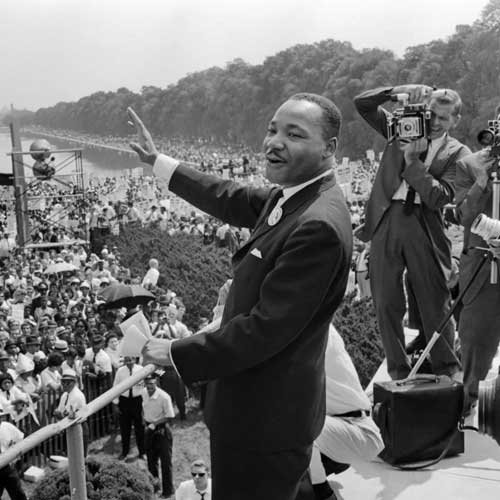
The title of this piece is a question I have avoided for years as I’ve navigated giving speeches about the life and legacy of The Reverend Doctor Martin Luther King, Jr. throughout America, and as far away as Japan.
In these United States—land of my birth and that of my ancestors dating back three centuries—my talks have been in red states, blue states, cities, the suburbs, and rural environments. I never thought, when I was a youth, Dr. King would become a vital part of my life work, as a writer, as a public speaker, as someone who cares spiritually about everyday people, but here I stand.
Which is precisely why I have dodged questions of what Dr. King, or others long gone, would say about any chapter of the American social experiment. Because we simply do not know. However, I have used much bandwidth absorbing MLK’s journey: His speeches and sermons, his interviews and writings, and endless essays, books, and documentaries produced about him.
Dr. King was not a perfect man, not by any stretch of the imagination. Indeed, he was a very human human being who did and dreamed extraordinary things. This is why I continue to do the lectures every year, why he matters deeply to me, especially now.
Because I am also clear I am a blessed beneficiary, due to Dr. King and game changers like Ella Baker, Fannie Lou Hamer, Bayard Rustin, Malcolm X, Rosa Parks, and countless others, known and unknown, alive or un-alived, who made the Civil Rights Movement of the 1950s and 1960s soar. An energy that transformed, so some thought, America and American democracy, for the better, for the wellness of us all.
I especially think of this when I consider my single mother, a poor Black woman from South Carolina, had her education cut short, because of the gruesome racism, sexism, and classism she endured as a product of segregated America prior to the Civil Rights era. I think of how I, her only child, became a first-generation college student because Tom Kean, a young and moderate white male Republican state assemblyman, born of lineage of privilege, and only in his first year of office, championed legislation in my home state of New Jersey—the Educational Opportunity Fund—which has sent thousands of poor kids like me to college. This bill was signed in July 1968, just months after the assassination of Dr. King in April, and the initiative still exists.
Tom Kean saw what was happening in America, what happened to Dr. King, to Bobby Kennedy Sr. two months later, and decided to do something—not for himself, not for his small circle or brand, but for his neighbors near and far. In 2018, at the 50th anniversary of the program, I was honored to be the keynote speaker. And there was Tom Kean, who had become a two-term Governor of New Jersey during my Rutgers University years. I said aloud how his empathy, compassion, and love transformed more lives than he could imagine, including mine.
It is that empathy, compassion, and love that propelled Dr. King, even in the face of boiling hate, hovering violence, and deafening opposition. I know America had evolved because of the Civil Rights Movement, a bit, and I wonder what the country would have been if that period never existed. But not in my gloomiest nightmares did I think I would be present in a place where the sheer cruelty my mother experienced in the 1940s and 1950s and 1960s would become my reality in this century. I feel, so many of us feel, like unrooted children.
But, alas, here we are. The small-minded will reduce it to Democrats versus Republicans, liberals or progressives versus conservatives or MAGA. No, it is much more profound than that. What we are talking about is what Dr. King spoke of frequently in the last days of his life: the very soul of America. Who are we as a society, and who do we actually want to be? Or do we care, and are, thus, willing to rip each other apart, over ideologies, over identities?
Or, rather, if the videotaped murder of George Floyd in Minnesota in these times was akin to the untaped slaughter of Emmett Till in Mississippi during Dr. King’s day, then the videotaped murder of Renee Nicole Good in Minnesota was akin to the untaped slaughter of James Chaney, Andrew Goodman, and Michael Schwerner in Mississippi during Dr. King’s day.
Black, white, Jewish, men, a poet-woman who was a lesbian, Americans each of them, same and different, innocent victims and people who were trying to disrupt injustice, gone, some killed for who they were, some killed because they cared.
Yet those of us with selective amnesia and inhumane indifference will say their lives were disposable, the way we dis the lives and histories of the Indigenous, first walkers of this land, or African Americans, builders of this nation with free, enslaved labor; and the way we turn our heads as modern-day immigrants trek in total terror of ICE, bodies snatched, families smashed by the same kind of masked men who killed my great-grandfather over one hundred years ago, and stole most of his land.
This is America Dr. King and others sacrificed their blood to make better. It is hypocritical, to be mad blunt, to celebrate Dr. King this year or any year, and not acknowledge how far backward we are racing, and not to own that democracy is not democracy until all have chance at full life possibilities, and it is not democracy if all of us do not live in peace to be whoever we are.
This is what I think about daily, what Dr. King said in his final year about community, or chaos. I choose community, I choose love, I choose hope, in spite of everything. Because I know what is possible from my own life, because my mother, nor I, never gave up, and we never will.
Kevin Powell is a Grammy-nominated poet, humanitarian, author of 17 books, filmmaker, public speaker and frequent contributor to Newsweek. He lives in New York City. You can find him on social media platforms by typing poet kevin powell.
The views expressed in this article are their own.
Source: Newsweek