


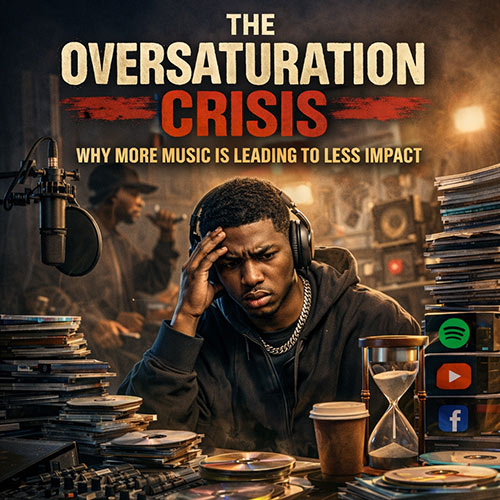
The Oversaturation Crisis: Why More Music Is Leading to Less Impact in Hip-Hop
Hip-Hop has never been more active. Every day, thousands of songs hit streaming platforms, social media feeds, and digital storefronts. From independent artists to major label rollouts, the volume of music being released has reached a level the culture has never seen before.
But here’s the contradiction: more music is not creating more impact.
If anything, the opposite is happening.
Songs are coming and going faster. Artists are releasing more frequently but struggling to build lasting records. Even strong releases are getting buried before they have a chance to breathe. The system didn’t slow down—the attention did.
This is the oversaturation crisis, and it’s quietly reshaping how Hip-Hop moves.
The Flood of Content Changed the Game
Streaming platforms removed the barriers that once limited releases. There’s no longer a gatekeeper deciding who can drop and when. Distribution is instant. Uploads are unlimited. Timelines move fast.
At first, that felt like freedom.
Now, it feels like noise.
When every artist can drop at any time, the release itself is no longer the event. It’s just another entry in an endless stream. The volume doesn’t just increase competition—it reduces the perceived value of each drop.
Listeners are no longer asking, “What dropped today?”
They’re asking, “What’s worth my time?”
Attention Became the Real Currency
The real bottleneck in today’s music economy is not production—it’s attention.
Listeners only have so many hours in a day. Social feeds move fast. Algorithms reward engagement spikes, not slow burns. Songs don’t just compete with other songs—they compete with everything.
That includes:
- Short-form video content
- Podcasts
- Gaming
- Streaming platforms like Netflix and YouTube
In that environment, even a great record can disappear if it doesn’t capture attention quickly.
And when attention is limited, impact becomes rare.
The Shorter Life Cycle of Songs
There was a time when a record could build over months, even years. Word of mouth mattered. DJs broke records slowly. Fans sat with music.
Now, songs are judged almost instantly.
If a track doesn’t catch within days—or even hours—it risks being replaced by the next drop. This creates a cycle where artists feel pressure to release again quickly, which only adds to the oversaturation problem.
It becomes a loop:
- More music → less attention per song
- Less attention → faster releases
- Faster releases → even more oversaturation
And the cycle continues.
Algorithms Reward Volume, Not Always Value
Streaming platforms are designed to keep users engaged. That often means prioritizing consistency and activity.
Artists who release frequently can stay in algorithmic circulation. But frequency doesn’t always equal impact. In fact, constant drops can dilute anticipation if there’s no clear strategy behind them.
The result is a system where:
- Visibility can increase
- But memorability can decrease
Being seen is not the same as being remembered.
Listen to Spit Fire Radio: www.spitfireradio.com
Independent Artists Feel It the Most
Major artists have built-in advantages—marketing budgets, media coverage, playlist relationships. Independent artists don’t always have that support.
So when the market becomes crowded, independent creators are forced to compete harder for smaller windows of attention.
That’s why many artists are asking:
How do you stand out when everyone is dropping at the same time?
The answer is no longer just “make good music.”
It’s about how you package, time, and position that music.
In an oversaturated market, impact is not accidental. It’s engineered.
The artists breaking through today are not just releasing music—they are creating moments, narratives, and reasons for listeners to care.
That includes:
- Strategic rollout timing
- Strong visual identity
- Consistent storytelling
- Audience engagement before and after the drop
The music still matters. But without context, even great music can get lost.
The Shift From Volume to Precision
The next phase of Hip-Hop isn’t about who releases the most.
It’s about who releases with intention.
Artists who understand timing, audience behavior, and positioning will outperform those who simply flood platforms with content. Precision is becoming more valuable than volume.
That doesn’t mean releasing less—it means releasing smarter.
What This Means for the Future of Hip-Hop
The oversaturation crisis is not going away. If anything, it will intensify as more artists enter the space and tools become more accessible.
But that doesn’t mean opportunity is shrinking.
It means the rules are changing.
The artists who win in this era will be the ones who:
- respect the listener’s attention
- build real connection, not just streams
- and understand that impact is not about how often you drop, but how deeply your music lands
Because in a world where everything is available…
only a few things actually matter.