


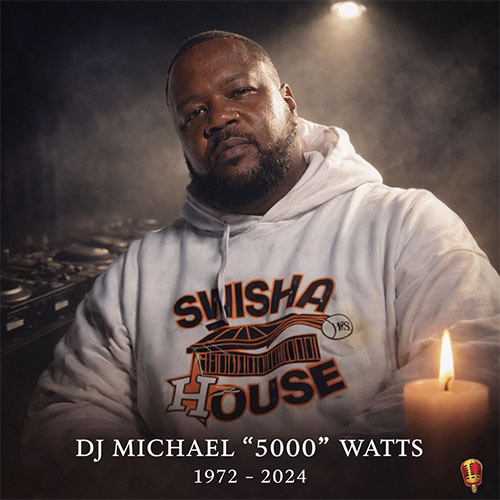
Houston just lost one of its most important architects.
DJ Michael “5000” Watts — the founder and CEO of Swishahouse, the Northside powerhouse that helped take Houston rap from city blocks to the national stage — has died at age 52, according to reports from Houston-area news outlets and statements attributed to his family.
Multiple reports say Watts had been hospitalized for serious health complications in the days leading up to his death.
For fans of Southern rap, his name isn’t just a credit — it’s a chapter heading.
The Swishahouse blueprint: local first, then the world
Swishahouse wasn’t built like a traditional label. It moved like a neighborhood economy: tapes circulating hand-to-hand, car speakers doing the marketing, street buzz doing the A&R. Watts helped turn that grassroots engine into something scalable — a system that could break records and still feel like Houston.
According to local reporting, Swishahouse was founded in 1997, and its rise became synonymous with the city’s late-’90s/2000s explosion.
That matters because mixtapes weren’t “extra content” back then — they were the infrastructure. Before algorithms told the story of what was hot, DJs and mixtape circuits decided what the world heard next. Watts was one of the people who understood that power early, and he operated like it.
Chopped-and-screwed culture, pushed into the mainstream conversation
Houston’s slowed, hypnotic, trunk-rattling remix tradition has deep roots — and while the style is widely associated with DJ Screw, Watts became one of the key figures who carried the sound into a broader commercial lane through Swishahouse’s mixtapes, collaborations, and city-to-city reach.
It’s hard to explain to newer listeners just how influential that was. “Chopped and screwed” wasn’t merely an effect — it was a whole feeling: patience, gravity, and confidence. Watts helped that identity travel.
The careers Swishahouse helped ignite
If you followed rap in the 2000s, you’ve felt the Swishahouse ripple effect. Local reports credit Watts and the Swishahouse movement with helping elevate or platform artists who went on to national recognition — including Paul Wall, Slim Thug, Mike Jones, and Chamillionaire, among others.
One reason Swishahouse worked is because it wasn’t built around one star — it was built around a sound and a scene. The brand meant something. You could hear the city in it.
And in a music industry that often extracts culture and leaves the neighborhood with crumbs, Watts helped build a platform that kept Houston’s identity loud in the mix.
A Houston institution, not just a name on flyers
There’s a certain kind of respect you can’t buy — the kind you earn by showing up for years, by building relationships, by staying consistent when the industry shifts. Watts carried that kind of reputation in Houston. Local coverage describes him as a foundational figure in the city’s music culture — not as a trend, but as an institution.
Reports also note he is survived by family, including his wife and children.
Why his legacy hits different in 2026
Today, every artist is told to “build a brand,” “own your audience,” and “move independently.” Watts lived a version of that before it was packaged as advice.
He built distribution without streaming.
He built community before social media.
He built proof before press.
That’s the part worth holding onto — especially for the next wave of independent artists trying to break through in a crowded, pay-to-play attention economy. Watts’ career is a reminder that culture moves fastest when the foundation is real.
Rest in peace to a Houston legend.
If you grew up on Swishahouse tapes, drop your favorite memory — a song, a mix, a moment — and let’s celebrate what he helped create.