

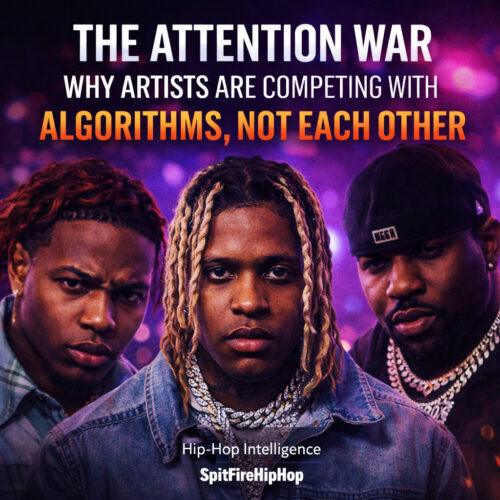
In today’s Hip-Hop landscape, artists aren’t battling for chart positions—they’re fighting for attention. The real competition isn’t another rapper; it’s the algorithm deciding what gets seen, shared, and remembered in an oversaturated digital ecosystem.
The Battlefield Has Changed
There was a time when competition in Hip-Hop was clear and visible. Artists went head-to-head on tracks, radio spins, and album sales. Success was defined by who had the better record, the stronger presence, or the louder buzz in the streets.
That model is gone.
Today, the battlefield is invisible. It exists inside recommendation engines, engagement metrics, and content feeds. The deciding factor is no longer just talent—it’s whether the algorithm chooses to amplify you. Artists aren’t just releasing music; they’re entering a system designed to filter, rank, and distribute attention at scale.
This shift has quietly rewritten the rules of the industry.
The Algorithm Is the New Gatekeeper
In the past, gatekeepers were human—A&Rs, DJs, label executives. Now, those roles have largely been replaced by systems that prioritize performance data over relationships.
The algorithm doesn’t care about your backstory. It doesn’t respect legacy. It only responds to signals.
These signals include:
- Watch time
- Save rate
- Shares
- Comments
- Replay value
If your content triggers these behaviors, it spreads. If it doesn’t, it disappears—regardless of how good the music is.
That’s why two artists can release songs of equal quality, but only one gains traction. The difference isn’t always the music. It’s how the audience interacts with it—and how the algorithm interprets that interaction.
Attention Is the New Currency
Streams used to be the goal. Now, they are the result of something deeper: attention.
Before a fan ever presses play, they’ve already been influenced by:
- A clip
- A comment section
- A visual moment
- A social interaction
In this environment, attention flows before consumption. Artists who understand this don’t just drop songs—they create moments that pull people into the music.
This is why short-form content, behind-the-scenes footage, and fan interactions matter more than ever. Each piece of content becomes an entry point into your catalog.
Listen to Spit Fire Radio: www.spitfireradio.com
The New Competition Isn’t Artists—It’s Content
Here’s the reality most artists miss: your song is not just competing with other songs.
It’s competing with:
- Viral videos
- Memes
- Influencers
- Lifestyle content
- News clips
All of it exists in the same feed.
That means your music has to do more than sound good—it has to stop the scroll. If it doesn’t capture attention within seconds, it gets skipped, buried, and forgotten.
This is the attention war.
Why Some Artists Break Through (And Others Don’t)
The artists who are winning today understand that music is only part of the equation. They treat their presence like a system, not a series of random posts.
They focus on:
- Consistency over perfection
- Engagement over vanity metrics
- Storytelling over promotion
Instead of asking, “Is this song good?” they ask, “Will people react to this?”
That shift in thinking is what separates artists who grow from artists who stall.
The Strategy Shift Artists Must Make
To survive in this environment, artists need to rethink how they approach releases.
Instead of treating a song as a one-time drop, it must become a multi-layered rollout designed to generate interaction.
Key adjustments include:
- Creating multiple content pieces around one release
- Designing moments that encourage comments and shares
- Building anticipation before the drop
- Extending the life of a song beyond release week
This isn’t about gaming the system—it’s about understanding how the system works.
The Long-Term Impact on Hip-Hop
This shift is changing the culture itself.
Artists who adapt will:
- Build stronger fan relationships
- Maintain longer relevance
- Control their growth trajectory
Those who don’t will find themselves releasing music into silence, wondering why quality alone isn’t enough.
The gap between talent and visibility has never been wider.
Conclusion: Winning the Attention War
The future of Hip-Hop doesn’t belong to the most talented artist—it belongs to the most visible and engaging one.
The algorithm is not your enemy, but it is your judge. Every post, every clip, every release sends signals about your relevance.
Artists who learn how to create attention will win.
Those who ignore it will be left behind.