

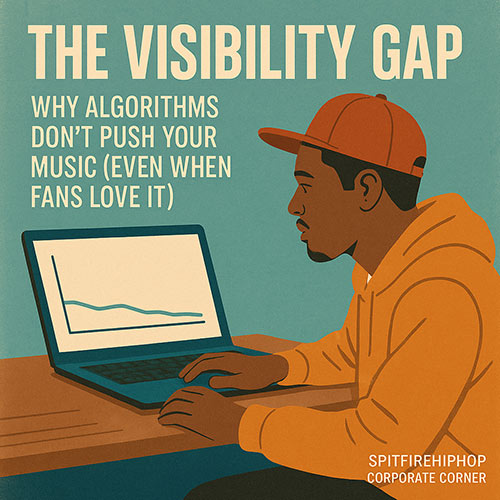
Artists often believe quality alone earns visibility. But in 2025, great music can still remain hidden behind algorithmic walls. The visibility gap explains why artists with strong reactions, loyal fans, and real momentum still struggle to reach wider audiences.
What the Visibility Gap Really Is
The visibility gap is the distance between fan love and platform confidence. It’s the space where an artist sees real enthusiasm from listeners, yet algorithms refuse to distribute their music beyond a small circle.
This gap feels unfair. And to artists, it often looks personal. But it isn’t. It’s structural.
Platforms don’t promote music based on emotion or perceived quality. They promote based on data predictability, catalog density, behavior patterns, and trust scoring. Until an artist proves stability within these areas, the system treats them as high-risk content, even if fans adore the music.
That disconnect is the visibility gap.
Why Algorithms Don’t Trust New or Inconsistent Artists
Platforms require behavioral proof, not lyrical brilliance.
Inconsistent artists, those who post randomly, drop sporadically, or shift identity too often, appear unreliable to the system. Without trust, algorithms limit exposure to reduce user dissatisfaction risk.
This is why some lower-quality artists still grow: the system trusts their behavior even when taste-makers don’t.
Behavior > artistry in the visibility equation.
The 3 Visibility Tiers Artists Don’t Know They’re In
Every artist exists in one of three algorithmic tiers. Most never realize they’re stuck in the bottom one.
Tier 1: Contained Visibility
The algorithm limits you to your existing followers or listeners.
You are “safe” but not expandable.
Tier 2: Expanded Testing
Your music is tested with new listeners in small batches.
You must outperform expectations to advance.
Tier 3: Algorithmic Acceleration
The system proactively distributes you.
Your engagement is predictable, and your catalog supports consumption.
The gap exists between Tier 1 and Tier 2. That’s where careers stall.
Why Fans Loving the Music Isn’t Enough
Fan enthusiasm matters, but algorithms look for systemic signals, not emotional ones.
You can have:
- high save rates
- strong comments
- messages from supporters
- glowing feedback
…but still remain invisible if:
- your catalog is thin
- fans aren’t exploring your other songs
- your posting rhythm is inconsistent
- your repeat listener rate dips
- your content theme keeps shifting
Fans respond to art.
Algorithms respond to patterns.
How Identity Inconsistency Kills Visibility
Algorithms track patterns of:
- visual themes
- sonic cohesion
- tempo and tone
- audience targeting
- posting style
- metadata and descriptions
When these shift too often, the system can’t determine your category. That uncertainty reduces visibility because platforms cannot confidently predict who will enjoy your next release.
Confusion to the algorithm = limited push.
The Catalog Problem No One Talks About
Platforms heavily reward artists with catalog density.
A bigger catalog:
- increases session time
- boosts retention
- creates internal link pathways
- reduces algorithmic risk
Artists with 2–6 songs struggle not because the songs are bad, but because the system doesn’t have enough data to justify promotion. Catalog depth is confidence.
This is why one-hit wonders often vanish.
Not because the hit fades — but because the catalog fails to catch new listeners.
Engagement Without Structure Doesn’t Scale
An artist can have strong comments, emotional DMs, even viral spikes—but no long-term visibility—because engagement alone doesn’t create system trust.
Algorithms evaluate whether the experience around your content is predictable. Without structure, your highs become isolated events, not growth patterns.
Why Algorithms Push “Mid” Artists Instead
Artists often wonder why less-talented peers get more traction.
The answer is simple: consistency creates trust.
Artists with:
- predictable release cycles
- cohesive sound
- aligned visuals
- stable retention
- similar song structures
are considered low risk.
Platforms expand low-risk profiles before they expand brilliant but unpredictable ones.
How Artists Break Through the Visibility Gap
Breaking the gap demands system alignment, not more creativity.
Artists who rise:
- build catalog depth
- maintain quarterly release cycles
- sustain visual consistency
- reinforce one emotional lane
- track KPIs
- maintain stable audience retention
- avoid constant reinvention
Visibility isn’t given.
It’s unlocked.
The Corporate Corner Reality
Companies don’t promote products they cannot predict.
Platforms don’t push artists they can’t model.
The visibility gap closes when the system feels confident—not when fans say you’re great.
The Real Truth
You’re not invisible because you’re unworthy.
You’re invisible because the platform doesn’t understand you yet.
Once it does, everything changes, and growth becomes inevitable.