




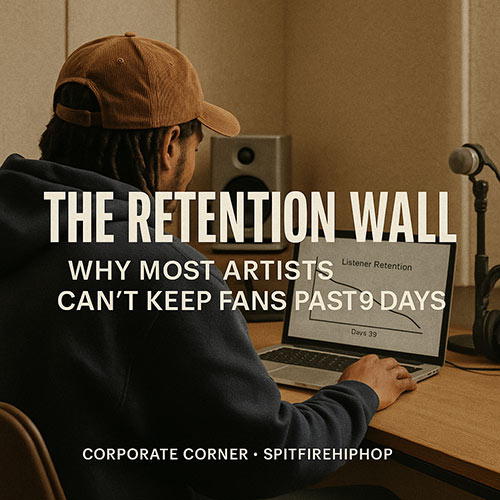
Most artists don’t lose fans slowly; they lose them all at once. Around the 60–90 day mark, momentum quietly collapses. Streams dip. Engagement fades. Algorithms stop testing. This invisible drop-off is the retention wall, and it ends more careers than bad music ever does.
What the Retention Wall Really Is
The retention wall isn’t a mystery. It’s a behavioral threshold. It’s the point where casual listeners decide whether your music fits into their routine, or disappears from it. Most artists assume fans drift because attention spans are short. In reality, fans leave because no system encourages them to stay.
Retention measures how long interest lasts after discovery. Growth without retention creates noise. Growth with retention creates careers.
Why the First 90 Days Matter More Than the First 7
Artists obsess over opening-week numbers. Platforms don’t. The first week shows curiosity. The next 60–90 days reveal habit formation. That’s where real demand appears.
In that window, platforms track:
- how often saved songs get replayed
- how many listeners migrate through the catalog
- how frequently listeners return after discovery
- how engagement behaves after promotion stops
If these taper quickly, testing ends. If they stabilize, careers expand.
How Artists Accidentally Create the Retention Wall
Most artists unintentionally push fans away right after they arrive.
The most common errors:
- abandoning songs after one week
- flooding releases too quickly
- changing sound before attachment forms
- disrupting visual identity mid-cycle
- disappearing between drops
- promoting discovery content but not retention content
These actions reset trust before it solidifies.
Why Algorithms Penalize Weak Retention
Platforms are loyalty machines. They optimize for user satisfaction over time, not momentary hype. When listeners stop returning, the system interprets that as disappointment, regardless of how big the initial numbers were.
Low retention signals:
- poor catalog depth
- weak artist identity
- inconsistent emotional connection
- lack of audience relationship infrastructure
Once flagged, testing narrows dramatically.
Why Virality Makes Retention Harder
Virality introduces the wrong audience faster than attachment can form. Viral fans arrive for the moment, not the mission. Without a guided retention path, they vanish as quickly as they came.
This is why many viral artists stall after their biggest spike. They gained exposure without building infrastructure.
Exposure creates opportunity.
Retention determines survival.
The Psychological Reason Fans Drift
Fans don’t leave because they hate the music. They leave because nothing pulls them back in. Every return requires a trigger:
- a familiar emotional feeling
- a new chapter in the story
- a deeper catalog connection
- a reminder of why the artist mattered
Without these signals, memory fades before loyalty forms.
How Artists Break Through the Retention Wall
Artists who sustain growth design post-discovery systems.
They:
- spotlight one song long enough for habits to form
- guide fans into deeper catalog sessions
- reinforce the same emotional lane
- build email, SMS, or community access
- create continuity between drops
- offer reasons to return beyond music alone
Retention is not a song issue. It’s a system issue.
Why Catalog Depth Is the Strongest Retention Weapon
A single strong song sparks discovery. A cohesive catalog sustains it. When listeners finish one song and immediately find another that fits the same emotional space, return behavior accelerates naturally.
Catalog depth increases:
- listening session length
- replay probability
- platform satisfaction scoring
- artist confidence signals
Thin catalogs bleed fans quickly. Deep catalogs absorb them.
Retention Is the Bridge Between Attention and Income
Fans who stay:
- convert faster
- spend more
- advocate publicly
- stabilize revenue
- reduce algorithm dependence
This is why retention outperforms discovery for income generation. A small base of retained fans out-earns a massive pool of casual listeners.
Why Most Artists Never See Their Retention Problem
Platforms highlight vanity metrics. They hide decay.
Artists notice:
- stream totals
- follower counts
- viral moments
But the silent graph that matters most is listener return over time. Without tracking that curve, artists assume growth is healthy when it’s actually leaking.
The Corporate Corner Reality
Companies don’t measure customer acquisition without tracking churn. Artists measure discovery without tracking fan loss.
That gap creates the retention wall.
Retention transforms creative output into a stable business asset.
The Real Truth
Artists don’t fail at growth.
They fail at holding what they’ve grown.
Breakthroughs don’t disappear because talent fades.
They disappear because no system catches the audience after they arrive.



Pingback: The Revenue Stack: Why Streams Are the Weakest Income Layer – SpitFireHipHop.com
Pingback: The Catalog Flywheel: How Songs Feed Each Other for Years – SpitFireHipHop.com