


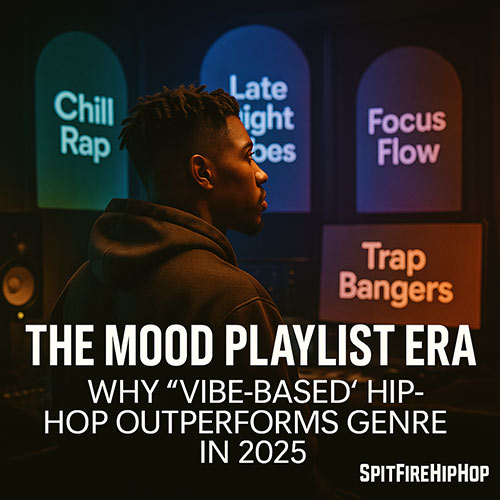
Hip-Hop fans don’t search for “genres” anymore—they search for how music feels. In 2025, mood playlists dominate discovery, shaping how songs spread, how artists break, and how the algorithm decides who rises and who gets buried.
The Algorithm Has Shifted From Genre to Emotion
For the past decade, Hip-Hop lived inside traditional genre categories—Boom Bap, Trap, Drill, Lo-fi, Experimental, and so on. But in 2025, there’s a major shift happening across Spotify, Apple Music, YouTube Music, and even TikTok:
Mood matters more than genre.
Streaming platforms realized listeners rarely think in genre terms. They think in emotional utility:
- “I need something for late nights.”
- “I need something to focus.”
- “I need something that feels calm.”
- “I want something aggressive.”
This shift has transformed discovery. Hip-Hop tracks that fit specific emotional niches now outperform songs labeled strictly by style.
DSPs Are Rebuilding Their Ecosystems Around Mood
Platforms like Spotify and Apple Music have data proving:
- People search moods 10x more than genres
- Mood playlists have higher retention
- Mood mixes receive more “save behavior”
- Passive listeners lean on vibes, not categories
This is why playlists like:
- Chill Rap
- Late Night Vibes
- Rap Caviar… but softer variants
- Mellow Bars
- Dark Trap
- Sad Boi Rap
- Hype Workout
- Focus Flow
- Lo-Fi Rap Beats
…regularly outperform traditional Hip-Hop genre playlists.
DSPs follow behavior, and behavior shows that fans live inside emotional spaces.
What “Vibe-Based Discovery” Means for Hip-Hop Artists
This new ecosystem changes HOW artists should think about their music.
Most artists categorize their songs based on:
- production style
- region
- subgenre
But listeners categorize based on FEEL.
Artists who understand this shift have a HUGE advantage.
To thrive in 2025, artists must begin asking:
“What emotional space does my music live in?”
Your vibe is now your discovery engine.
Listen Live: Spit Fire Radio
Moods Are the New Marketing
In a mood-first world, successful artists build their brand around:
- consistent emotional tone
- recurring sonic themes
- recognizability in vibe
- predictable sound identity
Fans don’t just want a style—they want a feeling they can rely on you for.
This feeling becomes your product.
That’s why artists like:
- J. Cole (reflective)
- Don Toliver (vibey, atmospheric)
- Larry June (smooth, luxury chill)
- Travis Scott (dark, cinematic hype)
- JID (intense, technical energy)
…own emotional lanes, not just subgenres.
It’s intentional emotional branding.
How to Identify Your Mood Lane
Artists should define a primary mood lane before releasing music in 2025.
Ask yourself:
“When fans think of my music, what moment of their life does it fit?”
Your lane might be:
- late-night introspection
- aggressive energy
- summertime smooth
- soulful lift
- heartbreak mood
- focus & grind
- meditative vibe
- street realism
- melancholy bars
Once you identify it, everything you release should reinforce it.
Because consistency builds recognition.
Recognition builds retention.
Retention unlocks the algorithm.
Why Mood Playlists Create Longer Lifespans for Songs
Unlike trend playlists—where songs come and go—mood playlists have extremely long shelf lives.
Here’s why:
People don’t stop needing moods.
Fans will ALWAYS:
- study
- chill
- drive at night
- work out
- contemplate
- heal
- celebrate
These needs don’t disappear with trends.
They renew themselves daily.
That means:
A mood-fitting song can generate consistent streams for YEARS.
How Artists Can Write Music for Mood Playlists
This is where craft meets strategy.
Mood-based writing requires thinking in emotional design.
Key elements include:
1. Cohesive sonic identity
Your production must reinforce your emotional lane—same texture, ambiance, or feel.
2. Strong intro tone
Listeners know the mood of a song in the first 5–7 seconds.
3. Vocal delivery that matches the vibe
Vocal texture, tone, pacing, and intensity matter more now than raw bars.
4. Simpler, more immersive arrangements
Mood playlists reward space, atmosphere, and replay value—not complexity.
5. Lyrics that paint a feeling
Fans save songs that articulate their emotions better than they can themselves.
6. Repeatability
Loop-friendly songs perform best because mood playlists often run while fans multitask.
Why Mood Playlists Matter for Independent Artists
Indie artists have an opening that didn’t exist 10 years ago:
You no longer need to fit a genre.
You just need to fit a feeling.
In a mood-first market, small artists can outperform big ones IF they nail their emotional lane.
This reduces the barrier to entry.
Because fans don’t care who made the song—
they care how the song makes them feel.
Mood is the great equalizer.
Mood = Algorithmic Advantage
The algorithm LOVES mood-based music because it is predictable and highly retainable.
Mood songs typically have:
- low skip rates
- high save rates
- high repeat behavior
- long streaming sessions
- stable listener retention
These are the metrics the algorithm uses to decide who to push.
If you create music that fits a mood category consistently, the algorithm starts treating your catalog as a “solution” to a specific emotional need.
That’s how artists break in 2025.


Pingback: The Single Snippet Strategy: Why 15 Seconds Decide a Song’s Fate in 2025 – SpitFireHipHop.com
Pingback: The Playlist Saturation Problem: Why Most Hip-Hop Songs Fail After Getting Playlisted – SpitFireHipHop.com
Pingback: The Loop Effect: Why Fans Replay the Same Hip-Hop Songs and How Artists Can Use It – SpitFireHipHop.com
Pingback: The 30-Day Drop Cycle: How Smart Hip-Hop Artists Release Music in 2025 – SpitFireHipHop.com