

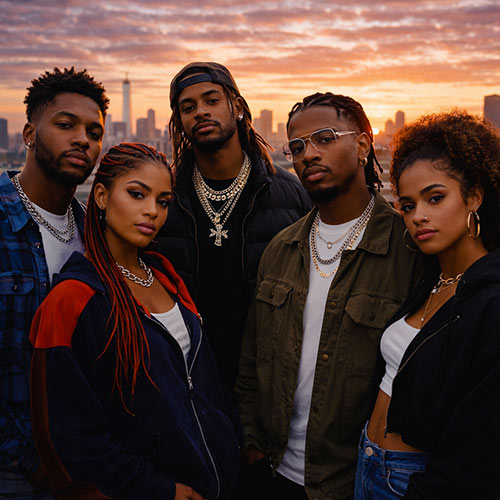
Hip-Hop is entering a new era of collaboration. After years of solo dominance, artists are forming collectives, crews, and creative teams again. This shift is changing how music is made, promoted, and consumed in the modern streaming landscape.
The Return of the Collective Mindset
For decades, Hip-Hop has thrived on both individual excellence and collective identity. Early movements were built on crews—Wu-Tang Clan, Dipset, and Odd Future—groups that didn’t just release music, but defined entire cultural moments.
In recent years, however, the industry leaned heavily toward solo artists. Streaming platforms rewarded individual branding, and social media amplified personal identity over group affiliation. The result was a generation of artists building careers independently, often disconnected from larger creative units.
Now, that dynamic is shifting again.
Across the culture, artists are beginning to regroup—not just for features, but for shared identity, strategy, and long-term growth.
Why the Crew Model Is Returning
The comeback of Hip-Hop collectives is not nostalgic—it is strategic. The modern music landscape rewards momentum, consistency, and engagement, all of which are easier to sustain as a unit rather than as an individual.
A collective creates energy. It multiplies visibility. It accelerates output. And in a world where attention is the most valuable currency, these advantages matter more than ever.
Instead of one artist carrying the burden of content, promotion, and fan engagement, a group distributes that responsibility across multiple voices. This allows for constant presence without burnout, and continuous cultural relevance without relying on a single release.
Social Media Changed the Power Structure
The rise of platforms like TikTok, Instagram, and YouTube has made collaboration more valuable than ever. Algorithms favor activity, frequency, and interaction—all areas where collectives naturally outperform individuals.
When multiple artists share the same audience and amplify each other’s content, they create overlapping networks that expand reach organically. A post from one member becomes exposure for the entire group. A viral moment from one artist can elevate the entire collective.
This interconnected growth model is far more efficient than building an audience alone.
Why the Crew Model Is Returning
The comeback of Hip-Hop collectives is not nostalgic—it is strategic. The modern music landscape rewards momentum, consistency, and engagement, all of which are easier to sustain as a unit rather than as an individual.
A collective creates energy. It multiplies visibility. It accelerates output. And in a world where attention is the most valuable currency, these advantages matter more than ever.
Instead of one artist carrying the burden of content, promotion, and fan engagement, a group distributes that responsibility across multiple voices. This allows for constant presence without burnout, and continuous cultural relevance without relying on a single release.
Social Media Changed the Power Structure
The rise of platforms like TikTok, Instagram, and YouTube has made collaboration more valuable than ever. Algorithms favor activity, frequency, and interaction—all areas where collectives naturally outperform individuals.
Listen to Spit Fire Radio: https://www.spitfireradio.com
When multiple artists share the same audience and amplify each other’s content, they create overlapping networks that expand reach organically. A post from one member becomes exposure for the entire group. A viral moment from one artist can elevate the entire collective.
This interconnected growth model is far more efficient than building an audience alone.
The Collective as a Growth Engine
Modern Hip-Hop crews are not just creative groups—they are growth systems. They function like decentralized brands, where each member contributes to the overall momentum of the collective.
This model allows artists to:
- release music more frequently without overextending themselves
- tap into multiple fanbases at once
- maintain constant visibility across platforms
- create a shared narrative that fans can follow
In many ways, a collective operates like a startup team. Each artist plays a role, and the success of one member strengthens the entire structure.
Why Fans Connect More With Crews
Fans don’t just follow music—they follow stories. A collective provides multiple personalities, perspectives, and relationships for audiences to engage with.
Instead of connecting with one artist, fans become invested in a network of individuals. They watch how members interact, collaborate, and evolve together. This creates deeper emotional engagement and stronger long-term loyalty.
Crews also create moments. Whether it’s group freestyles, shared performances, or behind-the-scenes content, collectives generate dynamic interactions that feel more alive than solo promotion.
The New Version of the Rap Group
Today’s collectives are not structured like traditional rap groups. They are more fluid, more digital, and more adaptive.
Members can operate independently while still contributing to the group identity. Releases can be solo, collaborative, or fully collective. The boundaries are flexible, allowing artists to maintain individuality while benefiting from shared momentum.
This hybrid structure fits perfectly within the streaming era, where adaptability is key.
The Corporate Corner Perspective
From a business standpoint, the return of collectives reflects a broader shift toward network-based growth models.
Instead of building a career around a single brand, artists are building ecosystems. These ecosystems allow for:
- diversified content output
- shared audience acquisition
- increased retention through constant engagement
In a landscape driven by algorithms, collectives provide a strategic advantage by increasing the number of touchpoints fans have with the brand.
The Real Takeaway
Hip-Hop is not moving backward—it is evolving forward. The return of crews and collectives represents a smarter way to navigate the modern music industry. Artists are recognizing that collaboration is not just creative—it is competitive.
In 2026, the strongest artists may not be the ones who stand alone. They may be the ones who build together.