


In today’s Hip-Hop landscape, relying on a single fanbase is no longer enough. Artists must build layered audiences across platforms, communities, and content formats. The most successful careers are driven not by one audience—but by a connected audience stack.
The Myth of the “One Fanbase” Artist
For years, artists were told to build a loyal fanbase, and everything else would follow. While loyalty still matters, the idea of a single, unified audience is becoming outdated.
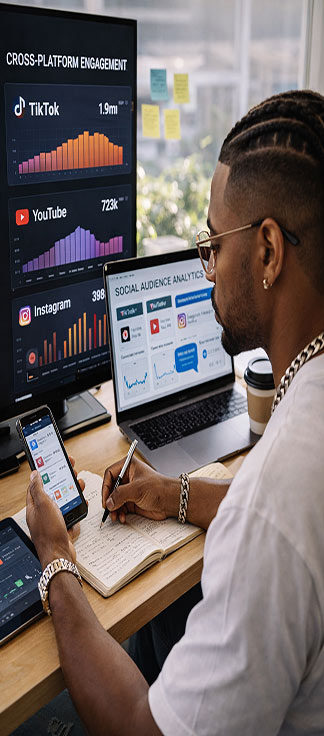
In the streaming era, fans don’t exist in one place. They are spread across platforms, behaviors, and content environments. A listener on Spotify may never follow an artist on Instagram. A fan on TikTok may never stream the full song. A YouTube viewer may never engage with the artist’s music catalog.
This fragmentation has changed how artists must think about growth.
What an Audience Stack Actually Is
An audience stack is a layered system of fan communities built across different platforms and behaviors. Instead of relying on one central audience, artists create multiple entry points for discovery and engagement.
Each layer of the stack serves a different purpose. Some fans discover the artist through short-form content. Others engage through full songs. Others connect through storytelling, interviews, or live interactions.
The goal is not to force all fans into one place. The goal is to allow each layer to contribute to overall momentum.
Why Fragmentation Is the New Reality
The modern fan journey is no longer linear. Listeners do not move in a straight line from discovery to loyalty. Instead, they enter and exit the artist’s ecosystem at different points.
One fan might discover a snippet on TikTok, then disappear.
Another might hear a song on a playlist, then follow on Instagram weeks later.
Another might engage through comments or livestreams without ever streaming consistently.
This behavior creates a fragmented audience—but also a powerful opportunity.
Artists who understand how to connect these fragments can build much larger and more resilient careers.
The Power of Layered Growth
The strength of an audience stack lies in its ability to generate momentum from multiple directions at once.
Instead of relying on one platform to carry a release, artists can activate different layers simultaneously. A song can perform moderately on streaming platforms while gaining traction through social media conversations, visual content, and fan interaction.
This creates a more stable growth model. If one layer slows down, others can continue to push the artist forward.
The Core Layers of the Audience Stack
While every artist’s stack will look different, most successful Hip-Hop careers are built across a few key layers:
- Discovery Layer: short-form content, viral clips, and algorithmic exposure
- Engagement Layer: comments, shares, and fan interaction
- Consumption Layer: streaming, downloads, and repeat listening
- Community Layer: loyal fans who follow the artist across platforms
Each layer feeds into the others, creating a cycle of growth rather than a single point of failure.
Why Collectives Accelerate Audience Stacking
The return of Hip-Hop collectives ties directly into the audience stack model. When artists collaborate, they merge their audiences, creating immediate expansion across multiple layers.
A collective allows each member to tap into different fan segments. One artist may dominate short-form content, while another drives streaming numbers. Together, they create a more complete and powerful audience structure.
This is why collaboration is no longer optional—it is strategic.
Why Fragmentation Is the New Reality
The modern fan journey is no longer linear. Listeners do not move in a straight line from discovery to loyalty. Instead, they enter and exit the artist’s ecosystem at different points.
One fan might discover a snippet on TikTok, then disappear.
Another might hear a song on a playlist, then follow on Instagram weeks later.
Another might engage through comments or livestreams without ever streaming consistently.
This behavior creates a fragmented audience—but also a powerful opportunity.
Artists who understand how to connect these fragments can build much larger and more resilient careers.
The Power of Layered Growth
The strength of an audience stack lies in its ability to generate momentum from multiple directions at once.
Instead of relying on one platform to carry a release, artists can activate different layers simultaneously. A song can perform moderately on streaming platforms while gaining traction through social media conversations, visual content, and fan interaction.
This creates a more stable growth model. If one layer slows down, others can continue to push the artist forward.
Listen to Spit Fire Radio: https://www.spitfireradio.com
The Core Layers of the Audience Stack
While every artist’s stack will look different, most successful Hip-Hop careers are built across a few key layers:
- Discovery Layer: short-form content, viral clips, and algorithmic exposure
- Engagement Layer: comments, shares, and fan interaction
- Consumption Layer: streaming, downloads, and repeat listening
- Community Layer: loyal fans who follow the artist across platforms
Each layer feeds into the others, creating a cycle of growth rather than a single point of failure.
Why Collectives Accelerate Audience Stacking
The return of Hip-Hop collectives ties directly into the audience stack model. When artists collaborate, they merge their audiences, creating immediate expansion across multiple layers.
A collective allows each member to tap into different fan segments. One artist may dominate short-form content, while another drives streaming numbers. Together, they create a more complete and powerful audience structure.
This is why collaboration is no longer optional—it is strategic.
The Corporate Corner Perspective
From a business standpoint, the audience stack represents a shift toward multi-channel growth strategy.
Artists are no longer building a fanbase—they are building an ecosystem. This ecosystem increases:
- audience reach
- engagement frequency
- long-term retention
It also provides protection against platform volatility. If one platform changes its algorithm or loses relevance, the artist still has other layers to rely on.
The Real Takeaway
The artists who win in 2026 will not be those with the biggest fanbase in one place. They will be the ones who build presence across many places. A single fanbase can grow a career. An audience stack can sustain it.