




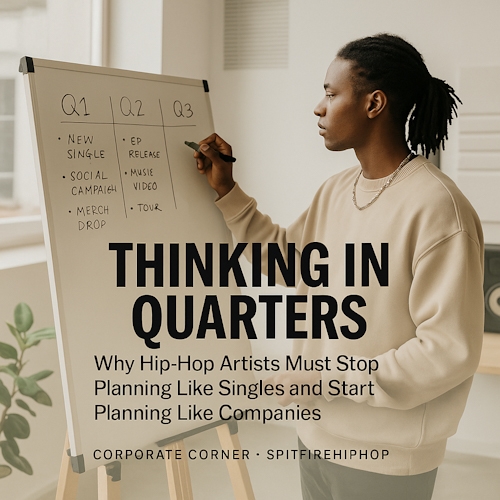
Independent artists don’t fail because they can’t make good music. They fail because they plan emotionally instead of operationally. In today’s economy, careers don’t scale one release at a time — they scale in quarters, like real businesses do.
Why Planning Song-to-Song Keeps Artists Stuck
Most Hip-Hop artists plan in microbursts. One song. One video. One post. One drop. That approach feels flexible, but it creates chaos.
Planning one release at a time forces artists to constantly reset. There’s no momentum runway, no feedback loop, and no sense of progress beyond short-term metrics. Every song becomes a gamble rather than part of a system.
Companies don’t do this. They’d collapse.
What “Thinking in Quarters” Actually Means
Quarterly thinking doesn’t mean becoming corporate or losing creativity. It means grouping creative output into execution cycles with clear objectives.
A quarter gives you:
- enough time to test strategy
- enough space to iterate
- measurable benchmarks
- controlled pressure
Instead of asking, “What should I drop next?” you ask, “What is this quarter designed to accomplish?”
That question changes everything.
Why Artists Burn Out Without Quarters
Burnout isn’t caused by work — it’s caused by uncertainty.
Artists who plan randomly never feel ahead. They react to algorithms, trends, and feedback in real time, which creates constant urgency. There’s no pause, no finish line, no validation that progress is happening.
Quarterly planning gives artists permission to slow down without falling behind.
It replaces panic with pacing.
How Quarters Create Momentum
Momentum isn’t volume. It’s direction.
When artists commit to a quarterly plan, releases stop competing with each other. Songs, visuals, content, and monetization align behind a single theme or objective. That alignment tells platforms and audiences what to expect.
Consistency stops feeling forced and starts feeling intentional.
What Artists Should Structure Inside a Quarter
A quarter doesn’t need ten releases. It needs clarity.
Most successful quarters focus on:
- 1–3 related releases
- supporting short-form content tied to the same narrative
- one primary performance metric to optimize
- one supporting revenue goal
- one audience-building priority
These elements reinforce one another instead of pulling attention apart.
Why Algorithms Prefer Quarterly Behavior
Algorithms don’t reward randomness. They reward pattern recognition.
When an artist’s output shows:
- thematic consistency
- steady engagement
- predictable scheduling
- reinforced signals (saves, replays, completions)
Platforms gain confidence. That confidence turns into extended testing, deeper playlist consideration, and longer shelf life.
Thinking in quarters accidentally makes your behavior algorithm-friendly.
The Difference Between Strategy and Tactics
This is where many artists get confused.
Tactics are actions:
- posting a clip
- dropping a song
- running an ad
Strategy is direction:
- why that song exists now
- what this release sequence teaches the algorithm
- how this moment feeds the catalog
Quarterly planning forces artists to lead with strategy instead of reacting with tactics.
Quarterly Thinking Makes Monetization Easier
Revenue stacks don’t form accidentally. They require rhythm.
When artists know what a quarter is designed to do, monetization fits naturally. Instead of awkward asks, offers feel contextual. Fans understand why something is being promoted because it fits the larger narrative.
Predictable income depends on predictable execution.
What Artists Who Think in Quarters Look Like
They don’t look rushed.
They don’t chase everything.
They don’t panic when a post underperforms.
They:
- build catalogs deliberately
- space energy efficiently
- analyze results at the end of each cycle
- adjust before starting the next
Their careers feel calm — even when they’re growing fast.
How to Start Thinking in Quarters Immediately
You don’t need a spreadsheet or a consultant. You need intention.
Start by deciding:
- what this quarter is for
- what success looks like after 90 days
- what you’re willing to ignore temporarily
- how this cycle feeds the next one
Progress becomes visible when it’s measured in blocks, not moments.
The Bigger Truth
Artists don’t need more motivation. They need structure.
Thinking in quarters transforms Hip-Hop careers from survival mode into scalability. It doesn’t kill creativity — it protects it.
Companies plan this way because it works.
Artists who adopt it stop guessing and start building.



Pingback: The Artist Operating System: How to Run Your Career Like a High-Performance Company – SpitFireHipHop.com