

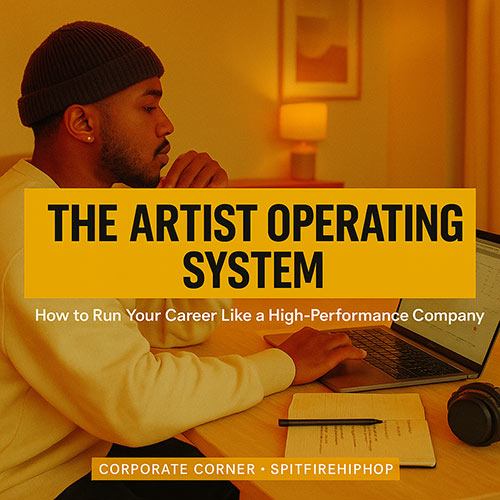
Independent Hip-Hop artists don’t fail because of talent. They fail because their careers run without systems. Companies operate with structure, workflows, and predictable cycles — artists operate on emotion. The Artist Operating System bridges that gap and turns creativity into a scalable business.
Why Artists Need an Operating System
Most artists build their careers like passion projects, not companies. They create music when inspired, post when motivated, and release when they feel ready. But inspiration cannot sustain a career — systems can.
An operating system gives artists consistency, clarity, and direction. It eliminates guesswork, reduces anxiety, and creates professional momentum. Companies use operating systems because they remove randomness. Artists need that same discipline if they want stability, expansion, and longevity.
Without an operating system, every decision becomes emotional. With one, every decision becomes strategic.
The Core Principle: Your Career Is a Company
Artists are not just creatives — they are executives.
A modern Hip-Hop career mirrors a corporate structure more than ever.
You have:
- a product (your music)
- a brand (your identity)
- a catalog (your assets)
- a market (your fans)
- a distribution system (social + DSPs)
- a revenue model (streams + direct-to-fan)
- and a roadmap (your quarterly plan)
When artists recognize this, their approach shifts from reactive to intentional.
The Five Pillars of the Artist Operating System
Every functioning company relies on systems that work together. Every successful artist needs these same five operational pillars.
Pillar 1: Product Development
Your songs aren’t random. They’re part of a product line.
When artists build with intention, they develop a catalog that stacks value over time.
Pillar 2: Distribution
Content is distribution — and distribution must be consistent.
Companies schedule campaigns, cycles, and rollouts.
Artists must do the same.
Pillar 3: Audience Development
Fans don’t appear randomly. They’re acquired, nurtured, and retained.
Companies use funnels.
Artists need a version of that funnel too.
Pillar 4: Revenue Architecture
Revenue isn’t an accident. It comes from designing multiple income layers that work together.
Streams alone can’t sustain anything.
Pillar 5: Measurement & Feedback Loops
Companies track KPIs.
Artists track vibes.
That gap ends now.
These pillars form your entire ecosystem.
Pillar 1: Product Development — Your Music as a Product Line
Songs aren’t standalone ideas; they’re assets with lifespans and strategic value.
High-performance artists think about:
- thematic consistency
- sonic identity
- catalog cohesion
- long-tail replay potential
Your catalog is your intellectual property portfolio.
When structured well, it pays like one.
Pillar 2: Distribution — Your Content as a Delivery System
Posting randomly is not a distribution strategy.
Companies use predictable delivery cycles.
Artists who post consistently (not constantly) signal reliability to fans and algorithms.
Distribution is rhythm.
It’s cadence.
It’s expectation.
Your content ecosystem exists to ensure your product actually reaches people.
Pillar 3: Audience Development — Your Fans as a Market
Most artists measure fanbase size, not fanbase depth.
Companies understand customer behavior better than customers understand themselves.
Your audience needs:
- entry points (snippets, hooks, stories)
- pathways (catalog flow, playlists, content)
- retention loops (email, SMS, community, experiences)
When artists build an OS around retention, their careers stop restarting every release.
Pillar 4: Revenue Architecture — Your Income as a System
Money doesn’t appear because your art is good.
It appears because the system supports it.
Streams aren’t revenue. They’re awareness.
Monetization happens through:
- direct-to-fan offerings
- catalog compounding
- merch
- memberships
- experiences
Revenue flows through architecture, not luck.
Pillar 5: Measurement — KPIs as Your Operating Dashboard
Companies track what matters.
Artists track what feels good.
Your OS depends on a small, powerful set of KPIs:
- save rate
- repeat listen rate
- 30-day listener retention
- fan conversion rate
- revenue per supporter
These KPIs tell you the truth about your career’s health.
Numbers don’t remove artistry — they protect it.
Why Artists Lose Momentum Without an OS
Every artist who burns out shares one thing:
their career is powered by emotion instead of structure.
When emotions swing, the entire career swings.
An operating system stabilizes everything:
- creative cycles
- release planning
- marketing rhythm
- revenue expectations
Stability is freedom.
How the Artist Operating System Scales a Career
When these pillars work together, the career becomes fluid and strategic.
The OS gives artists:
- predictable momentum
- stronger catalog performance
- better content cohesion
- deeper fan loyalty
- diversified revenue streams
- quarterly clarity
Suddenly, growth feels natural instead of forced.
This is how artists operate at a high-performance level — without sacrificing creativity.
The Mindset Shift
Artists who adopt an operating system stop thinking like participants and start thinking like leaders.
Instead of:
“How do I get more streams?”
they ask:
“How do I strengthen my system so streams grow automatically?”
That is the difference between hustle and strategy.
The Real Goal
An Artist Operating System isn’t about being robotic.
It’s about protecting your time, lowering your stress, and giving your creativity a foundation that can truly grow.
Art thrives when structure supports it.
The artists who last aren’t just creating — they’re operating.