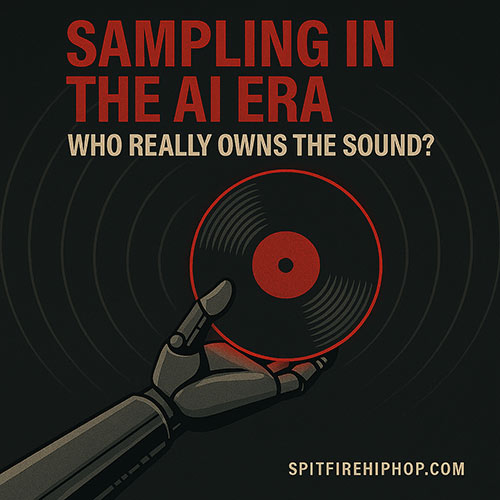
Sampling built Hip-Hop’s foundation—but in 2025, artificial intelligence is rewriting the rules. As AI learns to mimic producers, blend sounds, and create samples, one question grows louder: who really owns the sound?
Hip-Hop was born from sampling, turntables, crate-digging, and the art of flipping the familiar into something new. Producers like J Dilla, DJ Premier, and Madlib turned fragments of soul, funk, and jazz into cultural blueprints. Every sample was a dialogue between past and present, between respect and reinvention.
Now, AI tools like Suno, Udio, and OpenAI’s Jukebox can generate samples in seconds, trained on millions of songs, many without consent. What used to be creative homage is fast becoming a legal grey zone.
AI Sampling: The New Crate Digging
AI-generated sampling works differently from traditional crate digging. Instead of pulling loops from vinyl, producers feed algorithms data to generate new “inspired” sounds.
These samples can sound identical to real instruments or artists, without ever touching the original recording.
That’s efficiency, but it’s also erasure. Who owns that new sound? The producer who prompts it? The AI company that built it? Or the artists whose work trained the system? As one producer put it: “It’s like digging in crates that don’t exist, but the records still belong to someone.”
Ownership in the Age of Code
Copyright law was never designed for AI. In the U.S., only human authorship qualifies for protection. That means AI-generated samples technically belong to no one, or to whoever controls the AI platform.
This creates a dangerous imbalance. If major tech companies own the platforms, they indirectly control the sound of the next generation. Independent artists, once empowered by affordable tech, now risk being priced, or programmed, out of their own creativity.
Producers and AI: Friend or Foe?
Not all producers fear AI. Some are using it to extend their creativity, generating stems, remixing vocals, or crafting entirely new textures. The technology can democratize sound design, making production faster and more accessible. But most veterans agree: AI should be a tool, not a ghost producer. It should enhance a sound, not erase the fingerprint of the human behind it.
The Legal and Ethical Battle Ahead
Major labels and artists are already lawyering up. The lawsuits around AI training data and copyright are likely to define the next decade of music. For Hip-Hop, a culture rooted in remixing, the stakes are especially high.
The same creativity that built the genre could become its next battlefield if artists lose control of their intellectual property to algorithms.
The Cultural Consequence
Hip-Hop’s essence has always been human, born from expression, emotion, and rebellion.
AI can replicate rhythm, but not rebellion.
It can simulate swing, but not soul.
If the culture lets machines define what’s “authentic,” the art form risks becoming a copy of its own innovation.
Sampling has always been about transformation, not imitation.
As AI continues to reshape production, Hip-Hop must decide how to protect its roots while embracing innovation.
Because in this new era, ownership isn’t just about masters or publishing—it’s about the very DNA of sound.