
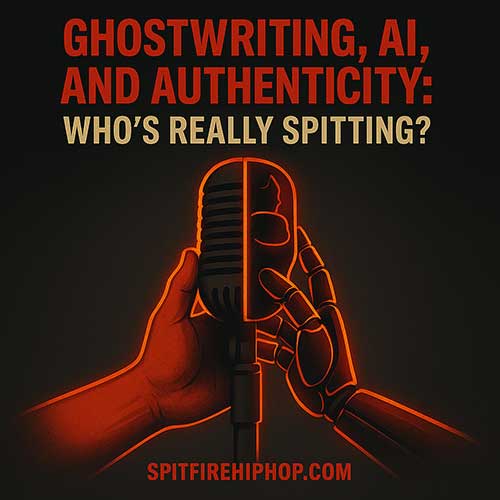
In the digital booth, the question isn’t who’s the best—it’s who’s real. As ghostwriters and AI models flood Hip-Hop, authenticity—the genre’s lifeblood—is under its biggest test yet.
When the Pen Isn’t Yours
Ghostwriting isn’t new to Hip-Hop.
From Dr. Dre to Diddy, some of rap’s biggest names have relied on others to craft their bars.
But what once sparked quiet industry debates has become a public reckoning.
Fans now demand transparency. In a culture built on self-expression, the idea that someone else wrote your truth hits different. Yet, there’s nuance: ghostwriters have long been part of rap’s collaborative DNA—hooks, references, and punch-ups are part of the process.
The issue isn’t teamwork; it’s authenticity. When your pen defines your identity, who are you if it isn’t yours?
AI Enters the Booth
Artificial intelligence has rewritten the rules.
Tools like ChatGPT, Suno, and Udio can now generate entire verses that mimic specific artists’ flows and cadences.
AI doesn’t get tired. It doesn’t forget rhymes. And it doesn’t ask for royalties. That efficiency terrifies some and tempts others. For underground MCs with tight budgets, AI can help sketch demos, write hooks, or even generate beats. But for purists, it’s cultural blasphemy. If Hip-Hop is built on lived experience, can code ever capture pain, pride, or perspective?
Authenticity Is the New Currency
In 2025, credibility is worth more than clout.
As AI-assisted music grows, audiences are craving something real, proof that emotion still beats automation.
We’re seeing rappers document their writing sessions, freestyle live on IG, or release handwritten lyrics to prove authorship. Authenticity has become a marketing tool, a badge of truth in an age of replicas. And fans are responding, authentic content consistently outperforms heavily polished AI-generated work.
Because the human touch still feels different.
Ghosts in the Machine
Some artists now openly merge AI with their own writing, using technology as a collaborator, not a replacement. They treat AI like a studio assistant: helping with rhyme structure or melody ideas, while the artist remains the soul behind the sound. That’s where Hip-Hop’s innovation thrives, using tech to amplify, not erase, the human story.
The danger lies not in the tool, but in forgetting the origin of the voice.
The Culture Check
At its core, Hip-Hop has always been about truth:
your story, your neighborhood, your grind. When AI writes bars, that truth risks becoming synthetic. But when artists harness it consciously, when they guide the machine instead of letting it ghost them, the result can still honor the craft.
As one producer put it:
“The mic doesn’t care who’s speaking. The people do.”
Ghostwriters once whispered behind closed doors. Now, algorithms write in plain sight. Hip-Hop’s challenge isn’t stopping technology—it’s preserving integrity inside it. Because the culture’s real power has never been the tools. It’s the truth behind the voice.