


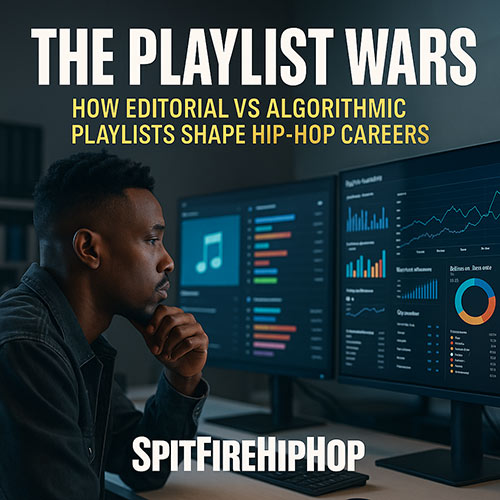
Playlists have become Hip-Hop’s new battleground. Editorial tastemakers and algorithmic engines each push artists in different directions, and understanding the difference determines who rises, who stalls, and who breaks through the noise.
Two Systems. One Goal: Break Artists.
In the late 2000s, breaking an artist meant radio spins and magazine coverage. Today? It’s playlists. But not all playlists carry the same weight, and their influence shapes careers in radically different ways.
Editorial playlists are curated by humans. Algorithmic playlists are triggered by behavior.
Both can skyrocket an artist.
Both can bury one.
And the tension between them is reshaping the future of Hip-Hop discovery.
Editorial Playlists: The New-Curation Gatekeepers
Editorial playlists (e.g., RapCaviar, Most Necessary, BARS, The Plug) still carry cultural prestige. They’re curated by humans who understand trends, moods, and moments.
Placement on one of these lists can:
- Boost streams by 50k–300k daily
- Signal credibility to labels
- Create industry momentum
- Open touring opportunities
But there’s a catch:
Editorial playlists are exclusive.
You’re competing with label-backed artists, trending names, and strategic pushes. For independent rappers, landing editorial is like getting a radio add—powerful, but political.
Algorithmic Playlists: The Silent Giant
While editorial playlists get the hype, algorithmic playlists break more artists—quietly, consistently, and globally.
These include:
- Release Radar
- Discover Weekly
- Daily Mix
- On Repeat
- Your Discover
- Radio Playlists (auto-generated after a track ends)
Unlike editorial lists, algorithmic playlists run on:
- Save rates
- Skip rates
- Listener retention
- Fan engagement
- Repeat listens
- Organic shares
If fans play your track twice in a row?
The algorithm listens.
If your skip rate is low?
The algorithm listens.
Algorithmic playlists become personalized radio stations, and those stations can introduce an artist to millions—without a curator touching a button.
The Battle: Culture vs Code
Editorial playlists shape culture.
Algorithmic playlists shape numbers.
Artists are caught in the middle—trying to prove artistry to the culture while also satisfying the math.
Editorial wants:
- Story
- Vibes
- Buzz
- Relevance
Algorithmic wants:
- Engagement
- Completion rates
- Saves
- Early traction
The best Hip-Hop artists of 2025 understand this duality. They craft music that hits emotionally and performs analytically—tracks that feel real and feed the machine.
Why Many Artists Break Through Algorithmic, Not Editorial
The numbers don’t lie. Independent Hip-Hop artists who crack algorithmic playlists gain momentum faster than those waiting for editorial co-signs.
Because algorithmic playlists:
- Update constantly
- Promote based on listener behavior
- Have no gatekeepers
- Scale globally
- Don’t require industry access
A song with strong fan behavior can climb organically, then trigger radio-like exposure across thousands of personalized playlists.
Labels watch this closely.
They track “algorithmic energy spikes” as one of their top A&R signals.
Fans don’t know they’re part of the process—yet they’re driving it.
The Future: Artists Who Master Both Systems Win
Hip-Hop’s playlist wars aren’t about choosing sides.
They’re about understanding the systems.
Artists who treat editorial playlists as cultural stages—and algorithmic playlists as engines—are the ones breaking without traditional backing.
Those who study the numbers…
Those who build communities…
Those who understand retention science…
Those who can trigger the algorithm…
These are the new winners of the Hip-Hop economy.


Pingback: The New Stream Economy: Why Only a Few Artists Dominate—and How Indie Rappers Break Through – SpitFireHipHop.com
Pingback: J. Sands Rocks the Conquering Hip-Hop Hoodie – SpitFireHipHop.com
Pingback: The New Stream Economy: Why Only a Few Artists Dominate—and How Indie Rappers Break Through – SpitFireHipHop.com