


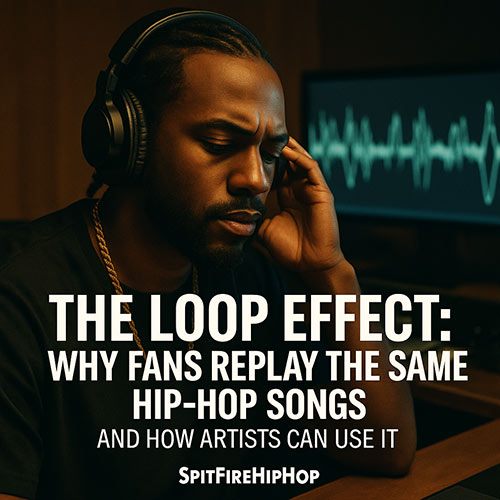
Some Hip-Hop songs get replayed once. Others get looped all day. In 2025, replay behavior is a major algorithmic signal, shaping discovery, playlist placement, and catalog growth. The artists who understand why fans loop songs will dominate the modern streaming era.
Repeats Are the New Streams
In the past, getting someone to hear your song once was the goal. Today, one listen is meaningless. Platforms care about replays—the songs fans return to. Replays show emotional connection, identity fit, and long-term value.
The “Loop Effect” happens when a song becomes addictive enough that listeners replay it two, three, or twenty times in a row. And the algorithm pays very close attention to this pattern.
Replay behavior is one of the strongest signals that a track should be pushed into more personalized playlists, recommended mixes, mood-based rotations, and future algorithmic placements.
One repeat is just a replay.
Multiple repeats activate the algorithm.
Why Fans Loop Certain Songs
Fans loop songs because they’re not just listening—they’re feeling. A looped track becomes a backdrop to a moment, a mood, a memory, or a mindset.
Listeners replay music when it:
- fits an emotional moment
- creates a vibe they want to stay in
- feels cinematic or atmospheric
- offers a satisfying sonic “universe”
- aligns with personal identity
- reinforces a mood (sadness, confidence, nostalgia, ambition)
- blends into daily rituals (driving, gym, late-night sessions)
In 2025, people use music more functionally than ever, and looping is how they extend the feeling.
When a song becomes a place instead of a track, it becomes loop-worthy.
The Algorithm Loves Loops
Platforms use replay behavior as a core indicator of song value. When fans loop your track, streaming services interpret it as:
- high satisfaction
- emotional attachment
- strong vibe match
- high mood consistency
- low listener fatigue
- future playlist potential
A looped song is algorithmically ranked as a “sticky song,” meaning it creates retention and enhances platform engagement.
This is why:
A song with moderate streams but high replays can outperform a viral track with low retention.
DSPs are not looking for hits—they’re looking for “sticky songs” people live with.
How Looping Connects to the Rest of the System
Everything you’ve covered in the Hip-Hop Intelligence Series is tied to looping:
- Skip rate — fewer skips = more loops
- Save rate — fans save songs they loop
- Mood playlists — looping happens inside vibe contexts
- Catalog effect — looped songs perform for years
- Retention fanbase — loyal fans loop more often
Looping is the center of the modern success formula. It amplifies every other metric.
High loop rate = stronger catalog + bigger playlists + more algorithmic favor.
What Loopable Hip-Hop Songs Sound Like
Not every good song loops. In fact, many technically impressive tracks fail to generate replays. Loopable songs share certain qualities:
1. Strong Emotional Atmosphere
Atmosphere matters more than structure.
Songs that create a mood get looped more.
2. Sonically Smooth Transitions
Loop-friendly songs feel seamless, without jarring transitions.
3. Clean, immersive production
Reverb, space, ambience, and texture matter.
4. Lyrics that resonate or hypnotize
A replayed line isn’t just clever—it’s relatable.
5. A hook or anchor moment that feels addictive
Not loud. Not overproduced. Just magnetic.
6. Shorter lengths support loops
Many of today’s most looped Hip-Hop tracks land between 1:45 and 2:15.
The less friction a song has, the more it gets looped.
How Artists Can Intentionally Create Loop-Ready Tracks
Loopability is NOT luck. It’s craft.
Here’s how artists design loopable records:
1. Produce a Sonic Universe
Listeners loop experiences, not tracks.
Build a vibe that feels like a space someone can sit in.
2. Make the First 7 Seconds Irresistible
If the opening hits emotionally, looping becomes automatic.
3. Use Familiarity with Freshness
The song should feel new but recognizable—this balance drives repeat value.
4. Build Emotional Anchors
Give listeners a moment they want to feel again.
5. Remove Distractions
No unnecessary drops, abrupt changes, awkward bridges, or clutter.
6. Write With Looping in Mind
End the song in a way that flows naturally into the beginning.
Many modern tracks technically “loop” when played back-to-back.
7. Mix for Longevity, Not Loudness
Loud or harsh mixes reduce replay appeal.
Loopable music is smooth, soft, and emotionally addictive.
Why Looping Creates Career Momentum
Looping isn’t just a streaming hack.
It creates:
- stronger catalog value
- deeper fan connection
- higher save rates
- more algorithmic playlisting
- more mood playlist compatibility
- higher numbers per listener
- more stable income
- better retention over time
One loopable song can carry an entire year of catalog growth.
And for independent artists, this matters more than ever.
The Artists Who Will Win the Loop Era
The Loop Era rewards artists who create:
- emotional environments
- immersive vibes
- cohesive moods
- replay-friendly production
- relatable lyrics
- atmospheric soundscapes
- consistent sonic identity
The artists who understand looping science will build the strongest catalogs of the decade.
Loopability is the new superpower.


Pingback: The 30-Day Drop Cycle: How Smart Hip-Hop Artists Release Music in 2025 – SpitFireHipHop.com
Pingback: Why Your Song Isn’t Getting Saved (Even If the Snippet Goes Viral) – SpitFireHipHop.com