

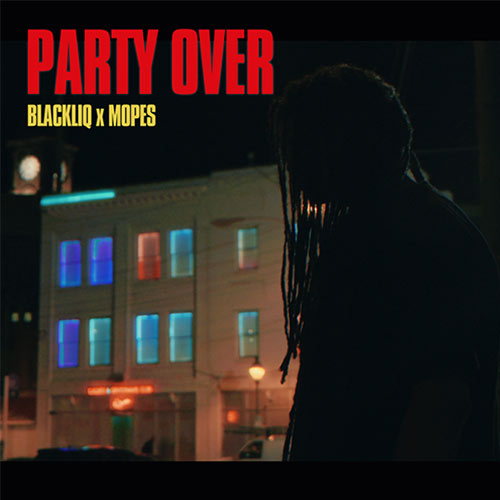
The party is over, but the damage doesn’t disappear when the drinking stops. That uncomfortable reality sits at the center of “Party Over,” the latest collaboration between Richmond emcee BlackLiq and Providence producer Mopes. It’s a record that confronts addiction, recovery, emotional exhaustion, and the difficult process of learning how to live with yourself after years of destructive behavior.
There is nothing celebratory about this party. BlackLiq isn’t reminiscing about wild nights with the intention of glorifying them. He’s examining the person he used to be, the decisions that shaped him, and the complicated reality of being sober without necessarily feeling whole. It’s the kind of subject that requires more than clever rhymes and an attractive instrumental. Fortunately, BlackLiq and Mopes have developed the musical chemistry to handle it.
The record opens with a chaotic burst of voices and crashing glass before settling into Mopes’ production. The introduction feels like the aftermath of a night that has gone terribly wrong, an appropriate entrance for a song built around the consequences of excess. Once the drums arrive, the music finds its footing in a steady, head-nodding rhythm that contrasts with the instability running through BlackLiq’s words.
Mopes constructs a groove with a firm snare, weighty low-end, and a hazy melodic backdrop that gives the record an almost hypnotic quality. There is an understated funkiness to the arrangement, but it never becomes cheerful. The instrumental moves with the familiarity of classic sample-driven Hip-Hop while maintaining an uneasy atmosphere. Small vocal fragments and background textures add movement without crowding the emcee. The result is music that sounds comfortable on the surface while carrying something considerably heavier underneath.
Listen to Spit Fire Radio: www.spitfireradio.com
BlackLiq enters with an unfiltered account of his former lifestyle, recalling drinking, smoking, reckless behavior, and the sense of invincibility that can accompany self-destruction. His delivery is direct and conversational, but there is considerable technique beneath that apparent simplicity. He moves through tightly connected rhymes without sounding as though he is trying to impress the listener with complexity for its own sake. The words matter more than the performance of being lyrical.
One of the strongest aspects of his writing is his refusal to make himself the hero of every memory. He admits to being irresponsible, acknowledges the excuses surrounding his behavior, and recognizes that the consequences were not always immediately apparent. He also examines the judgment he received from others, particularly the way people reduced his struggles to drinking and smoking rather than understanding the person beneath those habits.
The song’s most revealing moment arrives in its refrain. BlackLiq repeatedly describes himself as deeply troubled despite being sober. It’s a devastating contradiction because it rejects the convenient idea that removing alcohol automatically repairs everything it helped damage. Sobriety may change someone’s circumstances, but it doesn’t erase trauma, emotional difficulties, or the habits of thinking developed over years.
That distinction gives “Party Over” its emotional center. BlackLiq isn’t dismissing recovery. He’s acknowledging that recovery can be an ongoing confrontation with the very things a person once tried to escape.
The second verse digs further into that struggle. BlackLiq addresses the difficulty of sleeping, overstimulation, emotional detachment, and the complicated relationship between personal progress and internal peace. He describes being capable of positive actions while continuing to wrestle with negative thoughts about himself. There is a striking lack of sentimentality in these admissions. He doesn’t soften the language to make his experiences easier to consume, and he doesn’t offer a motivational conclusion that neatly resolves the conflict.
Instead, he allows the contradictions to remain.
That approach is particularly effective against Mopes’ production. The drums remain steady while BlackLiq’s thoughts become increasingly restless. The groove offers a sense of musical stability that the lyrics repeatedly challenge. Rather than responding to every emotional shift with a dramatic instrumental change, Mopes allows the tension between rhythm and subject matter to do much of the work.
There is also something compelling about the record’s structure. The repeated refrain interrupts two densely written verses, forcing the listener to return to the same uncomfortable admission. By the time the second verse concludes, those words carry additional weight. What initially sounds like a provocative statement becomes a concise description of the difference between outward improvement and internal struggle.
The production eventually gives way to a more atmospheric closing passage, with lingering musical textures and additional spoken dialogue. It feels less like a conventional victory lap than the credits rolling on a difficult chapter of someone’s life. There is no triumphant declaration that everything has been fixed. The music simply continues after the confession has ended.
BlackLiq and Mopes have been building toward this kind of artistic understanding for years. Their 2021 debut, “Time Is The Price,” introduced a partnership grounded in personal reflection and rugged Hip-Hop production. Their 2023 follow-up, “Choice Is A Chance,” demonstrated how much that relationship had matured. Mopes previously explained that he began constructing instrumentals specifically for BlackLiq during the making of their second album, allowing the production to develop around the emcee’s personality rather than the other way around.
“Party Over” sounds like the work of two artists who understand exactly what the other brings to the recording. BlackLiq doesn’t need to shout to make his experiences feel significant, and Mopes doesn’t need to overwhelm the arrangement to establish its musical identity. Each gives the other enough room to make the record work.
The single arrives through Strange Famous Records as the first offering from the duo’s third collaborative album, scheduled for 2027. Its accompanying video was directed by BC Music 1st, extending the release beyond the recording itself.
What ultimately makes “Party Over” compelling is its unwillingness to confuse survival with complete recovery. BlackLiq has changed his behavior, but he is still wrestling with the person those experiences helped create. That is a more complicated story than the familiar narrative of hitting bottom, getting clean, and living happily ever after.
Mopes provides the musical foundation, BlackLiq supplies the uncomfortable truth, and together they deliver a record that understands something important about personal growth: sometimes the celebration ends long before the healing begins.
“Party Over” is a sobering reminder that putting down the bottle and putting your life back together are two very different accomplishments.