
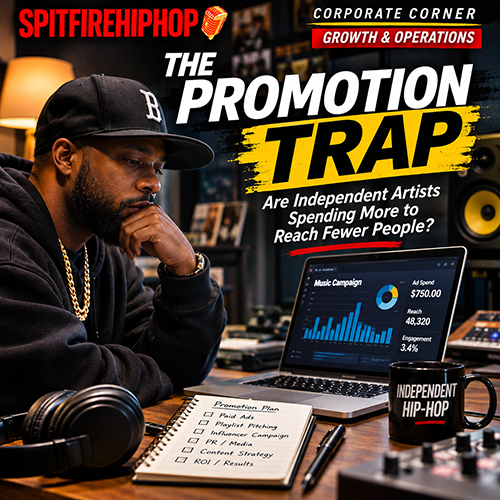
The music business has become remarkably efficient at selling independent artists the possibility of success.
For every new release, there is another opportunity to purchase visibility. Social media advertising promises targeted audiences. Playlist promotion offers access to listeners. Public relations campaigns promise exposure. Influencer marketing offers cultural relevance, while an expanding marketplace of promotional services claims to understand the algorithms that determine which songs get heard.
The message is familiar: Spend money, build momentum, and let the music do the rest.
But what happens when the campaign ends?
That question deserves more attention than another conversation about streaming numbers. For independent Hip-Hop artists financing their own careers, the difference between attracting temporary attention and developing a lasting audience can determine whether their next release is financially possible.
The industry continues to grow. According to the International Federation of the Phonographic Industry (IFPI), global recorded music revenue reached $31.7 billion in 2025, an increase of 6.4%. Streaming generated more than $22 billion, accounting for 69.6% of recorded music revenue worldwide. ifpi.org+1
Those figures demonstrate that people are spending money on music. They do not establish that independent artists are capturing a proportionate share of that growth.
And that is where the promotion trap begins.
A growing industry does not guarantee a growing artist
The contradiction becomes clearer when examining the financial circumstances of independent musicians.
Ditto Music’s 2026 Independent Music Report surveyed 5,039 independent artists across 112 countries. Among respondents, 74% reported earning less than $1,000 from music during the previous year, while 43% identified financial constraints as their biggest obstacle to career growth. Ditto Music
74% 43%
Earned under $1,000 from music in the previous year Named financial constraints as their biggest growth barrier
Source: Ditto Music, Independent Music Report 2026. Self-reported survey findings; not a representative census of all independent musicians.
This does not mean every independent artist is struggling, nor does it mean promotion is ineffective. It means the economic foundation supporting many independent releases is considerably smaller than the industry’s headline revenue figures suggest.
An artist earning a few hundred dollars annually from recorded music cannot treat a $1,000 promotional campaign as a routine business expense. That investment must compete with recording costs, mixing, mastering, artwork, music videos, distribution, equipment, and the everyday responsibilities of maintaining a career.
The pressure to remain visible can encourage artists to spend before they have established what their audience is worth—or whether that audience is growing at all.
The difference between attention and an audience
A promotional campaign can produce impressive numbers without producing a meaningful business result.
A video might receive thousands of views. A sponsored post might generate substantial reach. A song might experience a sudden increase in streams after appearing on a playlist.
Those results may be legitimate. They may even introduce the artist to potential supporters.
But visibility and audience development are not interchangeable.
The real questions begin after the initial engagement. Did listeners seek out another song? Did they follow the artist? Did they return after the campaign ended? Did they subscribe to an email list, purchase merchandise, attend a performance, or share the music with someone else?
An audience becomes valuable when its relationship with an artist extends beyond a single paid encounter.
This distinction matters particularly in independent Hip-Hop, where artists often develop careers through accumulated trust, recognizable identities, consistent releases, and direct relationships with listeners.
A campaign that introduces 100 genuinely interested people to an artist may create more lasting value than one that delivers 20,000 indifferent impressions.
The challenge is learning how to recognize the difference.
Listen to Spit Fire Radio: www.spitfireradio.com
Social media has become another cost of making music
Social platforms have made it possible for artists to reach listeners without relying entirely on traditional media, radio programmers, or major-label marketing departments.
That accessibility has created opportunity, but it has also introduced another demanding responsibility.
Ditto’s 2026 survey found that 86% of respondents create social content to promote their music. Meanwhile, 67% identified social video platforms collectively as their biggest source of new fans. Yet 54% said they had not experienced a meaningful spike in streams or followers attributable to social content during the previous year. Ditto Music
The findings suggest that social media participation has become widespread without guaranteeing measurable breakthroughs.
For independent artists, the cost is not limited to advertising dollars. Time spent filming videos, editing clips, monitoring performance, preparing posts, and following trends is time that cannot be spent elsewhere.
There is also a strategic problem with allowing platform activity to become the primary measure of progress.
An artist can become increasingly effective at producing content without becoming significantly more successful at selling music.
When the objective shifts from building an audience to satisfying a platform’s demand for constant activity, promotion begins to compete with the very creative work it was supposed to support.
Playlist promotion: opportunity, risk, and misplaced expectations
Playlist placement remains one of the most attractive promotional opportunities because it places music directly in a listening environment.
There is legitimate value in reaching listeners who already enjoy a particular sound. Independent Hip-Hop artists can benefit from thoughtful curation, especially when the audience has demonstrated an interest in discovering new music.
However, playlist promotion also illustrates how easily the promise of exposure can be separated from genuine audience development.
Spotify explicitly warns artists against third-party services promising streams or playlist placement in exchange for payment. Such services may involve artificial streaming, and Spotify says violations can lead to withheld royalties, corrected stream counts, distributor penalties, or removal of music. Spotify for Artists+1
That warning should not be confused with a blanket rejection of independent playlist curators, legitimate advertising, or earned editorial coverage. The concern is the sale of guaranteed streaming outcomes or manipulated placement.
Spotify also provides an official, no-fee editorial pitching process through Spotify for Artists. The platform recommends submitting unreleased music at least seven days before release, while emphasizing that editorial placement is never guaranteed. Spotify
For artists, the practical distinction is straightforward: a legitimate promotional service should be able to explain its methods, identify what it is actually delivering, and report outcomes without promising artificial popularity.
A playlist placement may be a useful introduction. It should not be mistaken for proof that a sustainable fan base has been established.
The hidden problem with promotional return on investment
Traditional marketing evaluates performance by comparing the cost of an activity with the value it generates.
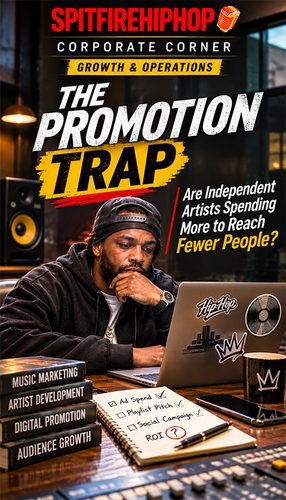
Music promotion is more complicated because not every worthwhile result produces immediate revenue.
A listener might discover an artist today and purchase an album six months later. A journalist might encounter a single and eventually feature the artist in a larger story. A genuine fan might share a record with dozens of people over several years.
These outcomes matter, but they do not eliminate the need for financial discipline.
Consider a hypothetical independent artist who spends $600 promoting a new single.
If that campaign generates 15,000 additional streams, the artist has paid four cents per incremental stream. That figure is a marketing cost calculation, not a streaming royalty rate.
Whether the investment makes sense depends on the artist’s actual royalty receipts, the number of genuine new listeners acquired, their subsequent engagement, and any longer-term revenue attributable to the campaign.
If the campaign produces no measurable audience retention or additional income, repeating it without changing the strategy is difficult to justify.
The problem is not spending money on promotion.
The problem is spending money without knowing what success should look like.
Independent artists need a different promotional strategy
For many artists, a more sustainable approach begins with treating promotion as a sequence of measured decisions rather than a single expensive launch.
Before purchasing advertising or promotional services, artists should identify the listeners they are trying to reach and determine what those listeners should do next.
That might mean watching a complete music video, listening to a project, following an artist, joining a mailing list, purchasing a physical release, or attending a performance.
The objective should determine the campaign—not the other way around.
An independent artist with limited resources may benefit from testing a small advertising budget before committing to a larger campaign. A producer releasing instrumental Hip-Hop might discover that behind-the-scenes production videos attract more engaged listeners than generic cover-art advertisements. Another artist may find that local performances and relationships with independent media produce stronger results than paid social campaigns.
Neither outcome can be assumed in advance. Both can be tested.
The artist should also distinguish between channels that provide temporary access to audiences and assets that allow relationships to continue independently of a particular platform.
An email list, an artist-owned website, a properly maintained catalog, and direct customer relationships can all contribute to a more durable business.
They are not substitutes for discovery. They are ways to preserve some of the value discovery creates.
The future belongs to artists who understand their numbers
Independent Hip-Hop has always valued ownership, creative control, and the ability to build outside traditional industry structures.
Those principles remain important, but ownership alone does not guarantee economic independence.
An artist who controls the master recordings but repeatedly spends more money promoting releases than those releases generate still faces a sustainability problem.
The solution is not to abandon marketing or retreat from digital platforms. It is to become more selective about where resources are invested, demand transparency from promotional partners, and evaluate whether each campaign is creating lasting value.
The industry’s revenue growth shows that the market for recorded music remains substantial. The financial challenges reported by independent artists show that participating in that market is not the same as profiting from it.
For independent artists, the next competitive advantage may not be a larger promotional budget.
It may be the discipline to recognize which expenditures are building a career—and which are merely purchasing another brief moment of attention.
Because the real measure of promotion is not how many people encounter a record. It is how many have a reason to come back.