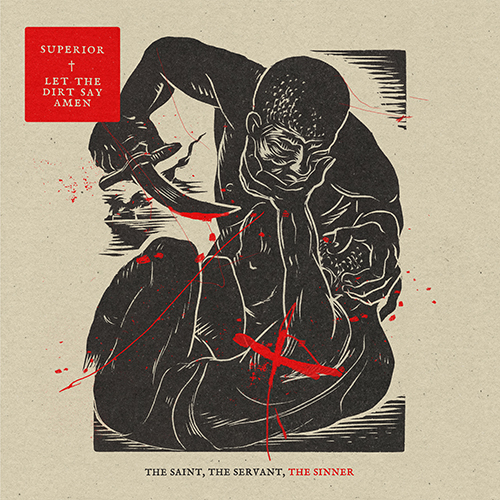
Superior & Let The Dirt Say Amen Confront Faith, Flesh, and Consequence on “The Saint, The Servant, The Sinner“
Some Hip-Hop albums are designed to tell you who the artist is. Others are brave enough to admit that the answer changes depending on which part of the soul is speaking.
On their collaborative album The Saint, The Servant, The Sinner, producer Superior and Washington, D.C. emcee Let The Dirt Say Amen build around precisely that tension. Released October 2 through FXCK RXP and RRC Music Co., the project is an examination of contradiction—not as something to solve, but as something human beings carry with them.
The concept supplied with the record puts its philosophy into three identities: the Saint seeking higher alignment, the Servant offering unconditional grace, and the Sinner trapped in self-indulgence. Rather than attribute that statement specifically to Superior or Let The Dirt Say Amen without confirmation, it is best understood as the album’s stated thematic foundation.
That distinction matters because The Saint, The Servant, The Sinner doesn’t approach spirituality as decoration. The language of faith runs directly through the architecture of the record. Titles including “Michael, Gabriel, God,” “Miracle At Cana,” “J.O.N.A.H.,” “Fashion Of The Christ,” “Why The Prophet Weeps” and “7 Churches” establish a world where scripture, morality, mortality, and survival continually collide.
Superior understands exactly how much space a record like this requires. His production is deliberately restrained: dusty loops, muted percussion, ominous textures, and stretches of negative space that force attention toward the writing. RRC Music describes that musical environment as one built around “faith, mortality, consequence and survival,” with Superior creating the shadows that Let The Dirt Say Amen fills with observation and confession.
That restraint is important. These aren’t beats fighting the emcee for attention. Superior constructs rooms and then lets Let The Dirt Say Amen walk around inside them.
Listen to Spit Fire Radio: www.spitfireradio.com
And the emcee makes use of every inch.
Let The Dirt Say Amen has spent years building a catalog rooted in Washington, D.C., personal experience, spirituality and independence. His own Bandcamp identifies him with D.C., while previous projects such as I LOVE YOU I’M NOT SORRY have similarly used relationships, change and the search for God as narrative material. His 2019 album Bullets—later reissued through his Bandcamp—won a 2020 Wammie Award for Best Rap Album in the DMV.
Here, that perspective meets a producer particularly suited to it. There is also another presence hovering over the album: Ka.
Reporting surrounding early single “J.O.N.A.H.” described The Saint, The Servant, The Sinner as Superior’s deeply personal tribute to the late Brooklyn poet, whose sparse production, spiritual inquiry and extraordinary economy of language left a lasting mark on underground Hip-Hop. “Hopeful Studies,” the project’s first single, was likewise presented as being inspired by Ka.
The connection can be heard less as imitation than as philosophical kinship. Silence has value here. A bar is allowed to linger. Religious symbolism isn’t presented to prove righteousness; it becomes a tool for interrogating whether righteousness is even attainable when survival, ego, temptation and consequence occupy the same body.
That’s where the album’s title becomes more than clever framing. The saint, servant and sinner aren’t necessarily three different people.
They can be the same person before breakfast.
That is the uncomfortable territory Superior and Let The Dirt Say Amen appear most interested in exploring. Human beings can seek God while wrestling with appetite. They can serve others while quietly serving themselves. They can understand what is right and still choose otherwise. The record doesn’t flatten those contradictions into a simple redemption story. It leaves them exposed.

Even the sequencing reinforces that spiritual vocabulary. “Michael, Gabriel, God” establishes the language immediately, while “Miracle At Cana,” “J.O.N.A.H.” and “From Bozrah Dipped In Blood” pull from biblical imagery before the album moves toward “Why The Prophet Weeps” and “7 Churches.” The journey finally arrives at the title track, where Sapphyre Bardot makes the album’s sole guest appearance. RRC’s official tracklist confirms Bardot on the closing title cut.
That decision says something about the discipline behind the album.
There is no crowded guest list to manufacture moments. No parade of features interrupts the conversation between producer and emcee. Superior establishes the environment; Let The Dirt Say Amen inhabits it. Sapphyre Bardot’s lone appearance at the conclusion consequently feels less like another feature slot and more like a final voice entering after the argument has already been made.
The rollout showed similar patience. “Hopeful Studies” arrived June 19, followed by “J.O.N.A.H.” and later “From Bozrah Dipped In Blood.” “True Unto Others” surfaced shortly before the album’s digital release.
The physical presentation extends the project’s seriousness as well. RRC Music’s vinyl edition includes a lyric sheet and an exclusive vinyl-only bonus track, while limited configurations were produced in collaboration with FXCK RXP.
But The Saint, The Servant, The Sinner ultimately succeeds because the concept never feels larger than the people inside it.
Superior and Let The Dirt Say Amen aren’t using spirituality to claim purity. They’re examining the distance between the person we aspire to become, the person we present to others and the person who emerges when nobody else is watching.
That makes the album’s central question much more difficult than deciding whether somebody is righteous or flawed.
Which version of you is speaking right now?
Because somewhere beneath the same skin lives the saint searching upward, the servant extending his hand—and the sinner still negotiating with himself. That is where The Saint, The Servant, The Sinner finds its weight. And that is exactly where Hip-Hop has always been most powerful: when the microphone becomes a confession booth.