

Substance Abuse Revisits Overproof 20 Years After Its Underground Arrival
Twenty years can expose the difference between a record that belonged to its moment and one that was simply overlooked in it. Substance Abuse’s debut album, Overproof, falls firmly into the second category. Originally released through Threshold Recordings in 2006, the project returns in a newly assembled 20th-anniversary edition that gives listeners another chance to hear how naturally Los Angeles emcees Eso Tre and Subz operated between golden-era discipline and the independent underground of the early 2000s.
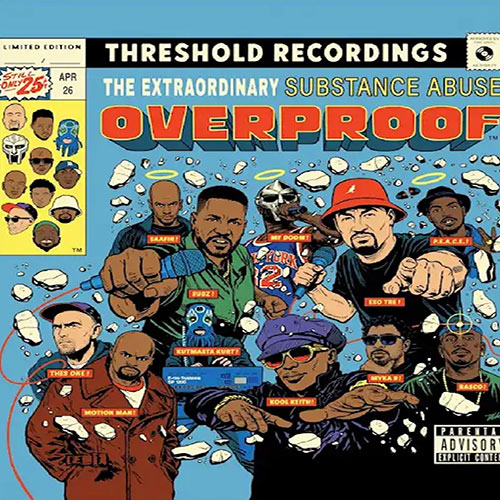
The anniversary release arrived September 3 through KutMasta Kurt’s Bandcamp page. Its 13-track sequence is leaner than the original album and includes alternate treatments of two important records: KutMasta Kurt’s remix of “Profitless Thoughts” featuring MF DOOM and Mike Nardone’s remix of “The Sickness” featuring Saafir. A limited physical edition also accompanies the release in the form of 20 numbered random-color test pressings, turning the reissue into both a listening experience and a collector’s artifact.
Substance Abuse never built Overproof around the kind of gimmick that would expire once a trend moved on. Eso Tre and Subz were more interested in complete songs, patient storytelling, and the chemistry created when two voices understand how to share space. Their writing could be humorous, skeptical, personal, or competitive without forcing the album into one narrow identity. That balance remains one of the record’s strengths. The duo sounds rooted in an earlier standard of emceeing, yet the music does not come across as a costume assembled from somebody else’s era.
Listen to Spit Fire Radio: www.spitfireradio.com
“Fake Contacts” immediately establishes that character. Its energetic opening has the snap of an older electro-influenced rap record, but Overproof soon settles into a broader palette of jazz textures, hard drums, and darker piano-led production. The sound is rugged without being muddy and traditional without becoming predictable. Rather than treating boom-bap as a museum piece, Substance Abuse uses it as working language—something flexible enough to carry observation, wit and everyday tension.
The guest list is substantial, but it never erases the album’s center. Kool Keith brings his unpredictable presence to “Night On The Town,” while “Check” pairs Substance Abuse with Motion Man. Rasco appears on “Everyone’s A Critic,” and P.E.A.C.E. of Freestyle Fellowship joins Deranged and Mawnstr on “Can’t Call It.” Elsewhere, “Mercy Killings” brings together Deranged, Mawnstr and Nebz, while Erik Solo appears on “Fractured Form.” These collaborations place the album inside a wide West Coast and independent-rap network, but Eso Tre and Subz remain hosts rather than spectators on their own project.
The most immediately recognizable name may be MF DOOM, whose appearance on “Profitless Thoughts” now arrives through a KutMasta Kurt remix. DOOM’s compressed phrasing and crooked sense of timing provide a sharp contrast to Substance Abuse’s more conversational approach. That difference is exactly what makes the collaboration work. Nobody strains to imitate the masked emcee; the record allows distinct styles to collide and find common ground inside the same groove.
The Mike Nardone remix of “The Sickness” carries additional historical weight through Saafir, one of the Bay Area’s most singular voices. His elastic delivery and unconventional rhythmic instincts fit an album that respects technique without insisting every emcee approach the microphone the same way. It is another reminder that Overproof was assembled by artists who understood underground Hip-Hop as a living network of regional styles, not a single prescribed sound.

That context matters. Before the album, Substance Abuse had already been building its name through releases including the late-1990s Brand New Crime EP, the 2000 single “What The F**K You Rhymin’ For?” and the “Can’t Call It”/”No Guarantees” single. Overproof was the point at which those years of development became a full-length statement. Contemporary coverage recognized the skill involved: the album earned four-star notices from URB and Scratch, while later descriptions have continued to emphasize its mix of humor, storytelling, introspection and tightly constructed production.
The anniversary edition also strengthens KutMasta Kurt’s connection to the record. His Threshold imprint issued the original album, and his presence on this new sequence is more than ceremonial. The producer and DJ has long occupied an important position in left-of-center West Coast rap, particularly through his work with Kool Keith and Motion Man. With “Collateral Damage” credited to his production and “Profitless Thoughts” presented in his remixed form, the reissue highlights the connective tissue behind the album as clearly as the names in front of the microphone.
What makes Overproof worth returning to is not merely the list of collaborators or the scarcity of the vinyl. It is the album’s refusal to confuse independence with isolation. Substance Abuse built outward, inviting distinctive emcees and producers into a world that still sounded like their own. Eso Tre and Subz valued structure, personality and lyrical clarity at a time when underground rap was splintering into increasingly specific lanes.
Two decades later, that approach feels less like revivalism than proof of construction. The drums still land, the contrasting voices still create movement, and the guest appearances still feel purposeful. The Overproof 20th-anniversary edition does not ask listeners to pretend 2006 never ended. It asks them to recognize that certain records were built well enough to survive it.