




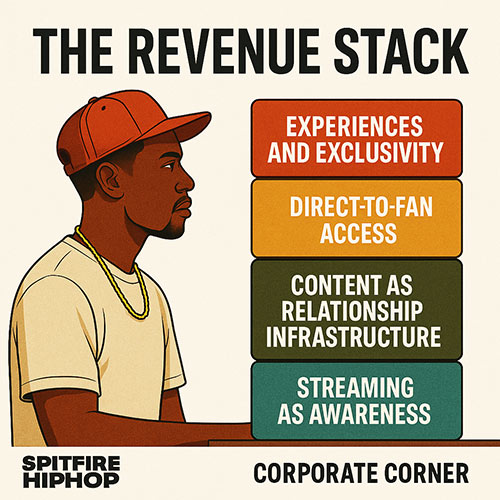
Streaming made music accessible, but it didn’t make artists stable. Streams create awareness, not security. The artists who survive and scale understand a hard truth: streaming is the weakest layer in the revenue stack—and treating it like the business is why so many careers collapse.
Why Streaming Was Never Designed to Be the Business
Streaming platforms were built to monetize users, not artists. Music fuels subscriptions, retention, and advertising, but individual songs were never meant to sustain creators on their own. That misunderstanding has distorted expectations across the industry.
Streams measure attention, not value. They tell you how many people passed through—not how many stayed, supported, or invested. Artists who chase streaming volume without building income layers underneath it eventually hit a financial ceiling, no matter how large the numbers look.
What a Revenue Stack Actually Is
A revenue stack is a layered income system where each tier supports the next. Instead of relying on one fragile source, artists build multiple income streams that work together. Companies do this naturally. Artists must do it intentionally.
The goal isn’t to replace streaming. It’s to reposition it—from end goal to entry point.
Layer 1: Streaming as Awareness
Streaming’s role is discovery. It introduces listeners to your sound, your tone, and your emotional lane. That’s it.
When treated correctly, streaming:
- fuels audience growth
- drives catalog discovery
- supports algorithmic testing
- feeds higher-value systems
When treated incorrectly, it becomes a financial trap.
Layer 2: Content as Relationship Infrastructure
Content is where awareness turns into familiarity. This layer builds trust before money ever enters the conversation.
Consistent content:
- humanizes the artist
- reinforces emotional identity
- keeps fans connected between releases
- sets the stage for conversion
Artists who skip this layer struggle to monetize without sounding desperate.
Layer 3: Direct-to-Fan Access
This is where revenue begins to stabilize. Email lists, SMS, private communities, and memberships convert casual fans into reachable supporters.
Direct access matters because:
- platforms don’t own the relationship—you do
- communication becomes predictable
- launches become controlled
- support feels personal
Artists without access layers are always rebuilding from zero.
Layer 4: Products That Reflect Identity
Merch isn’t about logos—it’s about belonging. Fans don’t buy items; they buy alignment. When products reflect the artist’s worldview, music, and story, they become emotional extensions of the brand.
Strong product layers:
- reinforce identity
- create repeat purchases
- increase lifetime fan value
- transform support into participation
This layer rewards clarity, not hype.
Layer 5: Experiences and Exclusivity
The highest-value layer is access to moments. Shows, meetups, limited drops, private streams, early releases—these are experiences fans can’t pirate or replicate.
Experiential revenue:
- deepens loyalty
- commands premium pricing
- strengthens community
- reduces reliance on scale
Small audiences with deep access often out-earn large audiences with shallow engagement.
Why Artists Fail to Build Revenue Stacks
Most artists wait too long. They chase growth first, hoping monetization will magically appear later. By the time they try to sell, fans haven’t been trained to support.
Others rush monetization without trust, damaging relationships before they begin.
The stack works only when each layer is built in sequence.
Why 200 Fans Can Beat 2 Million Streams
Two million streams might generate a few thousand dollars—once. Two hundred fans spending $10–$25 per month generate predictable income year-round.
Revenue follows:
- depth over width
- connection over clicks
- systems over moments
Artists who understand this stop chasing virality and start building sustainability.
The Corporate Corner Reality
Companies don’t depend on one income stream. Artists shouldn’t either. Revenue stacks transform creative careers from volatile to viable.
Streaming opens the door.
Stacks keep it open.
The Real Takeaway
Streaming is not the dream—it’s the introduction. Artists who treat it as the foundation collapse. Artists who build on top of it compound.
The future belongs to artists who design their income instead of hoping for it.




Pingback: The Ownership Threshold: When Artists Stop Needing Permission – SpitFireHipHop.com
Pingback: The Exit Myth: Why Artists Don’t Need Labels to “Win” – SpitFireHipHop.com
Pingback: Catalog Equity: How Songs Become Long-Term Wealth – SpitFireHipHop.com
Pingback: The Direct-Fan Economy: Why Hip-Hop Artists Are Building Businesses, Not Just Songs – SpitFireHipHop.com