
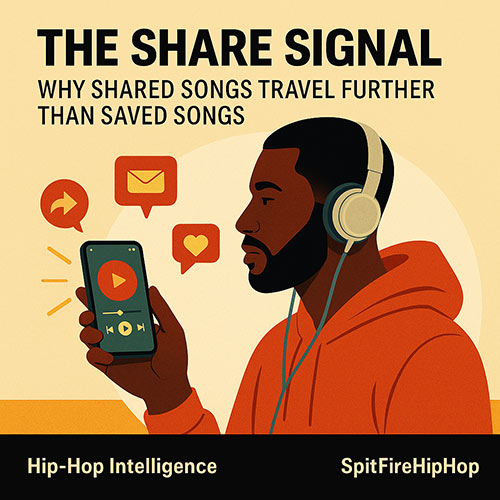
Saves keep songs alive. Shares make songs travel. In 2025, the loudest growth signal on every major platform isn’t how many people press a heart—it’s how many press “send.” This is the share signal, and it quietly decides who expands.
Why Shares Are the True Discovery Catalyst
A save is a private decision. A share is a public endorsement. That distinction changes everything. Platforms are built to amplify behavior that recruits new listeners without paid promotion, and sharing does exactly that.
When a listener sends your song to a friend, drops it in a group chat, or reposts it to Stories, the platform receives a signal that your music has crossed into social value—not just personal taste. That’s the threshold where algorithms move from testing to distributing.
How Platforms Weigh Saves vs Shares
Internally, platforms treat saves as retention indicators and shares as expansion indicators. Both matter, but they serve different system goals.
Saves tell the system:
- this listener wants to come back
- the song has personal resonance
- the artist should be tested further
Shares tell the system:
- this listener wants to recruit others
- the song creates social currency
- the content has viral potential
From a platform’s growth perspective, shares are leverage. They multiply users without multiplying cost.
Why DM Shares Often Outperform Public Reposts
Public reposts look big. Private DM shares move faster.
Group chats, direct messages, and private story replies create:
- higher trust transfer
- faster conversion
- deeper emotional relevance
Public reposts are performative. Private shares are intentional. Platforms track both—but DM-driven spread often converts at a much higher rate, which boosts downstream testing.
The Psychology Behind Why Fans Share
Fans don’t share because of marketing. They share because of identity.
They share when a song:
- says something they can’t say themselves
- represents a mood they’re stuck in
- signals who they are socially
- feels exclusive or early
- creates “I need you to hear this” urgency
Sharing is emotional first, algorithmic second. Artists who understand this design music and visuals that make the act of sharing feel necessary, not optional.
Why Most Artists Never Trigger the Share Signal
Artists are taught to chase saves and streams, but few are taught to engineer share moments. As a result, their songs live and die in isolation.
The most common blockers:
- generic subject matter
- hooks that sound good but say nothing
- visuals with no narrative tension
- drops with no social context
- marketing that asks for support instead of inspiring it
You don’t get shared by asking. You get shared by provoking.
How Artists Can Design for Shareability
Shareability is not random. It’s architectural.
Artists who build share signals intentionally:
- anchor songs around a clear emotional thesis
- place quotable lines early
- give visuals a “screenshot moment”
- connect releases to relatable social experiences
- create contrast between expectation and delivery
You’re not building “content.” You’re building conversation fuel.
Why Share Velocity Beats Follower Growth
Follower counts inflate slowly. Shares cascade quickly.
A song shared 300 times in private chats can outperform a song with 50,000 passive followers in:
- new listener acquisition
- playlist entry
- algorithmic re-testing
- geographic spread
Velocity comes from behavior, not audience size. Shares are velocity triggers.
The Relationship Between Shares and Breakouts
No modern breakout happens without sustained sharing. Every viral record—whether it looks organic or not—travels through thousands of micro-shares before it ever touches a chart.
Breakouts occur when:
- sharing sustains beyond 72 hours
- new listeners repeat and re-share
- multiple micro-communities activate at once
This is how isolated traction turns into public explosion.
Why Artists Should Track the Share Signal
Shares reveal your music’s transfer value—how well it moves between people. That’s the missing metric between discovery and explosion.
Artists who track:
- story reposts
- link shares
- message replies
- fan-generated edits
begin to understand what actually makes their music travel.
The Corporate Reality
Companies don’t measure how much customers like a product. They measure how many customers recommend it.
Shares are recommendations in motion.
The Real Takeaway
Saves keep your career stable.
Shares push your career forward.
If your music isn’t being shared, it’s not moving. And if it’s not moving, it’s invisible—no matter how many people quietly save it.